



Producers Build Packing Plant To Support Local Livestock Industry
Producer Co-Op Opens Meat Processing Plant
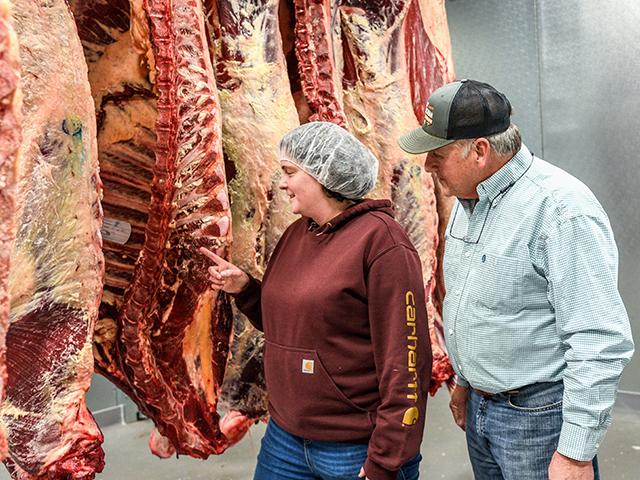
If you're in the cattle business, more than likely one of your favorite pastimes is bashing packers. Not so in northeast Tennessee. Producers are the packer.
In May 2025, the first cattle, sheep and hogs were processed at the Appalachian Producers Cooperative (APC), a meat processing facility owned by local producers. These owners are setting their sights on keeping livestock income in the area, stemming the loss of farmland and supplying local consumers with locally raised meat.
You're probably thinking it's another COVID-inspired deal. No doubt, the pandemic helped bring in grant money, but these folks started kicking around ideas in 2017. A feasibility study by The University of Tennessee (UT) answered the question whether a plant was needed. "When I was writing these grants, the census numbers of cattle within a two-hour drive of Washington County was about 400,000 head," says Lexy Close, administrative manager for the Telford, Tennessee, plant.
At the time, there were no packing plants in the county and only a few small facilities within that two-hour drive. Most of the cattle in the area leave as feeders and are finished in the Midwest.
"UT studies have shown that only about 6% of the animals born in Tennessee are processed and eaten in Tennessee," Close says. There is also the suburban sprawl part of the equation. "I've heard we have the third fastest rate of farmland loss in the country."
CAPITAL CHALLENGES
While statistics showed the plant was a good idea, there was the money hurdle. "A couple of investors were interested, but when they realized it was long term getting their money back, and there wasn't huge profitability, they backed out," says cattleman and APC board member Mike Southerland. "So, we started pursuing the co-op side of it."
Close, who worked for the Appalachian Resource Conservation and Development Council (ARCD) until the plant opened, was the key to writing and getting grants for the plant. "A lot of these grants were not accessible for privately owned businesses," she explains. "However, farmers' cooperatives could qualify." Like Southerland, she says, "I think the other impetus was there wasn't anyone sitting around with bags of money."
Forming the board was the simple part. "It was a meeting of producers, Extension folks, ARCD and some local consultants," Southerland says. "We went around and asked who wanted to be a board member. Nine people volunteered." Today, that nine-member board meets monthly and serves on a three-year rotation. "Every year, we'll have nominations and vote on new directors, so farmers have a voice. That's the way we want it."
Memberships are also available. There is a $50 annual fee, and members are required to use the plant for at least one animal equivalent, which is one beef, two hogs or four sheep. "Once we get where we're profitable, we will pay patronage back to our members based on their amount of usage of the facility," Southerland says.
BUILT FROM GROUND UP
Though the co-op structure did help bring in money, it also slowed the process. Tennessee is farm co-op country, but the APC was the first farmer-owned co-op started in 50 years. There was a learning curve. Anthony Shelton, then county Extension director in Washington County and now a UT marketing specialist, says that forming a cooperative and writing bylaws probably took an extra year and a half.
P[L1] D[0x0] M[300x250] OOP[F] ADUNIT[] T[]
However, it was worth the wait. "It allowed the county government to give $2 million of COVID relief funds toward the project," Shelton explains. "That was the first win and spun it in gear." There was also the added push of COVID, which created the wait for processing to two years in the existing packing plants.
While the money-gathering took place, the group was fortunate to find an architect, Luther Cane, who is also a cattleman. "He cut us a very good deal because he understood the vision," Close says.
Next, Cane and the board members toured plants in Kentucky, Tennessee and West Virginia. The plant they patterned after the most was Buzz Foods, in Charleston, West Virginia.
"Our harvest equipment and harvest floor pattern is the same as theirs," Southerland says. "They were so good to us, they gave us their plans and talked to us for hours. They told us the things we needed to know, and they were always available if we needed to ask questions."
Buzz Foods also allowed the new employees of APC to spend five weeks working in the plant to get hands-on experience with their new equipment. "That was really, really helpful," Close says.
Still, there were other challenges. Flooding from Hurricane Helene derailed the waste management system and shut construction down for months while a new septic system was designed and built.
LESSONS LEARNED
One hurdle, that of finding and hiring employees, wasn't quite as difficult as predicted. "Unbeknown to us, the Tennessee College of Applied Technology (TCAT) at Elizabethton was starting a meat-cutting program," Close says. Now, the plant provides on-the-job training for one to three students a semester. They also paid for the furnishing of a classroom at APC.
In addition to TCAT interns, Close and the board members were able to recruit employees who had at least some experience working at a meat processing plant.
Close says they try to provide the best working conditions possible. "The equipment in the plant is designed to do the work so the human body isn't having to do the bending and lifting." Even then, they've still had labor turnover but have managed to fill the vacant spots.
The plant is also designed to be as stress-free as possible for livestock. Most producers bring animals in the day before they're harvested to give them time to settle in. The pens are all under roof and have automatic waterers and fans. The slaughter floor is state of the art, especially when it comes to humane handling.
However, there is the challenge of running the plant by committee. While the day-to-day management is done by Southerland, Close and plant manager, Rudy Rodriguez, Shelton says, "Sometimes, it takes extra time to get multiple minds together."
He says the APC board is still a plus. "They are the folks that go out in the community and are the biggest advocates for the facility."
THE ROAD AHEAD
Currently, the biggest hurdle comes under the category of a mixed blessing: high cattle prices. While none of the board or members want to see prices come down, local producers are not taking the added risk and investment of finishing their cattle. As a result, the plant is only processing around 30 head a week of cattle and hogs. While it's designed to handle 125 head, Close says their immediate goal is 50 head.
"The custom processing has helped us limp along, but we need to be in a position of where we can start buying cows and having retail to sell," says John Abe Teague, board member, cattleman and sheep producer. "We need cattle. We need money."
They're working on it. Recently, the plant passed a third-party audit that allows it to harvest animals for producers who sell to specialty markets such as Whole Foods. They are in negotiations with a producer who has the capability to bring 20 head a week to the plant. The certification also allows APC to sell directly to those markets.
APC has worked through a zoning glitch that kept it from keeping a stocked display cooler in the plant and selling directly to consumers. It also plans to offer meat to local restaurants and grocery stores.
The dairy industry's demise in Washington County is another mixed blessing for APC. The county once had around 200 dairies; only two are left. "A driving force to a lot of these grants was the ability to transition some of these older dairy farms to feeding out cattle," Shelton says.
Shelton says they are working with UT animal scientists to help producers learn the basics of finishing animals, as well as using carcass EPDs more in their selection.
Remote grading is hopefully also going to be part of the progress on the genetic side. Currently, meat at APC is USDA inspected. However, like a lot of smaller plants, USDA grading isn't yet available. "USDA has started a pilot program," Southerland says. "You have to have a special camera, but you can cut and expose the rib eye, take a picture, send it and get it graded. They charge so much an hour." The commercial Angus breeder, who markets his grain-on-grass-finished beef directly to consumers, hopes both purebred and commercial cattlemen will take advantage of the service.
Pork, which only takes a fraction of the per-head investment for producers and consumers, is another bright spot. "We have folks who are farrowing, buying and finishing out feeder pigs," Shelton says. "They are providing a really, really good product. It is going to take APC some time to build up their wholesale and retail customer base, though."
While they're working toward a bigger weekly slaughter, Close says they're keeping the focus on helping producers, not only in Washington and surrounding Tennessee counties, but also neighboring southwest Virginia and western North Carolina. "One of the things we hope we can do is get to a point where we provide very reliable incomes to farmers," she says. "Right now, the market's really high, but we all know it's going to go back down. We can still provide an outlet and good incomes, regardless of what the overall market is doing. Having that kind of stability makes this industry more attractive to younger folks. There are still people out there who want that lifestyle if they can make it work financially."
Teague, who sells his grass-finished South Poll-Angus beef directly to consumers, says, "I'm heading into my 76th year of life. I know my sons are not interested in my farm. I've spent 25 years getting it set up so somebody, even if they don't own the land, might be interested in working the farm. We want to keep farmers farming."
**
-- For more information, visit Appalachian Producers Cooperative at https://www.apctn.org/…
[PF_061026]
(c) Copyright 2026 DTN, LLC. All rights reserved.