

Alabama Farmer Leverages On-Farm Storage, Futures to Build Strong Business
Grain Glut
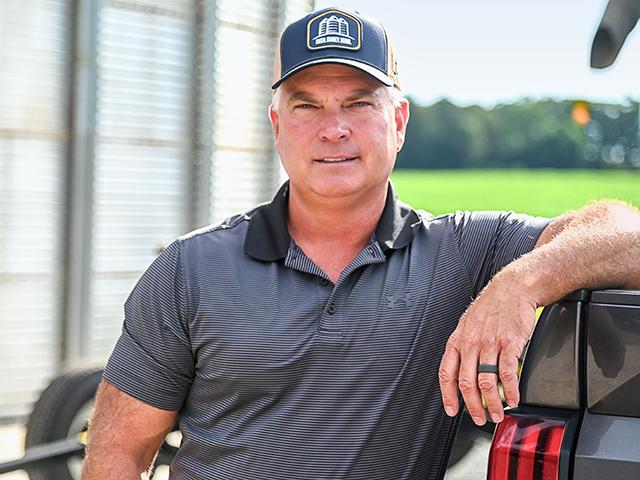
Stuart Sanderson sells more than a million bushels of corn, soybeans and wheat each year. With that much of his fifth-generation family farm's production on the line, he's well-versed at managing the risks associated with a glut of grain.
"It all circles back to profitability," says the Alabama farmer, who runs 9,000-acre Henderson Farms with his uncle and cousin, Mike and Chad Henderson. Between the volume the farm grows and the ability to store it, Sanderson operates more like a commercial grain elevator: hedging with futures, capitalizing on basis and capturing the carry.
Farmers are good at planting, growing and harvesting crops, he says. "What farmers are not as good at doing is determining what they want that crop to do for them."
It shows. Four years of big crops, compressed profit margins and eroding working capital have created one of the toughest farm business environments since the 1980s. Chapter 12 bankruptcy filings rose 46% in 2025 from the year before, and anecdotal reports of farmers shaving off acreage or quitting the business abound.
Sanderson can attest: His farm picked up acreage this winter after a nearby farm went out of business. He credits Henderson Farms' approach to marketing and financial management for growing the farm's balance sheet and reputation -- not only for sound business management but also high-quality grain production -- and creating growth opportunities.
Marketing is about reliably capturing profitability, he says, not catching the high. His advice for other farmers ranges from basic to advanced, but the bottom line is the same: Marketing is not speculation, it's what keeps the farm in business.
CHANGE TAKES TIME
Sanderson pursued a degree in business and marketing in college with the understanding that there wasn't room for him in the operation. That plan changed when his grandfather retired, and he assumed management of the farm's business, marketing and finances.
In his early years, the farm made a strategic pivot, reducing cotton acreage and expanding grain production, which necessitated a change in how the farm sold its output. Previously, cotton sales were managed by a broker, while the small amount of grain the farm grew each year was sold over the scales at harvest into the seasonal glut and often at marketing year lows.
"It made me branch out a little further into more hedging," he says. Sanderson started small. He'd sell enough grain ahead of harvest to cover 25 to 100% of the farm's input costs, confident that crop insurance would cover the position if he couldn't deliver the bushels.
In 2007, Sanderson and his partners decided their 8,000-bushel bin and batch flow dryer wasn't enough. They built a new setup: a 20,000-bushel wet bin with continuous flow dryer and two 60,000-bushel grain bins.
"People really thought we'd lost our minds," he says. "Outside of a co-op, there was nothing like that in this area."
Drought meant Henderson Farms didn't put a bushel of its own grain into the bin that year, but it did buy 20,000 bushels of corn from a neighbor. The market rallied, and "we made $1.95 per bushel on that corn," Sanderson explains.
He knew they were on to something, and over the years, the farm added to its storage capacity. It can now store 600,000 bushels in bins and a flexible amount in grain bags, if needed.
MAKE IT WORK FOR YOU
Sanderson and his marketing adviser, John Pfanner, make a plan each year. Pfanner is a commodity broker and crop insurance agent at advisory firm Tredas, and a former grain merchandiser and a Missouri farm kid. But, before the two determine details of how to sell the farm's output, Sanderson and his cousin, who manages the farm's production, create a budget based on what they need to grow it.
"You need to know your cost of production for a bushel of grain," he says. Then, he stresses that it's important to determine your goals above and beyond simply staying in business. For his farm, it's about building working capital, but for others it may be paying down debt or prepaying inputs in the fall with cash, for example.
Once you know what you need that bushel to do, Sanderson suggests setting up a white board for each crop you grow. Put it in the office or wherever you will look at it every day.
P[L1] D[0x0] M[300x250] OOP[F] ADUNIT[] T[]
"Put some target prices up there. Put your pie-in-the-sky prices up there. Put a few historical prices up there. Figure out what it is you want that bushel of grain to do for you," he says.
AVOID THE TRAPS
Once you know your price targets, stick to them. Sanderson says farmers often get caught in a trap: As commodity prices move higher, so do farmers' price targets. Then, the market reverses, and those farmers missed an opportunity for profitable sales.
"Quit chasing dollars, and start looking at the cents," he says. When the market hits his target price and looks set to keep rallying, Sanderson makes incremental sales regularly until the market changes direction. "With as much grain as we grow on our farm, I do a lot of 5,000-bushel increments," he says. While he has sold as much as 50,000 bushels at once, he prefers to build his price over time.
Pfanner advises several smaller farms that follow a similar feed-the-rally strategy, but they use mini-futures contracts, which cover 1,000 bushels instead of 5,000, like a standard contract.
Sanderson is very realistic about prices, Pfanner says. "He's never backwards critical. When the decision is made, it's made because it was a good decision that day, and then we move on to the next decision."
Sanderson doesn't let past success influence current choices. For example, he once sold 125,000 bushels of corn for an average price of $8.45, but that had no influence on his decision to hedge a portion of this year's corn crop at $4.70 in mid-March, nearly 45% less than his best-ever sale.
"Why? Because I can make money. I can stay in business," he says. "Corn at $4.50 to $5 is a lot more realistic than even $6. Forget the highs, but always remember how low something can go."
CAPTURE THE CARRY, MAXIMIZE THE BASIS
Sanderson doesn't plan on selling the corn he hedged with a $4.70 December futures contract at harvest. He'll likely take advantage of the futures spread -- the price difference between nearby and later-dated futures contracts -- and roll the position into May. In a carry market where there is plenty of inventory, later-dated futures contracts have a higher price, and rolling the hedge often nets an additional 15 to 18 cents on average, Pfanner says.
In years like this one, "If you can capture 20 cents, that might be what keeps you in the black and not the red," Sanderson explains.
Another way Sanderson optimizes his marketing is by separating his futures market decisions from his basis decisions. Basis is the difference between the futures price and the cash price received by the farmer. Basis can be positive or negative depending on factors like local supply and demand as well as transportation costs.
Pfanner says basis tends to appreciate after harvest, as elevators work to source bushels to fulfill their deals with end users.
A plethora of poultry production nearby means Sanderson lives in a grain-deficit area and usually deals with a positive basis, but he says farmers in heavily supplied markets that regularly manage a negative basis have opportunities, too.
He recalls putting this concept to work in a conversation with a friend last November. His friend had 100,000 bushels of soybeans in the bin, and prices were dropping. His friend was considering hauling them to town, but the local basis was 30 cents under futures. Sanderson encouraged his friend to call the elevator and ask what they'd pay for a delivery in late January or February. As it turned out, the elevator was offering 35 cents over the futures market in that time frame.
"Right there, he made 65 cents on 100,000 bushels of beans, not to mention there was a 20-cent difference in the futures market. So, he just made $85,000 by sitting on his beans for two months," Sanderson says. "That's the advantage of marketing. It broadens your ability to capture the basis, the market gains and the carries. It gives you options."
PUT SEASONALITY TO WORK
Sanderson says many of his best sales are made far outside of the harvest window. Generally, he finds prices he likes in the springtime.
Pfanner says there's a seasonality to every commodity, and statistically, the best time for preharvest corn and soybean marketing with futures is February to June.
Sanderson often takes seasonal trading a step further. In the spring, he'll start looking 18 months down the road. "Some of my highest hedges are preharvest of the previous crop," he says.
For example, on May 11, 2024, he sold November 2025 soybean futures at $12.90. The contract expired at $11.38, although it traded as low as $9.61 per bushel.
Farmers often worry about two things hedging that far out: Will they be able to produce the crop, and can they manage margin calls? A margin call occurs when the market moves against your futures position, and your account equity drops below the required maintenance level, requiring you to deposit additional funds to maintain the position.
BROKER BENEFITS
"Margin call is not a dirty word," Sanderson says. "Because I'm not margining something I don't have. I have equity in my grain." In a true hedging situation, a paper loss means that the physical grain has appreciated in value, he explains.
While Henderson Farms eschews debt and funds margin calls with working capital reserves, many banks will offer farmers a separate line of credit specifically to manage margin calls, alleviating fears of a capital draw when the farm needs money to pay other bills.
Pfanner says the interest expense on an operating line often works out to be less than the fee an elevator would charge on a hedge-to-arrive contract (HTA). For a Dec. 26 HTA, elevators usually charge 4 to 5 cents per bushel because they assume the margin risk. If you sold the same futures contract on the board, and it went up $1, the cost of interest on your margin call might only be 1.5 to 2 cents, he says.
"Margin calls are not a sign of success or failure. They're just part of business, like spending money on fertilizer or seed," Pfanner says. If farmers are truly hedging, not speculating or spending all their money on options, they want a negative brokerage account balance because it means their physical grain carries a higher price.
Pfanner says many of his clients had big brokerage account losses in 2021 and 2022 as the market ran up, but "after taking out brokerage account losses, they had the highest bottom lines they'd ever had in their life." That's because their preharvest marketing helped them optimize their basis and pick up the carry.
Sanderson advises farmers to thoroughly vet their broker. Look for someone who understands row-crop production and examine their fee structure. "You don't want someone who is worried about making a commission every day, because they're not going to have your best interest in mind," he says.
GRAIN MARKETING IS BRAND MARKETING
Over the years, Sanderson has watched Henderson Farms' philosophies on risk and financial management translate into strong brand marketing. Storage not only supports his grain marketing strategies, it also keeps the grain in top condition, allowing the farm to sell directly to end users like poultry companies, dog food processors and a high-end miller.
Many of these buyers pick up grain from his farm, paying him a positive basis and saving him the transportation costs.
"I'm a go-to person when these places need corn. We created that brand, and that's all due to the [grain] marketing aspect," he says. "Marketing gives you so many opportunities to expand your operation and to increase your income. Marketing is not just the dollars and cents of your operation."
Sanderson understands that not all farms have his level of production or storage capacity, but stresses that everything is a ratio.
"Your philosophy still needs to stay the same: You need to have an understanding of what you want that bushel of grain to do for you and how you want it to work for your benefit."
**
-- You may email Katie at katie.dehlinger@dtn.com, or follow Katie on social platform X @KatieD_DTN
[PF_0526]
(c) Copyright 2026 DTN, LLC. All rights reserved.