



How Fall Fertilizer Affects 45Z Plans
What Farmers Need to Know About 45Z Before Applying Fall Fertilizer
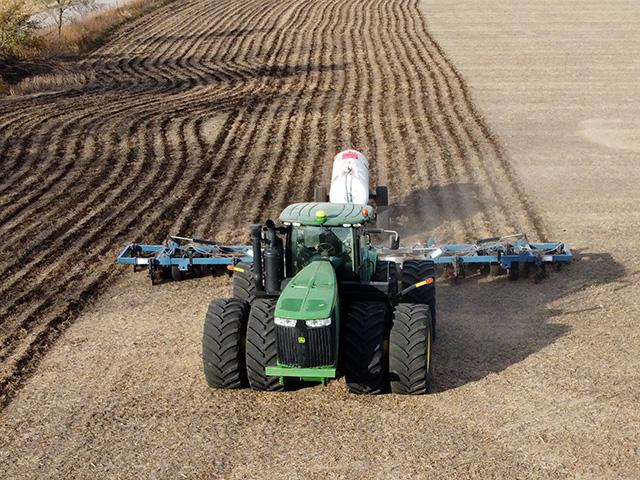
OMAHA (DTN) -- Before you jump into your fertilizer applications or tillage this fall, take a look to see if your local biofuel plants are planning to offer premiums for low-carbon grain next year.
Farmers preparing to apply fall fertilizer for their 2027 corn crop may need to complete some paperwork first if they hope to collect premiums for grain going to biofuels under the federal 45Z Clean Fuel Production Tax Credit.
Some ethanol plants are beginning to detail premiums for corn grown with practices that reduce the crop's carbon intensity. Premiums range from just a few cents to as much as 75 cents per bushel, depending on the practices used and the carbon-intensity score achieved.
New federal guidelines on the 45Z require farmers to develop nutrient management budgets, document field practices and maintain records to verify their corn's carbon-intensity score. A key element here is that nutrient budgets must be done before fertilizer applications begin.
Chris Malone, a partner with Richards Lakes Partners, an agricultural advisory firm that works with biofuel producers and grain companies, said the rules are arriving late for farmers making fall management decisions.
"We were supposed to have all these regulations two years ago," Malone said. "Obviously, we're getting this stuff very late, and farmers don't have a lot of time to react to it."
Here are six things farmers should know before applying fall fertilizer.
TALK TO YOUR ETHANOL PLANT OR GRAIN BUYER BEFORE MAKING CHANGES
The opportunity to earn a 45Z premium depends not only on farming practices but also on where and how the grain is marketed.
Because the federal tax credit goes to the biofuel producer, individual ethanol plants must determine whether and how to compensate farmers for lower-carbon feedstocks.
"This is a production tax credit," said Jacqui Fatka, lead economist for farm supply and biofuels at CoBank. "The money flows from the IRS to the biofuel producer. The only way it can flow to a farmer or to a grain co-op is if the biofuel producer chooses to do so."
Some plants may purchase qualifying grain directly from farmers, while others could work through grain elevators, cooperatives or certification programs. That could create new marketing considerations for farmers accustomed to delivering grain to a local elevator.
Farmers also need to understand whether participation in other sustainability or carbon programs affects their eligibility. Farmers cannot claim the same carbon reductions under multiple programs. However, conservation cost-share payments that compensate farmers for implementing practices may be treated differently from payments for the carbon reductions themselves.
Farmers also should ask whether a buyer requires enrollment before the crop year, what verification services are available, when premiums will be paid and whether the buyer will accept grain delivered through an intermediary.
PLUG YOUR FARM INTO USDA'S CARBON INTENSITY CALCULATOR
Before making decisions about changing fertilizer rates or adopting new conservation practices, farmers should consider running their expected 2027 production practices through USDA's Feedstock Carbon Intensity Calculator (FD-CIC).
The online calculator allows farmers to enter their location, expected yields and management practices to estimate the carbon intensity of their corn production. See the link to the calculator below.
Farmers can compare different scenarios involving no-till, reduced tillage, cover crops, nitrogen application rates, manure and nitrification inhibitors.
P[L1] D[0x0] M[300x250] OOP[F] ADUNIT[] T[]
The calculator provides a baseline carbon intensity (CI score) expressed in grams of carbon dioxide-equivalent emissions per bushel. Lower CI scores create more potential value for ethanol plants seeking to reduce the carbon intensity of the fuel they produce.
Malone said the first question farmers should consider is which practices actually generate value.
"I think first it's, hey, what is worth money here and what really drives practice value," Malone said.
No-till and cover crops can provide some of the largest improvements in carbon-intensity scores, especially when used together.
"If you do no-till and cover crop together, that tends to be where we see very large value," Malone said. "One plus one equals three type of value."
Nitrogen efficiency also matters. The calculator considers how much synthetic nitrogen farmers apply relative to their crop yields.
Nitrification inhibitors also can improve scores, although the value depends on the product and other management practices.
DEVELOP A NUTRIENT BUDGET BEFORE APPLYING FERTILIZER
All farmers looking to capture a premium need to develop a nutrient budget before applying fertilizer for each field they plan to use to achieve a lower CI score.
Under USDA's technical guidelines, farmers must prepare a nutrient budget that accounts for planned applications of nitrogen, phosphorus and potassium, along with other measurable nutrient sources and crop nutrient removals.
Farmers develop the nutrient budget using soil tests collected within the past two years or recommendations from a university, agricultural extension agent, or an advisor approved by the Federal Crop Insurance Corp., as an "agricultural expert" such as a certified agronomist or crop consultant.
Farmers who have already applied fertilizer without a nutrient budget could have difficulty qualifying those acres for premiums tied to the 2027 crop.
Malone encouraged farmers to complete the necessary documentation as quickly as possible.
"I think getting that done now, even if it's a few weeks or a month late, is much preferable to doing it this time next year when you're in a program."
CHECK SOIL TESTS AND MANURE REQUIREMENTS
Under USDA's guidelines, the nutrient budget must be based on either soil tests conducted within the previous two years or the professional opinion of a qualifying agricultural expert.
"You either have to have a soil test that was done in the last 24 months or, if you don't have that, the recommendation of a certain type of agricultural expert that has to sign off," Malone said.
For producers applying livestock manure, additional testing requirements apply and must be incorporated into the nutrient budget. Farmers are advised to test manure sources being applied this fall rather than relying on previous years' analyses. Those results must be incorporated into the nutrient budget.
Farmers also need to recognize that fields may have to be divided into separate management units when different nutrient management practices are used.
For example, acres receiving manure and acres receiving commercial anhydrous ammonia may require separate budgets, even when those acres are within the same field.
KEEP RECORDS OF EVERY FIELD OPERATION
Even farmers already following qualifying practices could miss out on premiums if they cannot document what they have done.
"The burden of 45Z is really one of evidence," Malone said.
He encouraged farmers to maintain as much third-party documentation as possible for fertilizer applications, cover crops, tillage and other field operations. For example, cover crop records may need to include seeding rates, planting dates and other information farmers have not traditionally documented in detail.
Some groups are advising farmers to document each fertilizer application, including the product, rate, application method and acres treated. At harvest, producers will need records establishing production from participating fields or management units.
Those records ultimately support the Biofuel Feedstock Report used to document qualifying grain moving through the supply chain to the ethanol plant.
The Iowa Soybean Association's 45Z participation guidance also advises farmers to retain records for at least five years and prepare for independent verification.
DON'T WAIT UNTIL SPRING
The 45Z tax credit could create another revenue opportunity for corn farmers at a time when producers are struggling with low commodity prices and higher production expenses.
Farmers who already use no-till, cover crops or efficient nitrogen management may be positioned to benefit without making major changes to their operations.
Others will need to determine whether adopting new practices makes economic sense.
Either way, farmers interested in the 2027 crop should begin by contacting their grain buyers, reviewing their nutrient management records and evaluating the requirements before applying fertilizer this fall.
USDA's Feedstock Carbon Intensity Calculator: https://www.usda.gov/…
Iowa Soybean Association 45Z participation guide: https://www.iasoybeans.com/…
Chris Clayton can be reached at Chris.Clayton@dtn.com
Follow him on social platform X @ChrisClaytonDTN
(c) Copyright 2026 DTN, LLC. All rights reserved.

