

Alfalfa Weevil Pressure Building
Scout, Treat Alfalfa Weevils Before Forage Yield, Quality Is Lowered
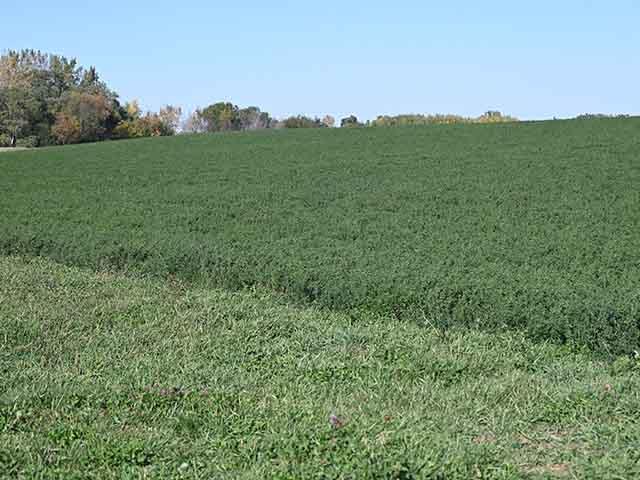
OMAHA (DTN) -- With consistently warmer temperatures, alfalfa growers should be aware that alfalfa weevil populations are increasing and feeding will begin to ramp up. Timely scouting and spraying are key to prevent damage from the pest.
Failing to heed this risk, producers could see both yields and quality decline rapidly, according to forage experts.
ALFALFA WEEVIL FEEDING RAMPING UP
Alfalfa weevils have already been active for a good month to six weeks in parts of Missouri and Kansas, according to Missouri-based Jeff Jackson, CROPLAN alfalfa and forage specialist. Producers have already scouted and treated for alfalfa weevils, with some producers in these states spraying twice already.
Weevils emerge and begin to feed as the growing degree units (GDU) begin to build. As temperatures warm, the feeding begins to increase, he said.
This spring's roller coaster of temperatures has increased weevil presence in some areas and decreased it in others. With more northern areas of Nebraska, Iowa and Minnesota beginning to warm up and these temperatures remaining warmer, alfalfa weevils feeding will ramp up significantly.
Jackson said one of the keys to limit weevils is to scout regularly for the pest in the spring. Every other day in at least one alfalfa field will allow you to keep a close eye on their levels, he said.
"You could be out one day and they aren't too bad," Jackson told DTN. "However, it can change very quickly."
Jackson said alfalfa fields could be subject to much weevil feeding damage.
P[L1] D[0x0] M[300x250] OOP[F] ADUNIT[] T[]
Untreated field strips in studies have shown that up to 30% yield could be lost and 30 points in forage quality could be at risk. A $30/ton loss in forage price could be seen by not treating for weevils, he said.
Once the economic threshold has been met, farmers should apply insecticides, with such insecticide families as pyrethroid, indoxacarb or chlorantraniliprole. Jackson said there are areas in both the Great Plains and Midwest where alfalfa weevils are becoming resistant to pyrethroids.
A product such as Steward insecticide needs to be utilized. The insecticide's active ingredient is indoxacarb. Producers should consider rotating insecticides for five years to avoid resistance problems, he said.
"Farmers should consult their local agronomist for more options to limit resistance issues," he said.
Jackson said from his 15 years of being forage specialist, alfalfa producers tend to treat weevils south of Interstate 90 before the first cutting. From I-90 to Highway 14, some producers will cut first and then treat or the other way around. North of Highway 14, generally the first cutting will be taken and then an application of insecticide will be applied.
IOWA, MINNESOTA ALFALFA REPORTS
In an Iowa State University Extension and Outreach Regional Crop Update last week, northeastern Iowa was a region where alfalfa weevil population was starting to build (https://crops.extension.iastate.edu/…).
Josh Michel, ISU region 5 extension field agronomist, reported that alfalfa is growing very well in the northeast corner of Iowa, and he expects the first cutting to occur in the coming weeks for most dairy operations. Alfalfa weevil larvae pressure is beginning to rise, he said.
"Feeding has been fairly limited to just a few areas at this time," Michel reported.
Further north in Minnesota, alfalfa growth has been slowed, according to a University of Minnesota Extension Alfalfa Harvest Alert for May 12 (https://blog-crop-news.extension.umn.edu/…).
Jackie Estrem, University of Minnesota Extension educator for Stearns, Benton, Morrison and Sherburne counties and Taylor Herbert, Extension educator for crops for Wright, McLeod and Meeker counties report that cooler temperatures have slowed alfalfa growth this spring.
Fields in the south-central region have hit the 14-inch mark while fields in north and west-central Minnesota are lagging behind at only three to nine inches tall. Some reports have indicated some significant winterkill in these areas, especially on sandy soils.
"We have also seen some minor frost damage with slight browning on leaf edges," the report said.
SUMMER ANNUALS CAN PROVIDE MORE FORAGE
Jackson said expanding drought situation could limit forage production in many regions this growing season. A simple way around having a shortage of forage would be to plant summer annuals, such as sorghum sudangrass or pearl millet.
His phone has been ringing off the hook in recent weeks as producers in drought regions consider what forage to grow to counter dry conditions. The historic wildfires in Nebraska earlier this spring have also had an effect on the amount of forage available to livestock producers, as much hay has gone to these areas.
"We went from a pretty mild winter with a huge stockpile of hay to a greatly reduced supply of forage in a very little amount of time," Jackson said.
He recommends that forage producers check their hay supplies and pasture conditions to see how much production they really have this spring. If they are worried about having enough forage, planting summer annuals could be an easy way to increase the amount of forage needed, he added.
Russ Quinn can be reached at Russ.Quinn@dtn.com
Follow him on social platform X @RussQuinnDTN
(c) Copyright 2026 DTN, LLC. All rights reserved.

