



Ibach Outlines Trade Priorities
New Trade and Farm Credit Nominees Testify Before Senate
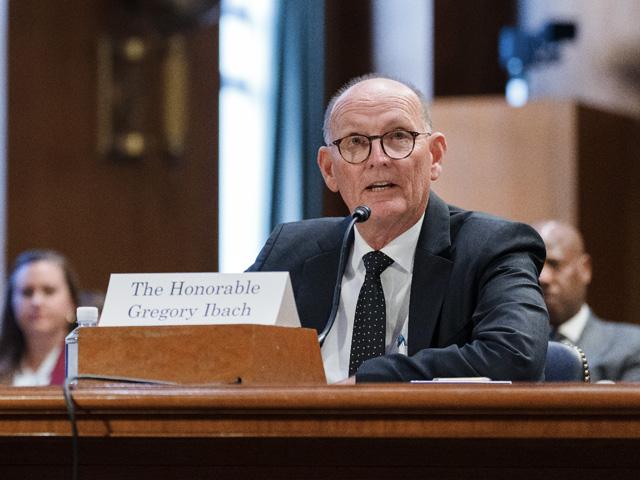
WASHINGTON (DTN) -- In its first formal hearing during the lame-duck session, the Senate Agriculture Committee heard testimony from three nominees to the Farm Credit Administration board and USDA's nominee for undersecretary of trade and foreign agricultural affairs, Greg Ibach.
Both parties used the hearing to discuss uncertainty surrounding the U.S.-Mexico-Canada Agreement, challenges facing agricultural credit borrowers and what could change in 2027 under new leadership.
Acknowledging trade tensions with Canada, Ibach said, "My job would be to show up in Canada and try to build those old relationships back, build the customer base back, and try to normalize trade as soon as possible."
Currently, the U.S. and Canada maintain reciprocal 50% tariffs on dairy products, alcohol and steel, with recent exemptions for certain agricultural products in Maine.
"I was encouraged, a week or so ago, to hear the prime minister (Mark Carney) state that he and the president (Donald Trump) had a good conversation and felt that they had identified a path forward," Ibach said.
While affirming the Trump administration's trade policy, Ibach said his mission would be "to identify and remove barriers, whether tariffs or non-tariff, that limit opportunities for U.S. agriculture. It also means sending firm language behind our producers or trading partners who fail to honor their commitments."
As head of USDA's Foreign Agricultural Service, he said he would work closely with U.S. embassies and agricultural attaches to communicate priorities to the Office of the U.S. Trade Representative.
When questioned about the Food for Peace program and proposed funding cuts before Congress intervened, Ibach said he did not have enough knowledge of the program to answer the questions, but noted, "I will follow the law."
"It is my hope that you will leverage your experience to try and restore some sanity and stability to our trade policy," Sen. Amy Klobuchar, D-Minn., told Ibach. "You are coming to the role at a challenging time. I've been clear on my views on this. The administration's tariffs have been very, very bad for farmers."
USMCA AND BEEF
Sen. John Hoeven, R-N.D., pressed Ibach on the timeline for renewing the USMCA, both seriously and jokingly asking whether an agreement among all three countries could be reached this year.
P[L1] D[0x0] M[300x250] OOP[F] ADUNIT[] T[]
Hoeven said USMCA should be completed in 30 days, adding that "that's more time than you'll need."
The senator reiterated that North Dakota cattle producers need trade certainty to retain and expand their herds. Access to additional capital is also important for young farmers looking to remain in the business.
Ibach's response did not indicate that an agreement was imminent, reflecting the broader expectation that individual negotiations with Canada and Mexico could come first.
"I want to provide the technical assistance that they need to complete the trade deals that are underway, USMCA, and others. And then I think I want to take very seriously, if confirmed, the responsibility to go out and ask for the business back for our farmers and ranchers and expand trade opportunities for them," he said.
When pressed about the downturn in beef processing by Sen. Michael Bennet, D-Colo., Ibach committed to exploring ways to get U.S. beef processors relisted for eligible Chinese export.
"We need to press on China to try to relist those plants to make them eligible once again to be able to export into China," he said, calling China a beef-deficit country.
Despite China's $17 billion earmarked purchase commitment, which has not yet been entirely fulfilled, "We need to show up and ask for that business," he said.
On beef imports, Ibach remarked, "Brazilian beef happens to be flowing into our market because of our strong consumer demand for beef and in the marketplace. We have opportunities in China."
Brazil has remained a significant source of lean beef and beef trimmings for U.S. processors. In September, the Trump administration and USDA allowed the importation of 300,000 tons of additional Brazilian beef, a move intended to help address domestic supply pressures and consumer prices ahead of the midterm elections.
Ground beef, 100%, has remained elevated at $6.76 a pound as of the first week of November, according to the Federal Reserve Bank of St. Louis.
FARM CREDIT NOMINEES
The Farm Credit Administration is governed by a three-member board, all three of which sat for a confirmation hearing Tuesday.
-- Carl Bednarski, of Michigan, to be a member of the Farm Credit Administration Board.
-- John Grunewald II, of Oklahoma, to be a member of the Farm Credit Administration Board.
-- James Russell Middleton, of Virginia, to be a member of the Farm Credit Administration Board.
Bednarski and Grunewald are Republicans, while Middleton is a Democrat. Federal law requires that no more than two members of the board belong to the same political party and that each term last six years.
"I will also note that if you are all confirmed, it would restore the FCA board to full bipartisan capacity. Not a lot of boards could say that right now, and I hope this is the beginning of a shift back to normalcy for all independent boards and commissions across the government," Klobuchar said.
"In order to pull out of this downturn and remain competitive and evolve the economy, the nation's producers need access to agricultural credit," Senate Agriculture Committee Chairman John Boozman told the nominees.
Also see, "Trump Nominates Greg Ibach as Undersecretary for Trade and Foreign Ag Affairs," https://www.dtnpf.com/…
Watch the hearing: https://www.agriculture.senate.gov/…
Jake Zajkowski can be reached at jake.zajkowski@dtn.com
Follow him on social platform X @jzajkow
(c) Copyright 2026 DTN, LLC. All rights reserved.