

Editors' Notebook
Rural Resilience: How Small Towns Are Surviving -- and Thriving -- Against the Odds
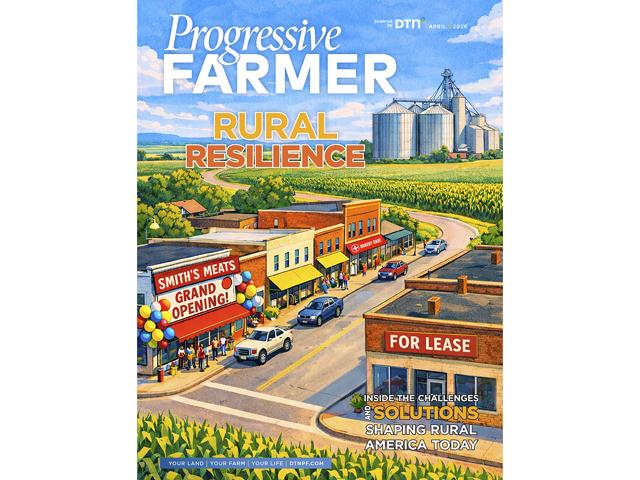
Drive through any small town in rural America, and you'll likely find a similar story: a shuttered clinic, a consolidated school, a Main Street holding on by its fingernails -- and a community that refuses to quit.
Over the next few weeks, DTN/Progressive Farmer will look beyond the fencerows and into those communities that farmers and ranchers both rely on and help sustain, in a series titled "Rural Resilience."
Agriculture doesn't exist in isolation. Farmers and ranchers depend on schools to educate the next generation, hospitals to keep their families healthy and Main Street businesses to supply goods and services for daily living.
P[L1] D[0x0] M[300x250] OOP[F] ADUNIT[] T[]
Rural America is facing significant challenges -- and unprecedented opportunities. Health-care systems are confronting closures and workforce shortages, even as innovative partnerships point toward new models of care. Schools are navigating declining enrollment and tight budgets, yet continue to outperform expectations by sharing resources, embracing place-based learning and serving as the social backbone of their towns. Broadband expansion has accelerated dramatically since the pandemic, opening doors to telehealth, precision agriculture and remote work -- though access remains uneven.
This series was especially meaningful for me as I worked with our team of writers and editors. My life, like many of our readers', is woven into the fabric of rural America. I grew up on a farm just outside of a small northern Nebraska town of about 60 people. I attended kindergarten through 8th grade at a now-closed school there with the same eight to 10 classmates. My mom also spent nearly 50 years as a grade-school teacher in several rural communities in north-central Nebraska. I saw firsthand how those schools served not only as places of learning but as anchors for their towns. Today's rural educators continue that tradition -- innovating, stretching resources and showing up for their students.
That same spirit of innovation and determination can be found in other aspects of rural life, as well. It shows up in a young Kansas entrepreneur who transformed a struggling lumberyard into a thriving rural business. And in Nebraska college students who discover that rural health care offers not just hands-on training but meaningful careers. Their stories and others are highlighted throughout the series.
The challenges currently facing rural America are real: aging populations, workforce shortages, policy uncertainty and infrastructure gaps. But so is the capacity to respond -- to collaborate across county lines, innovate with limited resources and welcome new people and ideas while preserving local identity.
Rural resilience doesn't mean resisting change, it means harnessing it. Resilience, after all, is not about bouncing back to what was -- but about building what comes next.
Anthony Greder can be reached at anthony.greder@dtn.com
Follow him on social platform X @AGrederDTN
(c) Copyright 2026 DTN, LLC. All rights reserved.