



Winter Wheat Tour Day 2 Yields 39.3 BPA
Abandonment Potential Increases on Hard Winter Wheat Tour Day 2
This article was originally posted at 8:23 p.m. CDT on Wednesday, May 13. It was last updated with additional information at 10:59 p.m. CDT on Wednesday, May 13.
**
WICHITA, Kan. (DTN) -- Combines could be rolling in southern Kansas wheat fields by Memorial Day weekend, but many fields won't make the cut -- literally -- as abandonment potential is high, especially in the state's southwest corner.
That was the assessment on Day 2 of the Wheat Quality Council's 2026 Hard Winter Wheat Tour as scouts assessed a crop barreling toward the finish line as hot, dry conditions continued to spur the drought-stressed, freeze-damaged crop to the finish line.
Tour participants scouted 177 fields on Wednesday, traversing six routes that included western, southwest and south-central Kansas from Colby to Wichita and five counties in northern Oklahoma. The group arrived at a weighted average yield of 39.3 bushels per acre (bpa), roughly 36% lower than Day 2 during last year's tour.
"The crop has decided it's done," said Tyler Ediger, who farms in Meade County in southwest Kansas. "Since November, we've only had 60/100ths of rain."
P[L1] D[0x0] M[300x250] OOP[F] ADUNIT[] T[]
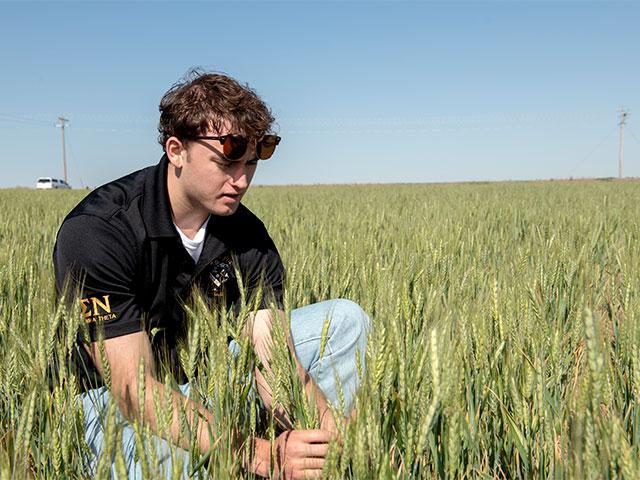
Ediger took a group of wheat tour scouts to two of his fields just a few miles apart. They were both planted with the same variety at about the same planting date, but their yield potential was vastly different. In the field where the wheat followed a fallow season, the yield potential was three times what the scouts found in the other field, which was in continuous production.
When asked where the line between abandonment and harvest was for his operation, Ediger said around 10 bpa. Below that and a discussion would need to be had with a crop insurance adjuster.
Many of the same themes from Day 1 of the tour carried over into Day 2. Scouts encountered wheat suffering the effects of drought, freeze injury and disease pressure, most notably from wheat streak mosaic virus (WSMV) and barley yellow dwarf virus.
In south-central Kansas, particularly in Barber and Harper counties, wheat fields that usually would be seas of green in mid-May were instead trending more toward amber waves of drought-stressed grain.
"From the road, it looked like 10 days, and they'd be ready for harvest," said Romulo Lollato, Extension wheat and forages specialist at Kansas State University. "But you'd go in and open those heads, and that grain is still pretty soft. We don't like to see as dry of plants as we are seeing with the kernels still as soft as this. So, what was going on is the crop really died."
He noted that hot, dry conditions moving forward will not be favorable for starch accumulation in the grain, which would likely bring down test weights.
Overall, estimated yields for Day 2 ranged from a low of 3.0 bpa to a high of 112.0 bpa, reinforcing that variable conditions still existed. Combining Day 1 and Day 2 of this year's tour, the average yield was 38.8 bpa, a 34% yield decrease from last year.
The third and final day of the 2026 Hard Winter Wheat Tour takes place on Thursday, May 14. Scouts will assess fields between Wichita and Manhattan, Kansas. The tour's final yield estimate and production projection will be released in the early afternoon following the wrap-up crop discussion at Kansas State University.
DTN Crops Editor Jason Jenkins is participating on this year's tour. Look for more daily updates and final yield estimates on www.dtnpf.com and on social platform X.
To read more about Day 1 of the tour, visit https://www.dtnpf.com/….
Jason Jenkins can be reached at jason.jenkins@dtn.com
Follow him on social platform X @JasonJenkinsDTN
(c) Copyright 2026 DTN, LLC. All rights reserved.

