



Ag Weather Forum
Late-May Heat Wave May Stress France Wheat
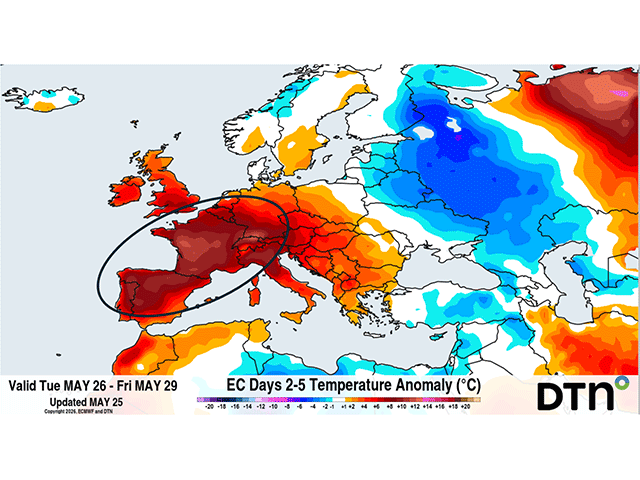
The last full week of May features a weather event that has been very familiar to Western Europe during the past few years -- a spell of extreme heat. A stout ridge of high pressure centered over the English Channel between Britain and Normandy, France, is the cause of this spell of heat. And the departure from normal is stark. Temperatures are forecast to reach as much as 20 degrees Celsius (36 degrees Fahrenheit) above normal during this final week of May.
High temperatures into the 90s Fahrenheit are forecast for much of Western Europe this week. Those values are more typical of mid-July rather than late May. This hot spell is a sharp change from a very cool pattern earlier this month.
P[L1] D[0x0] M[300x250] OOP[F] ADUNIT[] T[]
The forecast heat wave will be closely watched for possible stress to the 2026 French winter wheat crop. According to Victoria, Australia-based Lachstock Consulting, France's soft wheat crop condition was reported at 80% good to very good as of May 18, a steady rating value compared with the previous week and nine percentage points higher than 71% good to very good a year ago. However, that wheat rating could be challenged by the effect of this heat wave. Temperatures in the France wheat districts are forecast to reach 32 degrees C (89.6 degrees F) during this week.
Heat surges over a period of several days can lead to reduced yields. A Kansas State University discussion of heat impact on wheat yields noted "The optimum temperature for wheat from flowering to grain fill is about 54 to 72 degrees F. The longer the period of high temperatures and the higher the temperatures during reproductive stages, the more serious the potential yield loss. Temperatures above 88 degrees F immediately prior to anthesis (flowering) can greatly reduce pollen viability, thus reducing grain number and consequently grain yield."
France's wheat growers now face the prospect of extreme weather making an adverse impact on yields in two of the past three years. The 2024 French wheat crop was sharply reduced from the previous year because of heavy rain during the seeding period in the autumn of 2023, with rain again damaging reproductive wheat in the spring. The year 2025 was favorable. And now in this year 2026, crop potential faces a possible reduction because of hot conditions. Weather extremes have certainly asserted their presence in European agriculture. This week's heat wave in France, along with another primary wheat-growing county, Spain, offers another example of that trend.
This European heat wave, and its potential for wheat crop stress, coincides with prospects for U.S. winter wheat production to be 25% below a year ago, according to USDA, due to the impact of drought and spring freezes. (See "2026 U.S. Winter Wheat Crop Seeing Lower Estimates," https://www.dtnpf.com/….)
Bryce Anderson can be reached at bryce.anderson@dtn.com
(c) Copyright 2026 DTN, LLC. All rights reserved.