

Autonomy Comes to Kentucky Farm
Kentucky Farmer Aims to Plant 90% of His Corn, Soybeans Autonomously This Spring
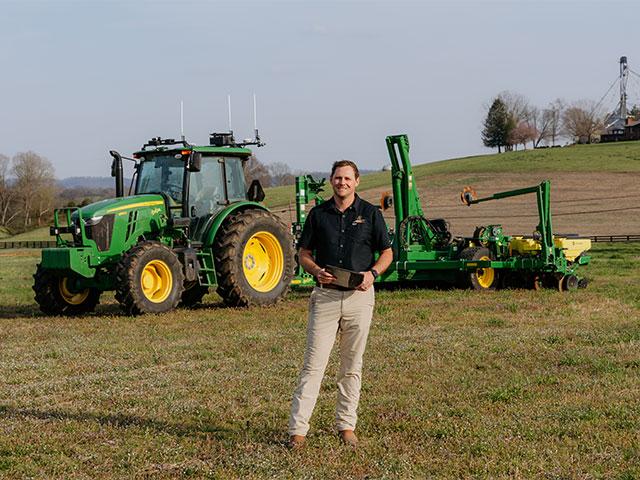
Quint Pottinger is planting 2,000 acres of corn and soybeans crops this spring not from the perch of his tractor driver's seat, but autonomously, armed with an iPad linked remotely to his 6130E John Deere tractor and Deere 1745 lift-and-twist planter.
U.S. farmers planting autonomously this spring, by one estimate, number at less than 50.
Historically, it has taken Pottinger 23 days with a pair of 16-row planters to seed his New Haven, Kentucky, corn and soybean crops. This year, he's anticipating his crop will be planted in 19 days.
Ames, Iowa-based Sabanto Inc.'s autonomous guidance package controls Pottinger's tractor. Sabanto-equipped tractors already perform commercial tillage and seeding operations -- even mowing tens of thousands of acres on sod farms. Sabanto supports between 200 and 300 of its autonomous packages controlling utility-sized tractors in the U.S., Canada and Australia, including more than 20 working at King Ranch in Texas.
Pottinger's planter is a JD1745 8/15 split-row planter. AGCO's PTx brand Precision Planting brings to Pottinger's Affinity Farms a pair of technologies: Its Gen3 20/20 monitor (smart interface visualizes performance and field conditions in real time) and Panorama (view maps, input summaries, agronomic data displayed on phone, computer or other platforms). Data from the 20/20 monitor flows to the cloud where it can be viewed in the Panorama system. Panorama allows Pottinger to log in, view and make planting changes remotely.
"We can see exactly what the monitor displays and make changes remotely as we would on the monitor in the tractor," Pottinger said. "Seed rate and placement, depth, ground contact. Imagine everything you look at while you are planting -- that is what you see remotely in real time, and you can make adjustments. My plan (this spring) is to let this thing go, and ideally only check on it every six hours. We should be able to finish in 19 planting days," Pottinger said.
Precision Planting's Panorama is not purpose built for autonomy. But for Pottinger, Panorama's live streaming feature is a critical piece of his plans.
"Live stream allows a user, through Panorama, to access and see what's going on," said Bryce Baker, North American tactical marketing, Precision Planting. "It sends notifications to your farm when there is an event code on the 20/20 monitor. Because the whole point of autonomy is that you don't want to have to babysit it, Panorama gives (the manager) confidence that the machine will tell you when something is going on, so you don't have to constantly check in."
Spring 2026 is actually "autonomous season" No. 2 for Pottinger. Last fall, he employed a 15-foot JD750 seed drill, also powered by Precision Planting, to autonomously plant winter wheat, cereal rye and barley. Sabanto controlled the tractor then, too.
"We planted 500 acres using Panorama, Sabanto and Starlink," said Pottinger. Quality is good, he told DTN/Progressive Farmer recently, except for 30 acres damaged by weather.
GLIMPSE OF THE FUTURE
Sabanto CEO Craig Rupp sees a glimpse of the future in Pottinger's operation.
"I'm convinced that the future is smaller swarms of equipment," he said. "If you just look at reducing (capital expenditures) by 70% in a $4 corn market, that's compelling," he said. "Autonomy will bring horsepower in the other direction, with longer hours (of operation) and with less costly equipment."
Sabanto's kit includes antennas, dual GNSS receiver, obstacle detection sensors and video cameras. Infrared object detection sensors are mounted on the cab and the front of the tractor. The tractor's vehicle path-finding module converts operator instructions into tractor performance. The tractor product retails for $70,000.
Pottinger's goal is not to run around the clock.
"The goal is to take advantage of the most efficient planting window," he said. "If that means starting at 8 a.m. and stopping at 10 p.m. one day and starting at 2 a.m., stopping at noon another, then so be it. We want to set up our (planting times) for maximum efficiency on the farms we are planting; and in central Kentucky, those are drastically different day to day."
P[L1] D[0x0] M[300x250] OOP[F] ADUNIT[] T[]
Pottinger learned one valuable lesson from last fall's autonomous work.
"It seems obvious now, but when we started, it was 'Let's get this thing running and address fuel, seed and maintenance as needed,'" he said.
But that practice was full of process inefficiencies. Toward the end of fall planting, Pottinger instead began setting acre limits to match seed with fuel needs and general machinery maintenance.
Pottinger plans to plant slowly.
"Instead of planting 4 1/2 to 5 1/2 miles an hour, we'll actually be planting 3 miles an hour, which with the airbags, should give us more consistent depth."
The corn planter is outfitted with Row Command row clutches. The clutches automatically shut off individual seed meters or sections to prevent overplanting, reduce overlaps and manage headlands.
Pottinger is opting for pneumatic down force (air bags) on the row units.
"We have issues with subsurface rocks that break the double disc openers. That can create a big mess. The air bags are more forgiving than hydraulic cylinders for down force," Pottinger said.
Pottinger's technology package includes Starlink, the satellite technology that delivers a high-speed, low-latency internet connection.
"Precision Planting's 20/20 monitor needs uninterrupted internet connectivity to remote in," he said.
Starlink also provides a fallback connection for Sabanto automation, which normally uses cellular signals for communication and RTK guidance.
Pottinger sees the tractor and planting alerts on his iPad. Messages give him information to make decisions. Can he fix it remotely? Or, if it's not a big issue, can planting continue? Or he can command the tractor to move to a predetermined location for an in-person check -- perhaps where the seed tender is parked.
NEW WORKDAY ROUTINE
Pottinger's farm workday routine is like any other, with some management exceptions. Labor management and deployment look different over 16-hour days. Pottinger pays two employees. He and they will work differently with a remote, autonomous planting function underway.
"Everybody will have a check-in," Pottinger said. "Depending on where the planter is running, whoever's coming in from that direction in the morning, they'll check the planter, make sure the seed is at appropriate levels, put fuel in the tractor."
At noon, Pottinger does a check. At the end of the human workday, the person closest to the tractor will do the evening check.
"And I'll do a final check from home around 11 o'clock before I go to bed," Pottinger said. "If I know it can't make it through the night, then I'll send an adjustment to have it go to the seed tender when it gets low on seed."
Once it's refueled and the hoppers are filled in the morning, the tractor and planter return to where they left off.
The lay of the land Pottinger works is an important consideration for autonomous farming. It is a plus to be able to move by remote command from field to field by way of private, internal roads. Moving autonomously on public roads is not possible; in fact, it is illegal.
Pottinger adjusted to optimize efficient travel between fields.
"We let some of our farms go. But we've kept some farms that we maybe wouldn't have kept because now we've got three (total) sections we work in. We can work across fields without having to go onto (public) roads," he said. "We have to get on roads to move only three or four times."
PATH TO LOWER COSTS
Autonomous farming is not something that has simply triggered Pottinger's inner geek. It is a critical piece giving his farm economic vitality. Autonomous farming is a path to slashing equipment costs, he believes.
In that, Pottinger made difficult decisions. He sold a pair of 40-foot planters, two large-frame tractors and -- also unexpectedly, he said -- a combine and two headers.
"Our goal was to try to return almost a half-million dollars back to the farming operation in equipment sales," Pottinger said.
With harvest of double-crop soybeans and autonomous fall planting, "We found a point where we could get one crop out (with one combine) and another crop in (autonomously)," he said. "This is the labor story of automation; with the one tractor running remotely (fall crop), we gained two guys -- a seed runner and tractor operator -- back to the harvest. We realized we didn't need the (capacity of an) extra combine to get the crop in."
With his more traditional heavy equipment lineup, Pottinger figured it cost him $2,800 per hour to keep the 16-row planters in the field. Running his 2019 6130E tractor plus automation (cost $190,000) with the 2022 8/15 split-row planter ($90,000) in the ground an average of 16 hours per day, over 19 days (assuming 7 acres per hour and 304 hours total), Pottinger estimates his planting costs are now $828 per hour.
"I had to put money back into the farm some way," he said, convinced his large equipment costs would hinder the survivability of his farm.
Pottinger believes his autonomous technology investments make sense.
"If we can automate certain sections of the farm with smaller pieces of equipment, then we can eliminate this need to maintain a larger equipment fleet without decreasing acres," he said.
Dan Miller can be reached at dan.miller@dtn.com
Follow him on social platform X @DMillerPF
(c) Copyright 2026 DTN, LLC. All rights reserved.