

Production Blog
Persistent Rain Creates Seed Corn Harvest Challenges
ANKENY, Iowa (DTN) -- While most central Iowa farmers wait for fields to dry to begin harvest, Sean Harmon doesn't have the luxury of time. He's up against the clock in a race to preserve quality of seed corn, picking in wet, muddy conditions that would make him think twice about running a combine through his commercial corn crop.
Seed corn must be harvested when it reaches maturity, regardless of the weather and field conditions, due to lodging, mold and future seed germination concerns.
"We were driving through water the other day in a field (near Nevada, Iowa) that was probably 2 feet deep in spots," Harmon said on Thursday, Sept. 21, in a field just north of Ankeny, Iowa. His family's business -- Harmon Ag based in Ankeny -- grows commercial corn and soybeans, seed corn and co-owns a custom seed corn harvesting operation. "Earlier last week, we got stuck quite a few times. I feel bad when I rut up fields, but we can't wait for perfect conditions."
Persistent rainfall has made for a challenging seed corn harvest. Harmon said it has rained almost every day since picking began early this month.
Iowa averages 3.4 inches of rain in September, according to State Climatologist Justin Glisan. Des Moines has received 12.55 inches of rain for the month as of Sept. 25, according to Iowa Environmental Mesonet. Ankeny is a northern Des Moines suburb.
How do Harmon and his crew adapt to the conditions?
More horsepower. More traction. More planning. And more field work.
P[L1] D[0x0] M[300x250] OOP[F] ADUNIT[] T[]
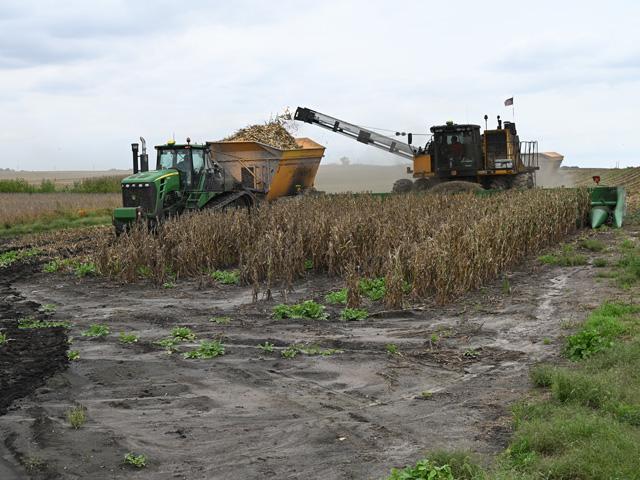
"Last week, we switched from using front-wheel assist tractors pulling seed corn dump carts to higher horsepower tractors with tracks, and we haven't been stuck since," Harmon said. "This fall, we'll have to do more deep ripping to break up compaction and level out a lot of ruts."
If semis can't be loaded with seed corn in the field, Harmon will coordinate with local law enforcement when needed to temporarily direct or stop traffic so trucks can be loaded on roads.
Harmon said tillage radishes, seeded as a cover crop into standing seed corn, will also help break up compaction. Radishes, known for long, thick taproots, have flourished with ample moisture. Cover crop seed is broadcast in fields when male corn plants are destroyed after pollination.
The Harmon family has grown and harvested seed corn since the 1980s. Bayer hired the family and their custom harvesting partner, Johnson Bros. Farm of Polk City, Iowa, to pick 2,500 acres of DeKalb and Channel seed corn this year. About 10% of the total is grown by the Harmons. As of Sept. 24, they have 900 acres to pick.
Technology, such as autosteer and remote grain cart control, has made seed corn harvest easier, Harmon said. This year, Mother Nature had other plans.
"It's been a challenge, at times, to drive the picker, sliding all over the place," said Harmon, who is often behind the wheel of the Oxbo 8435 with a 16-row corn head. Autosteer doesn't work well in muddy, slick fields. "It takes both hands, one on the wheel and one on the hydrostat lever, while using both feet on the brakes to keep it straight. I don't have a free moment when driving in those conditions."
Seed corn harvest moves forward rain or shine, as long as crews can keep trucks rolling. For Harmon, the muddy fields and long hours are part of a process most people never see.
"From planting to spraying to harvest, I don't think people understand how much work goes into producing seed corn," he said.
Learn more about seed corn production at https://www.dtnpf.com/….
Read about a "pioneer" in the seed corn business at https://www.dtnpf.com/….
Matthew Wilde can be reached at matt.wilde@dtn.com.
Follow him on social media platform X @wildeagwriter
(c) Copyright 2026 DTN, LLC. All rights reserved.

