


2026 Digital Yield Tour - Ohio
Ohio Crop Split by Planting Conditions, But August Rains Remain Key
WASHINGTON (DTN) -- Ohio's 2026 crop was split by spring weather, with farmers south of Interstate 70 largely getting crops planted on time while heavy May rains delayed fieldwork across parts of northern Ohio.
Despite the different starts, farmers across the state are impressed with the potential of this year's soybeans. Some farmers also cut corn acreage amid higher nitrogen costs.
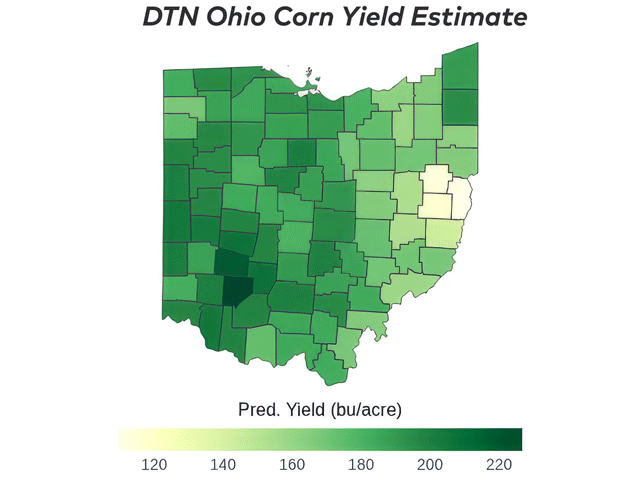
The 2026 DTN Digital Yield Tour estimates Ohio soybean yields will finish slightly below the USDA Risk Management Agency's five-year average for soybeans, while the state's corn estimate is about 5 bushels per acre below the five-year average.
Now, August weather will determine how much of the crops' potential reaches the bin. Regular rainfall without damaging wind or hail -- such as the potential derecho that swept across the state Aug. 11 -- could help southern Ohio's crop finish strong. In northwest Ohio, additional August moisture could be critical for soybean pod fill, corn kernel depth and test weights.
CORN YIELD ESTIMATES:
-- DTN 2026: 191.9 bushels per acre (bpa)
-- DTN 2025: 193.7 bpa
-- USDA RMA 5-YEAR AVERAGE: 196.8 bpa
SOYBEAN YIELD ESTIMATES:
-- DTN 2026: 55.4 bpa
-- DTN 2025: 52.7 bpa
-- USDA RMA 5-YEAR AVERAGE: 55.9 bpa
While the DTN Digital Yield Tour is in its ninth season, this is the third year that employs DTN's proprietary crop yield models. The tour estimates reported here are based on yield models as of Aug. 1. The models update every two weeks and do not incorporate weather forecasts.
For more about how those models work and what makes them unique, please see: https://www.dtnpf.com/….
Results for all states covered by the tour can be found here: https://www.dtnpf.com/….
Updated yield model results will be shared in early September on DTN's online products. You can view a Reporter's Notebook that previewed the Digital Yield Tour at https://www.dtnpf.com/…. On Aug. 14, you can find the post-tour Reporter's Notebook video at https://www.dtnpf.com/…. Also, later in August you can hear a Field Posts Podcast about the tour results at https://www.dtnpf.com/….
WEATHER COMMENTARY
DTN Ag Meteorologist John Baranick said that Ohio, much like neighboring Indiana, had a band of deep drought in the northwestern corner of the state in early March.
P[L1] D[0x0] M[300x250] OOP[F] ADUNIT[] T[]
"That drought went away quickly by mid-April," he said. "Ohio has been largely drought-free since, even though rainfall amounts have been below normal."
Some late July heat and lack of widespread heavy rain have brought in some spotty dryness to northern areas. However, much of the state has had good conditions for most of the late spring and summer.
"Heat has been in shorter supply this summer, and though temperatures have been above normal overall, frequent bouts of milder air have followed, reducing overall stress," Baranick added.
Editor's Note: This weather commentary covers conditions through the end of July. Severe weather moved through parts of Ohio on Tuesday, Aug. 11. Read more about Tuesday's severe weather here: https://www.dtnpf.com/…. If your farm experienced crop damage from the storms, please let us know.
MARKET COMMENTARY
According to DTN Lead Analyst Rhett Montgomery, the Ohio corn crop enters the homestretch of the 2026 growing season in a moderately better condition as compared to August 2025, at least according to USDA ratings.
"June and July were drier than average, particularly for northern Ohio, which may be something the DTN models are picking up on in generating a lower initial yield estimate for 2026 as compared to 2025," he said. "Overall, I believe the DTN forecast to be reasonable but would perhaps give a slight upward bias moving forward with a favorable forecast for August."
Ohio's USDA soybean rating of 59% good to excellent is very similar to the crop's rating at this point in 2025. The DTN Digital Yield Tour forecast is initially 2.7 bpa larger than last year, albeit just slightly lower than the previous five-year average.
"Yield potential for Ohio's crop may come down to August rainfall, which was below average in 2025 and likely took the top end off yields," Montgomery said.
OBSERVATIONS
-- Nathan Brown, Highland County, Ohio:
Nathan Brown farms in southwest Ohio and planted his crop by mid-May. Farmers south of Interstate 70 generally avoided the heavier rainfall that delayed planting farther north. He incurred 70 acres of replanting after a storm hit on the last day of corn planting.
Windy conditions created their own challenges. Brown said it seemed like there was rarely a calm day to complete post-emergence applications.
The lack of sunshine contributed to weed-control problems, including waterhemp, giant ragweed and common redroot pigweed. "I don't think we got a good kill because of the cloudiness and the coolness that we had there early," he said.
With fertilizer prices high, Brown said he tried to "more or less spoon-feed the crop" rather than put a large amount of dry fertilizer on early, trying more foliars. Brown was looking out for some yield drag in certain fields due to reduced fertility efforts.
Once temperatures increased in mid-June, however, the crop began to take off. Corn crop pollination occurred during the third week of July, when temperatures lowered again. While scouting, Brown found a few areas that appeared to have tar spot and applied a fungicide.
Recently pulled ears were running 16 to 18 rows around with about 40 kernels long. "Corn crops look really good," Brown said. "We need some more rain to fill out the ears."
Brown's fields have held moisture well. His cover-crop system has helped.
"If we get rain and no damaging winds or hail events or anything like that, I expect a really good crop here in southwest Ohio," he said.
For Highland County, the DTN model predicts yield estimates of 198.4 bpa for corn and 54.6 bpa for soybeans. The county's five-year yield averages are 181.7 bpa and 48.6 bpa for corn and soybeans, respectively.
-- Jake Heilmann, Lucas, Fulton and Henry counties, Ohio:
Jake Heilmann farms in northwest Ohio near the Maumee River, where sandy soils and drainage allowed him to take advantage of a dry spring. While portions of northern Ohio were hit by heavy May rainfall that delayed planting, Heilmann's crops were all planted in April when his cover crops were also terminated.
"We were in a drought, so our soil was able to absorb that (rain), and with our drainage, we were able to get right back out into the fields shortly after," he said. His operation also shifted his soybean acreage from 30- to 15-inch row spacing this season.
The growing season brought good emergence, uniform stands, early potential and timely rainfall to Heilmann's corner of Ohio. He said his farm avoided some of the large rain events that affected other parts of the area.
His management strategy also was proactive rather than reactive. He applied fungicide across all of his soybean acres and on about one-quarter of his corn acres.
"I think the corn crop is pretty much made. We just got to get it to the bin," Heilmann told DTN.
At the second week of August, his soybeans were around the R5 growth stage, and late-season rainfall could add pods and soybean size. "I think you'll see the most increase in yields from these August rains in our soybeans," he said.
Additional rainfall could also improve corn test weight and kernel depth. After entering the summer concerned that this could become a third consecutive drought year, Heilmann said the crop has instead maintained strong potential.
"The potential is usually restricted due to rain. The amount of rain you get is basically your yield-limiting factor," Heilmamn said.
For Ohio farmers, that makes August the final variable.
For corn yield estimates, the DTN model predicts 186.7 bpa for Henry County, 195.3 bpa in Fulton County and 193.2 bpa in Lucas County. For soybeans, DTN predicts yield estimates of 57.4 bpa, 55.8 bpa and 50.7 bpa in Henry, Fulton and Lucas counties, respectively.
Jake Zajkowski can be reached at jake.zajkowski@dtn.com
Follow him on social platform X @jzajkow
(c) Copyright 2026 DTN, LLC. All rights reserved.

