

View From the Cab
Farmers Pick Corn and Rocks as Harvest Intensifies
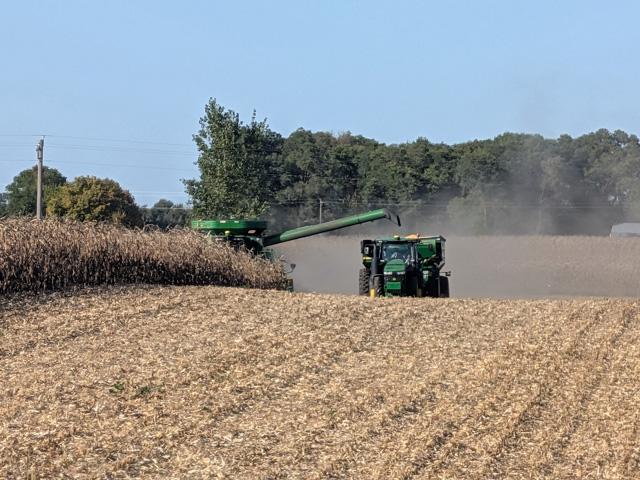
DECATUR, Ill. (DTN) -- The excitement of cutting into the first fields each fall never grows old for Chris Weaver.
"I don't really like to talk yields. I'm more focused on whether we maximized what nature offered us this season," said the Finksburg, Maryland, farmer. "It's all about mitigating stress on the crop. We have had some stress this year. Now, we start to evaluate what practices helped preserve yield potential and incorporate those observations into plans for next year."
Cover crop planting and delivering direct to a nearby corn mill were also keeping Weaver's farm crew hopping this week.
In Minnesota, weather woes continued for Tyler Rath, who farms near Belgrade. The first frost of the season came on Oct. 2. Although the timing isn't all that unusual, the cold snap nipped the tops of some double-crop soybeans. Rain events have also slowed harvest progress of corn and edible beans in his area. Still, he was experiencing some respectable yields on irrigated corn, despite the weather challenges.
Rath and Weaver have been reporting in this season as part of DTN's View From the Cab feature, a diary-like accounting of crop conditions in their respective regions. This week they give an update on harvest progress, talk about fall operations, discuss the importance of picking up rocks and introduce a new pup to the farm.
TYLER RATH: BELGRADE, MINNESOTA
Commodity corn harvest usually represents the seasonal finish line for Tyler Rath. But this year, rains have delayed edible bean harvest and compressed operations. This week he was busy rodding kidney beans -- a process where a rotating metal rod slices just below the soil surface to cut the bean plants at or just below the crown. As a second step, a pickup head lifts, conveys and then places the plants into windrows to dry down further. A separate harvesting operation separates the bean from the plant.
Recent rains and cool temperatures have made rodding rougher than usual this year. It takes considerably more power to move through wet soils, Rath said.
"Typically, we can get through 20 to 22 acres an hour. This year I'm down to 5 to 6 acres per hour. These kidney beans aren't drying as quickly as I like, and we're running out of time for good harvest weather," he noted.
Navy bean harvest wrapped up on Oct. 1, and it was a race to finish before another rain event. This was the first year for navy beans on the farm. Rath also grows peas and several types of kidney beans, among other specialty crops.
Every year has production challenges, but food-grade crops are more susceptible to yield and quality dings that can quickly eat into profits.
"What we are dealing with this year is a prime example of why a lot of farmers don't raise these kinds of crops. This year we would have probably been ahead to raise commodity corn and soybeans. The last rain event cost me $25,000 in edible bean quality loss in one field alone," Rath estimated.
P[L1] D[0x0] M[300x250] OOP[F] ADUNIT[] T[]
The potential for additional premiums if the year cooperates is enough incentive to keep rolling the dice.
"Right now, I feel a bit discouraged after this rough season," he admitted. "But we're already planning for next year, and once time passes and we get through winter, I'll be ready to do it again. The risk is worth the reward for me most years."
Rath and his farm team scouted every cornfield to assess stalk strength and moisture in an effort to prioritize fields for harvest last week. Harvest began on Oct. 3 in dryland sand fields where drought had influenced standability. Some of those acres yielded only 100 bushels per acre and will generate an insurance claim.
Irrigated fields, however, are looking much more promising. Kernel moisture was running between 23% and 30%. This week Rath knocked out some irrigated fields that went from 260 bushels per acre (bpa) to 280 bpa. Irrigated plots planted to meet the specs for the National Corn Growers Association Yield Contest were harvested this week. Results have yet to be tallied, but Rath, who has placed in past contests, said those designated plots may be some of the best he's produced.
Plot work also offers an opportunity to do strips of fungicide and extra fertility for comparison. Decades of data from test plots also help in decision-making for subsequent crop seasons.
There's no problem filling rain days. Keeping equipment maintained is a constant chore. This week he was also making ear tags for replacement heifers. And there are always rocks to pick.
The practice of rodding tends to bring rocks to the surface. The investment in a hydraulic-driven rock picker has paid off in recent years. "Residue is a problem with this tool. Rodding leaves a clean strip between the windrows, so we run this machine down those cleaned-off rows prior to combining," he said. There are still plenty of rocks for the kids to pick up the old-fashioned way by walking fields and tossing them into the Ranger.
These days, the kids are focused on chores involving a new border collie puppy named Buck that has joined the farm.
CHRIS WEAVER: FINKSBURG, MARYLAND
Corn harvest has begun in earnest for Chris Weaver, and it's already turning up some interesting results.
"Tar spot came in late season, and while the overall health of our crop reduced losses, I saw definite differences in efficacy against the disease in fields where fungicides were applied by drone. Fields sprayed with a high-clearance sprayer had consistently less disease than those where we used drone applications," Weaver said.
Nearly every acre he farms gets seeded to cover crops. Drone application of cover crop seed over the top of standing crop didn't fare well for Weaver this year, either. By contrast, direct-seeded fields following barley emerged strong.
Those fields with poor cover crop germination are being interseeded with a mix of triticale, rye, crimson clover and buckwheat. Weaver said he'll cut off seeding around Nov. 15.
"We're just not getting seed-to-soil contact with the drone. I'm not happy about the added expense of another cover crop mix going out, but I need a good stand," he said. Cover crops not only hold the soil and contribute to biology, but Weaver also depends on them to suppress winter annual weeds.
Other fall operations on the list in coming weeks include spreading lime and applying some sugars and other biologicals to increase microbial activity in the soil.
So far, corn yields have been falling into the 220- to 260-bpa range. Plant health is such that the plant still looks fairly green when shelled, he said. Moisture this week was running from 20% to 24%. The crop has continued to stand well, despite some strong wind events.
However, he's also seen lighter yields in a few fields, particularly where deer ate their fill.
Weaver feels he had success this year foliar spraying a plant-based deer deterrent called Buck Barrier from Concept AgriTek. He sprayed around the V6 growth stage, covering a 200-foot-wide swath around the field perimeter.
"In one field where we didn't use it at all, yields dipped to 145 bpa," he said. Weaver has also noticed deer are more attracted to some hybrids and varieties than others and is noting that for seed selection criteria.
He's hoping to break open some soybean fields this week. Those acres are where barley and rye grown for grain are seeded. Plant health looks excellent, he reported, and he expects bean size to be above normal.
The topic of rock picking is something Weaver is well familiar with, too. It's an important exercise, especially for no-till farmers. A rock-picker blade mounted on the front of the skid loader has increased willingness to tackle this farm chore of late.
However, Weaver has strong memories of rock picking from his childhood. "Dad had us pick rocks and put them on pallets. We were in the vegetable business at the time, and he marked them as 'native rocks' and sold them to customers. Another time, someone wanted flat rocks, so he sent us out to the creek to gather flat rocks to sell," he recalled.
Sounds like a rock-solid project for farm kids!
Pamela Smith can be reached at pameladsmith12@gmail.com
Follow her on social media platform X @PamSmithDTN
(c) Copyright 2026 DTN, LLC. All rights reserved.