



Scouts Tour Hard Winter Wheat This Week
Annual Tour Assesses Kansas Winter Wheat Crop's Yield Potential
MANHATTAN, Kan. (DTN) -- After two consecutive years of increased wheat production in the Central Great Plains, farmers across the region were hopeful that this year's crop would continue the trend. But the season's optimism has turned to anxiety.
This week, those who travel to Kansas for the Wheat Quality Council's Hard Winter Wheat Tour will assess how drought, wild temperature swings and late freezes have reduced the crop's potential.
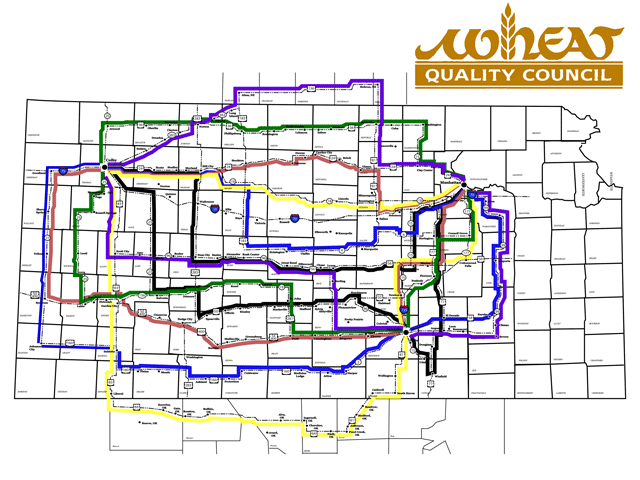
More than 60 are participating in this year's event, said Sean Finnie, Wheat Quality Council interim executive director. Over the course of three tour days, the group will collectively travel thousands of miles across multiple routes in Kansas, along with one route in southern Nebraska and one in northern Oklahoma. Along the way, the scouts will stop in hundreds of wheat fields and estimate the crop's overall yield potential, assessing its condition and quality and noting the presence and severity of insects and disease.
"We'll have the same spectrum of individuals as we've had on previous tours," said Finnie, noting that half of the millers, bakers, grain company employees, commodity representatives and government employees will be participating for the first time. "I think people are kind of fearing what we'll find, but I'm trying not to speculate now. We'll have to go out there and see what we see."
The group assembles late Monday afternoon in Manhattan, where each participant will be trained on how to calculate yield estimates and identify pests and diseases. Then, on Tuesday, they will hit the road and head west to Colby, Kansas, each group stopping to assess winter wheat fields every 10 to 15 miles along six predetermined routes that are followed year after year.
The tour continues Wednesday, venturing along routes that take the participants south before heading back east and ending the day in Wichita, Kansas. On Thursday, the tour concludes back in Manhattan, where the data from all three days will be combined to arrive at an average yield for the tour.
WHAT TO EXPECT
Despite planting fewer acres to wheat in 2025 than in 2024, production in Kansas increased and outpaced USDA's initial estimates. Kansas wheat farmers harvested nearly 347 million bushels of winter wheat with an average yield of 51.0 bushels per acre (bpa) in 2025. Last year's Wheat Quality Council tour predicted a total harvest of 338.5 million bushels with an estimated average yield of 53.0 bpa.
P[L1] D[0x0] M[300x250] OOP[F] ADUNIT[] T[]
Besting those totals in 2026 will be difficult. The USDA National Agricultural Statistics Service (NASS) Crop Progress and Condition Report released on Monday estimated that 51% of the Kansas winter wheat crop was in poor or very poor condition; last year, only 22% was in that condition during the same week. NASS rated the remainder of the current crop as 32% fair, 16% good and 1% excellent.
An estimated 86% of Kansas winter wheat was headed, well ahead of the five-year average of 49%.
The U.S. Drought Monitor map released May 7 showed that 40.18% of Kansas was experiencing severe drought conditions or worse, compared to 5.13% during the same week last year. The area of drought begins in areas of central Kansas and continues west. Most of the eastern third of the state is not experiencing drought, but winter wheat is not predominantly grown in this region.
Similar drought-related production reductions are being seen in other states within the Central Great Plains.
Last week, the Oklahoma Grain & Feed Crop Association released its estimates for the 2026 winter wheat crop in that state. Based on association member estimates, they predicted wheat production of roughly 47.8 million bushels, well below the 10-year average of 94.5 million bushels.
The USDA NASS Crop Progress Report released on Monday also rated 51% of Oklahoma's winter wheat crop as poor or very poor, with 40% fair, 8% good and 1% excellent.
In Nebraska, the wheat crop is suffering even more drastically. USDA NASS rated 82% of the state's winter wheat as in poor or very poor condition, a 15-percentage-point deterioration in condition in the past week alone. Royce Schaneman, executive director of the Nebraska Wheat Board, told DTN last week that the major wheat-growing regions of his state have had little to no precipitation since the crop was planted last fall.
"We're not looking like we're going to have a very substantial wheat crop out of Nebraska this year," he said. "Between the drought, the temperature swings and the late frost, it's all been things out of our control.
"I had a report from a producer in south-central Nebraska who had an insurance adjuster evaluate the crop at 2 to 10 bushels per acre," Schaneman continued. "I'm expecting that we'll have an increased amount of abandonment on acres this year. In an average year, maybe around 8% of acres are abandoned. This year from what I'm hearing, we will probably double that, and it may be a little bit more."
Finnie noted that while current conditions don't appear promising for this year's crop, the tour will help tell the tale. In the search for a silver lining with this season, he said things could always be worse.
"If this series of weather events happened 20 years ago, I think it would have been a lot more devastating," he said. "The advancements in wheat breeding have been fantastic. That continued investment in research is paying off and allowing us to even have the crop that's out there under these wholly unfavorable weather conditions."
DTN Crops Editor Jason Jenkins is participating in this year's winter wheat tour in Kansas. Look for daily updates and final yield estimates on www.dtnpf.com and on social platform X.
Jason Jenkins can be reached at jason.jenkins@dtn.com
Follow him on social platform X @JasonJenkinsDTN
(c) Copyright 2026 DTN, LLC. All rights reserved.

