


Cattle Virtual Fencing Has New Features
Halter's Satellite-Connected Cattle Collars Could Expand US Beef Market Coverage
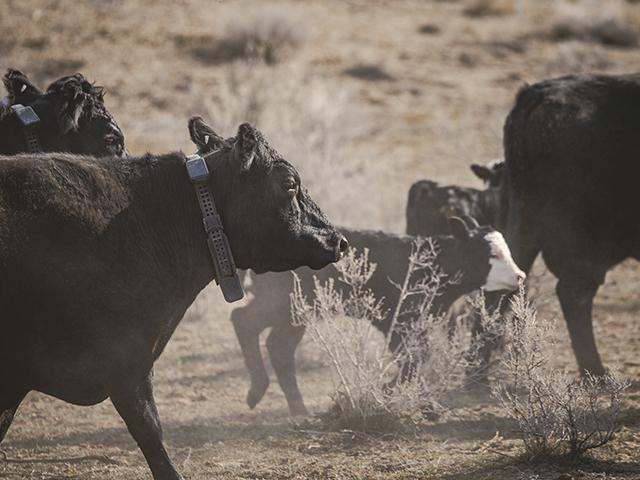
REDFIELD, Iowa (DTN) -- Global virtual fencing company, Halter, announced this week the launch of direct-to-satellite connectivity for its smart cattle collars.
Previously, the collars connected via cell towers or on-ranch infrastructure; now, using Starlink, the collars will be able to be used anywhere regardless of the terrain.
SATELLITE REMOVES CONNECTIVITY BARRIER
"This really opens up the opportunities for large ranches with rough terrain," Theo Beaumont, head of partnerships for Halter told DTN. Prior to the satellites, beef producers in remote and rugged regions were limited in connectivity, but now this makes it available to them at nearly the same prices as before for the collar and subscription. And there's no need now for a tower.
The company estimates having the direct-to-satellite capability of the collars potentially expands the coverage of the U.S. beef cattle market by 2.5 times.
P[L1] D[0x0] M[300x250] OOP[F] ADUNIT[] T[]
"Connectivity has been the final barrier to bringing virtual fencing across remote and expansive ranches," Craig Piggott, CEO and founder of Halter, said in a news release. "Direct-to-satellite allows ranchers to manage hundreds of thousands of acres in the most remote terrain on the planet. Combined with our new suite of product features, these ranchers can be even more productive."
Beaumont said the design of the collars is exactly the same as they have had, with just a change internally with the electronics. If current customers want to add to the number of collars they have and connection has worked with the towers, those will continue to work as they have and more can be added.
"Along with the new connectivity, we are rolling out a suite of new features, including estrus detection through the collars," Beaumont added. This update includes an all-in-one heat detection tool to identify non-cycling animals before breeding, thus leading to higher reproductive performance. This upgrade also provides near real-time insight into how feed allocation and pasture quality are influencing cattle performance, and advanced grazing features including high-resolution pasture mapping, pasture metrics, zone and block management, and a feed demand calculator, according to the company. These new features are focused to help beef producers with cow-calf management.
COLORADO RANCH AMONG FIRST TO ADAPT
The High Lonesome Ranch in western Colorado spans over 225,000 acres of complex terrain and is one of the first to have the satellite-enabled system.
"Halter has changed the game completely," said Lloyd Calvert, livestock and agriculture manager at High Lonesome Ranch. "Satellite unlocks the ability to run very remote country while still seeing what the cattle are doing, without needing someone with them all the time. We call ourselves Halter junkies now because we can check to see where the cows are any time of day, no matter where I am. It gives me a great deal of assurance and that's irreplaceable."
For more information on Halter, visit https://www.halterhq.com/….
Also read: Virtual Fencing: A Rancher's Best Friend: https://www.dtnpf.com/…
Jennifer Carrico can be reached at jennifer.carrico@dtn.com
Follow her on social platform X @JennCattleGal
(c) Copyright 2026 DTN, LLC. All rights reserved.

