



USDA Adds Text, Email Farm Surveys
USDA Adds AI Data Checks, Text and Email Surveys After Corn Error
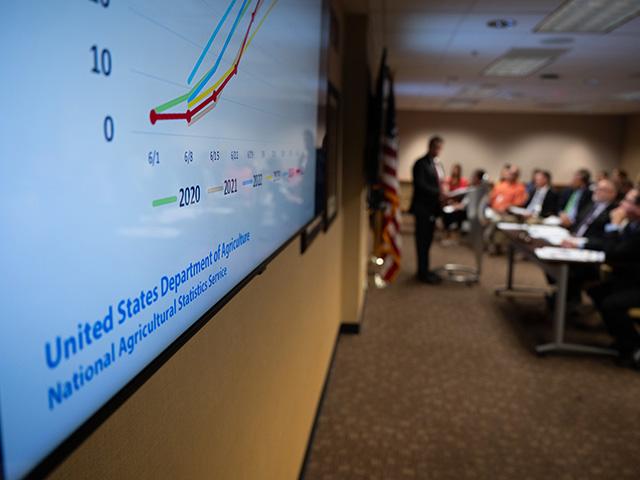
WASHINGTON (DTN) -- Before Tuesday's World Agricultural Supply and Demand Estimates report, National Agricultural Statistics Service officials shared more details about the September weighted corn error that unexpectedly raised U.S. corn yield and production estimates in October's report.
"The error ... had to do with acreage values that were in a file that we use to process the September corn objective yield data specifically in Kansas and Nebraska," Lance Honig, NASS's methodology division director, told Farm Journal last week.
The error incorrectly combined irrigated and non-irrigated corn acres data collected in the field. Honig explained that when the wrong weights were applied in the file, they further affected plant populations, ear counts and, ultimately, yield indications.
"We understand...that even though the magnitude of that error was relatively small, errors are still not acceptable," USDA Undersecretary for Research, Education and Economics Scott Hutchins told reporters Monday.
The agency's solution to catch similar human errors is an artificial intelligence tool developed to double-check Tuesday's monthly crop production report.
"We went back to September in retrospect, and we utilized a super intelligence (SI) tool that would allow us to identify anomalies in the data, things that don't seem appropriate based on what the model is showing. As it turns out, it was able to identify that. Because of that successful pilot, we're going to be utilizing that in November," Hutchins said.
As for the enumeration process, Honig said, "It had nothing to do with the number of samples, it was all how they were weighted together."
A Government Accountability Office report released Monday showed NASS lost 285 staff members since the start of the Trump administration, a 37% decline in the agency's workforce. NASS had 795 employees in December 2024, but that number fell to 461 employees as of September 2026.
"Trust is not something we ask for, we have to earn it," Hutchins said in the interview last week. But he also pointed right back at farmers, saying, "Our surveys are dependent on their participation."
TEXT AND EMAIL
To encourage further participation in USDA surveys, USDA announced Monday that selected producers will receive AN invitation to complete their December Agricultural Survey through text messages or email.
P[L1] D[0x0] M[300x250] OOP[F] ADUNIT[] T[]
It's a new step in USDA's data modernization that will roll out in late November. "Producers have limited time, especially during planting and harvest," said Joseph Parsons, NASS administrator.
The initiative comes as the agency works to address declining survey response rates, which reached a record low of 37.6% for key reports such as the March 2026 Prospective Plantings and June Acreage reports.
NASS faces the added challenge of rebuilding trust following data errors while encouraging producers to participate in surveys that help inform USDA estimates and commodity markets. Low survey participation has periodically contributed to market uncertainty, including in the corn market.
After verifying their identities, participants will submit responses through the secure online survey portal. Producers can confirm an invitation through https://portal.agcounts.usda.gov/…. Producers not selected for the December Agricultural Survey may opt to receive text or email notifications for future surveys.
"This program will help us learn whether a text or email invitation makes it easier to complete a survey and where we can improve the sign-in process," Parsons said.
NOVEMBER WASDE NOTES
Another new pillar of NASS reporting is the use of satellite technology to track crop progress.
However, November is not an ideal month for satellite-based assessments, Hutchins said.
"November is not a great month for these because the crop is all brown for the most part, and because these sensors rely a lot on color to determine plant health and ultimately yield associated with plant health," Hutchins said.
The agency will also place greater emphasis on data uncertainty and confidence intervals in its post-WASDE conference calls.
"What we'll be doing is emphasizing a 90% confidence interval or a 90% area of focus for the particular target. For corn, soybeans, and cotton, the presentation will put the ranges prominently in front of the audience at the top of the forecast slides," he said.
USDA Chief Economist Justin Benavidez also confirmed Tuesday that independent reviews of the methodologies behind NASS Crop Production reports, WASDE and other departmental data processes are underway.
The reviews are being conducted by the University of Missouri's Food and Agricultural Policy Research Institute (FAPRI), Texas A&M's Agricultural & Food Policy Center (AFPC) and the Center for Agricultural Policy and Trade Studies at North Dakota State University.
The end goal, he said, is "ultimately making sure that this material is digestible and usable for the producers."
Also see, "After Rare USDA Correction, Corn Growers Question Crop Data Reliability," https://www.dtnpf.com/…
"USDA NASS pilots text and email invitations for secure online survey reporting," https://www.nass.usda.gov/…
GAO Report: "Little Transparency on Whether Key Issues Were Analyzed Before Reorganization Decision," https://www.gao.gov/…
Jake Zajkowski can be reached at jake.zajkowski@dtn.com
Follow him on social platform X @jzajkow
(c) Copyright 2026 DTN, LLC. All rights reserved.