



High Cattle Prices Rewrite the Rules on Culling Cows
No Rules, Just Right
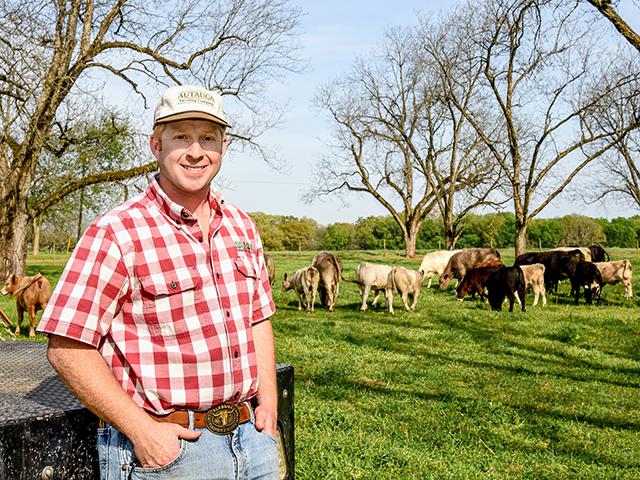
Even though he's only 28 years old, Dan Wendland has more than 60 years of detailed performance records at his fingertips. His family's Autauga Farming Co. was a charter member of the Alabama Beef Cattle Improvement Association (BCIA), so all he has to do is look at a cow's history to see if she has a habit of bringing substandard calves to the weaning pen.
"In a normal year, that cow would get sold to a different producer," he says. "It's hard to sell her now, though, because she's got a calf in her, and a calf is worth money, whether he's 800 pounds or 600 pounds."
When it comes to culling cows, there may be few hard-and-fast rules, but there are plenty of guidelines. With calves worth more, and replacement females expensive, producers have good reason to rethink which cows earn another year in the herd.
HARD-AND-FAST RULES
Pregnancy checks in the late summer or early fall are a given in Wendland's 860-cow Angus-Hereford-Charolais herd. An open cow is an automatic cull. So are the ones with crazy temperaments, but they are usually weeded out when he's picking his replacement heifers.
Historically, old cows or cows with bad feet or legs were out, too. Now, Wendland says, "If I have a bred cow, and I can get her to calve and can get her through the winter and get that calf weaned, then I'm going to have two animals that are worth something to sell in the spring."
RULES ARE MADE TO BEND
His answer is the cull pasture, where he feeds them with a high-fat ration to keep them growing. It's also a small pasture that minimizes the distance they have to walk to eat or drink.
"I don't rebreed the cows, and all those calves are marked," he adds. "The heifer calves from cows with bad feet are instant sells because we don't want those genetics to continue in our herd. If the cow has no teeth, that's not a reason to mark her calf, because she's probably been a pretty good cow if she's stuck around that long."
P[L1] D[0x0] M[300x250] OOP[F] ADUNIT[] T[]
University of Florida animal scientist Todd Thrift takes the same flexible approach with his own commercial cow herd. He doesn't automatically cull a cow when she reaches a certain age.
"If I have a cow that's 12 years old and is pregnant, has always raised good calves, is in good body condition and she's got a good mouth, I'm gonna keep her," he says.
Thrift adds that you don't even have to have a set of scales to keep track of the calves a cow has raised. "Just grade them."
Pregnancy alone isn't reason enough to keep an aging cow, he cautions.
"Oftentimes, that one more calf is worse than the small calf you could get from a heifer," he says. If she's been going downhill for several years, is missing teeth, has a poor body condition score, produced a small calf last year, "maybe it's time to let her roll."
DO THE MATH
Thrift also says it depends on your annual cow costs, as well as your cost to raise or buy a replacement heifer. At Autauga Farming Co., Wendland figures annual carrying costs $800 to $900 per cow. Against today's calf values, that makes keeping even a subpar producer easier to justify.
"You're still looking at whatever calf you get out of her being worth $2,000, even a sorry calf," Thrift says. With bred replacement heifers running $4,500 to $5,500 this fall, and the cost of raising one not a whole lot cheaper, he says the math is on the old cow's side.
The caveat is if she won't be marketable in the food chain by the time she raises the next calf. "If she continues to lose weight, if she gets crippled, if an eye goes bad, you probably need to look at euthanasia as opposed to marketing her. It's a case-by-case decision," he says.
For now, as long as they're sound enough to raise another calf, Wendland will continue funneling bred, older cows to his cull pasture for a little extra TLC. "We've shifted our goals because we want to try to get the value from the cow and the calf."
Sidebar: BONUS BUCKS FOR CULL COWS:
Cull cows and bulls account for nearly 20% of a cow/calf operation's yearly income, according to university Extension data. That makes them worth extra effort, especially when they're bringing record prices.
University of Florida animal scientist Todd Thrift says the university is doing a lot of work evaluating short-term feeding strategies.
"You can take cows that are in a body condition score (BCS) 3.0, a little bit thin, and in 45 days, you can turn them into a BCS 5.0."
That jump in condition equates to about 150 pounds. The extra feed can turn her fat white, or at least make it whiter, adding value on the rail.
"It's kind of like an old used pickup. When you trade it in, you clean it up. Right now, feed costs are low enough you can clean those cows up a little bit," Thrift says. "If you're gonna do that, though, you probably need to take that cow directly to a packer to garner that value."
Thrift still says it is not a one-size-fits-all decision. Ranchers should evaluate whether there's a better use for that grass or hay. "Maybe it would be better spent to upgrade your heifers."
If you do decide to put a little weight on your cows before you market them, Thrift says not to overdo it.
"The most valuable cull cow to a packer is one that has all of her muscle with just a little bit of fat. Not much fat, just a little bit. Then, she'll have her lean yield but not a lot of waste. They don't all just go to hamburger. The packers pull whole muscle cuts out of those cows, especially with the price of beef like it is right now."
At Autauga Farming Co., livestock manager Dan Wendland sends open cows to a separate pasture, then markets them by the truckload through private treaty sales. "At that point in the summer, they've been on grass and are usually pretty fat. If she's too skinny or her feet are just horrendous, I'll take her to the stockyard.
"With those buyers who buy private treaty, I try to send them what I know is going to be a high-dressing cow," he continues. "I want to send them something good they can take to harvest the minute she gets off the truck, and they'll see some value."
[PF_1126]
(c) Copyright 2026 DTN, LLC. All rights reserved.