



More Than Crops Emerge From European Soil
Finding a Killer Crop
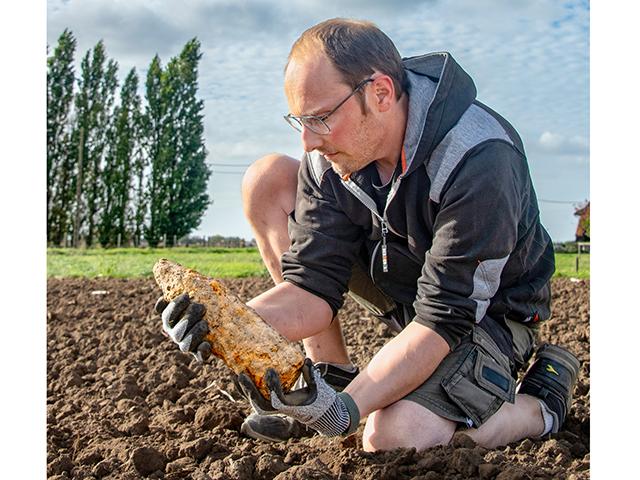
Bits of clay and dirt flaked away as Stijn Butaye shifted the black boot between his hands.
It was soiled and tattered, smashed but still sturdy, and with a heft that defied its years in the ground.
The steel hobnails, the style and, more than anything, the location it was found all told a story: The boot could only be from one country, Germany, and it could only have been lost in one span of history, during the first World War, between 1914 and 1918.
Butaye set it down on a concrete platform outside his family's farmhouse, near Ypres, Belgium, and let a moment of relief break across his face.
"At least there aren't any bones in this one," he says. "Sometimes, there are still bones."
The guns of World War I stopped firing long ago in south-central Belgium, where Butaye's family has farmed some of the world's most uniquely complicated fields for three generations. Still, the war remains everywhere, a surreal pall that drapes across the region's flat fields and subtle ridges. The war lingers in the cemeteries that dot the landscape and the memorials that designate key battlefields, in the concrete bunkers that block up farms and in the thousands of relics that, more than 110 years later, still pollute the soil.
It's the relics, particularly the artillery shells, which make it such a dangerous place to farm. They are "harvested" every year, pulled out of the soil alongside other crops. Many are still packed with gunpowder and shrapnel. They didn't explode when fired in anger but sometimes do in repose. Other shells still brim with poisonous gas, pumped 11 decades ago into glass bottles that fit neatly in the shells.
Now, those shells often leak, and farmers who carry them without protection first realize their mistake when their hands start to burn.
The Butaye family keeps gloves in every tractor just in case.
And, yet, live artillery shells are hardly the only concern facing the region's farmers. Many bristle at the politicians, insisting they're never supportive enough of the ag sector. The continent is critically short of young farmers, a threat to the whole industry, and the exorbitant price of land shackles those currently farming.
"It's too expensive for us," says Xavier Claeys, venting his frustration from his farm several miles up the road from the Butaye operation. "Now, we must have investors. The farmers become slaves again."
But, where farmers across the region may mirror Claeys' complaints, few deal with what the farmers of Flanders do, where the fields themselves could deliver a killer crop.
They're discouraged by the above-the-soil frustrations of today yet live anxious about the below-the-soil sins of yesterday.
All they can do is tread carefully.
WHEN HELL CAME TO TOWN
Ruin came to Ypres and its surrounding farmland in the summer of 1914, soon after World War I started. The Imperial German Army launched an August offensive that swept into then-neutral Belgium in a race toward France. The invaders gobbled up 95% of the country before the Allied powers finally held a line in front of the city of Ypres, and the action moved into the trenches for which the war is most remembered.
The fighting rarely ceased for the next four years, producing some of the war's most horrific battles, and for seemingly so little. The front lines rarely shifted more than a few miles in any year.
The reminders of what happened are ever-present, and a sadness still grips the community.
Long lines of white crosses gleam from the nearly 200 cemeteries that constantly interrupt the flat, fertile countryside. A towering battlefield museum glistens in the city's main square and is surrounded by chocolate shops and restaurants, but a memorial just outside the square is what draws a crowd every night. In that large, street-spanning stone arch, 55,000 names are carved into rock, honoring those killed whose bodies were never identified.
A small service takes place under the arch in the evening. Belgians have gathered there every single night since 1927, except when the Germans returned in 1940, and the service was relocated to London. It restarted in Ypres the very day of liberation in 1945.
A red pale comes over the memorial, and a trumpeter plays.
"We promised to never forget," one local shopkeeper says with a shrug. "We're keeping the promise."
P[L1] D[0x0] M[300x250] OOP[F] ADUNIT[] T[]
The Flanders farmers can't forget, even if they wanted to.
The land won't let them.
MILLIONS OF REMINDERS
The freeze-thaw cycle is what pushes the relics to the surface, specifically the hard winter rains, producing a bounty.
The Flanders farmers grow a great variety of crops. There are brussels sprouts -- Brussels isn't even 90 minutes away. There's wheat and corn, flax and leeks. Two weeks into November, potato harvest had just ended, and many farmers were still pulling up fields of sugar beets.
Outside of the obvious, it's a good place to farm.
But, there's always the obvious.
In the 15 days before the Third Battle of Ypres, in 1917, the British alone fired more than 4 million artillery shells. Some estimate more than 300 million shells were fired in the sector during the war, and between 20 and 30% may have been duds. So, no matter how many have been found, there could be millions still buried in the soil.
Trees Butaye-Parrein, Stijn's mother, still runs a tractor with a plow and dreads hearing the loud clang of a shell hitting her equipment.
"I keep my finger over the button to raise the plow fast," she says one morning, fresh sugar beets piled high nearby.
They've had their close calls. Stijn, as a child, ran into the house one afternoon to show his mom something he'd found in the field: a live grenade. Luc Butaye, Stijn's father, once hit a phosphorus shell while tilling. Brilliant white smoke shot into the air, not gas, but far from comforting.
They find as many as 40 shells a year, securing live ones in a cage in front of their farm house. The Belgian military bomb squad comes by every few months to safely dispose of the relics.
The action was so intense in certain areas that the soil itself is forever changed. A 2010 study confirmed parts of the region show elevated levels of lead, copper and zinc even when filtering out shards of ammunition larger than 2 millimeters. The Butaye family doesn't chance it and pipes in the water for their home and livestock from the nearby town instead of using wells.
Down the road, Xavier Claeys piles shells on an old concrete bunker that remains in his field. Many shells are missing their primers, making them safer, and some have already been found once and cast out again as the strip of brass that wraps around the shell to give it a rifling spin has been salvaged and sold for scrap.
Claeys will chuckle at tourists who balk in fear at the bombs on his land. If he puts one by the road, cyclists rolling by veer away and pick up their pace.
But, he won't hold a live one for a photo.
"We don't touch them unless we have to," he says without humor.
21st-CENTURY HEADACHES
It's a good place to farm, but, locals say, it used to be better and is growing more challenging.
The Butaye family first came to the region in the 1960s, Stijn's grandfather settling into what the British high command named Pondfarm for two ponds on the property. Frans and Agnes Butaye-Haghedooren, Stijn's grandparents, were set on returning the property to productivity. The farm was occupied by Germans and Canadians at different points. It once played host to three large bunkers, many smaller fortifications and a network of tunnels and a narrow-gauge railroad installed to keep the positions supplied. The family tore out most of what it could and grazed cattle.
Two generations later, the family was still running cattle on some side pastures. That was the only good use for them, they say, as they'd never been cleared of any wartime refuse. They also kept rabbits for meat in the attic of the barn.
Some of that has changed, however. They gave up most of their cattle and rabbits about five years ago, feeling they were nudged into those decisions by government regulations. Their cage system for the rabbits didn't meet Belgian standards, for instance, and Stijn says chasing them in the larger enclosures made them stronger and their meat less desirable.
"The attic was filled up with 1,200 rabbits," he adds. "They were in quite big cages, but they weren't big enough for the government."
Then, there's the land, which, warts and all, has grown so much in value that local farmers feel it's impossible to expand. Stijn still lives on the property and is retrofitting a barn for his family to live in -- he and his girlfriend on one end and his parents on the other. He won't be taking over the farming operation, though. He found a career in town as an electrician while his brother, Karel Butaye, stands to take over the farm as his parents move toward retirement.
Even then, Karel is counting on the dairy operation his girlfriend's family runs to help make ends meet, assuming they can get a governmental thumbs-up after a fire shut everything down several years ago.
Claeys, meanwhile, tends to his crops whenever he can but also runs a wholesale flower business.
"Now one of the biggest problems here in Belgium is the soil is too expensive," he says, citing prices as high as â?¬120,000 per hectare, or about $58,000 per acre.
HISTORY, FARMING, LIVING
Stijn Butaye has embraced the uniqueness of his life and his place in the world in ways few others have.
He's studied the war and knows the men who fought and died on the family property, and he's intent on paying tribute with a small by-appointment-only museum in an old farm building.
It's overflowing with the yield of the family's fields. There are dozens of rifles, some in such good shape they look like they could kill now, and others corroded down to just the metal parts.
There are buckets filled full of shrapnel balls. He has bottles and toothbrushes and eyeglasses and buttons.
In researching the property, he found the account of a South African tanker who reported his British Mark IV broken down near Pondfarm. The engine overheated, and the crew popped off the cover to have a look.
More than 100 years later, Stijn took to his field with a metal detector, dug where he got a large signature and found the engine cover for a Mark IV tank.
"That's my favorite part, doing the research," he says.
The crown jewel of his museum is a reproduction of that beast. He partnered with local organizations and ended up with a running copy of the British Mark IV tank. The inside is somewhat modernized, with seats for visitors to ride and a JCB engine -- donated by the company -- that proves much more reliable than the one that doomed the original machine.
Stijn is proud and relishes in the details of his finds, but he says he's most happy when the descendants of a solider who fought or died near Pondfarm visit, and he can take them out into his family's fields and show them where it happened.
Still, sometimes he comes across a soldier's personal effects, like a pair of still-laced boots, and he takes a moment.
Butaye eagerly shows off his property and his tank one autumn morning, a steady stream of visitors turning up at their appointed times.
The farm activity is slowing. Potatoes are out of the field, the beets, too.
Winter looms for Pondfarm, and Stijn stands beside the cage where they store live artillery shells. He cradles the beaten old boot in his hands, perhaps the first time it had been touched since a young German solider tied the laces more than a century ago, preparing to wade into the hell that was the battlefield around Ypres.
Stijn sets it back down, a somber reminder of the tragedy that still defines this region and his home.
"It's a part of history," he says. "It's a part of farming. It's a part of living here."
**
-- Follow Joel on social platform X @JReichPF
[PF_1126]
(c) Copyright 2026 DTN, LLC. All rights reserved.