



Easing Trade Uncertainty Brings Farmland Auction Action
Auction Block Heats Up
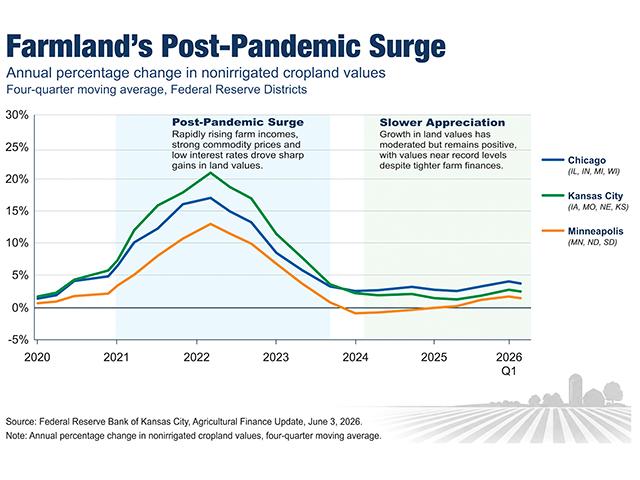
This winter's farmland auction market could be the busiest since 2022, as stronger grain prices and a less-uncertain trade environment coax sellers back to the market.
"This is probably the brightest outlook for the farm market that we've had in the past couple of years," says Doug Hensley, president of Hertz Real Estate Services, based in Nevada, Iowa, whose firm brokers land in Illinois, Iowa, Minnesota and Wisconsin. "This year, with a stronger grain market, I feel like that's giving a little bit of incentive for people who have thought about selling to push into the market."
Competitive bidding at auctions helped farmland values surge coming out of the pandemic, fueled by strong commodity prices, rising farm income and low interest rates. Corn Belt cropland values climbed nearly 22% from 2021 through 2023, according to USDA. Values have continued to increase since but at a much slower pace, as farm incomes retreated from their 2022 peak. Brokers say sellers shifted sales away from public auctions toward private sales and sealed-bid sales.
Jim Rothermich, vice president at Iowa Appraisal, based in Des Moines, Iowa, says year-to-date auction acreage through the end of August reached nearly 55,000 acres for his business. That's similar to the pace set in 2022 and into 2023, when Rothermich's business saw a 68% increase in auction volume.
It's also a reversal of three consecutive years of declining volume for his business.
"There was a lot of talk about tariffs and a lot of negative ag news media out there," he says, adding that most of that has been worked out in the market. "Sellers are feeling good about this market, and they wouldn't be selling right now if they weren't. I could see us having a run."
A DIFFERENT MARKET
While brokers see auction activity moving closer to 2022 levels, the dynamics driving today's market differ significantly from the 2021-2022 surge, says Howard Halderman, president of Halderman Farm Management Services, based in Wabash, Indiana. He's a broker licensed to sell in Georgia, Indiana, Illinois, Kentucky, Michigan and Ohio.
P[L1] D[0x0] M[300x250] OOP[F] ADUNIT[] T[]
That period was driven by record farm income and near-zero interest rates, Halderman says, leading to a 40% jump in land values across parts of the Corn Belt.
"Back in '21 and '22, you just bought whatever was available," he says. "But, not today. Today, we have higher interest rates. We have very tight, if not below, break-even farm incomes. And, the big thing -- the big positive -- has been we haven't had an oversupply of sales."
Buyers are now more selective and more willing to walk away from a below-average piece of ground, Halderman adds.
AUCTIONS TAKE THE LEAD
All three brokers say they expect public auctions to dominate farmland sale activity in the fourth quarter of 2026.
"Public auctions are a great method of sale when you have a really strong market," Hensley says. "How many buyers does it take to sell a farm through a brokered sale arrangement? It only takes one. Whereas it takes at least two to make an auction go."
Halderman says private transactions still are the best tool for unique or "heavily improved" properties, because the pool of competitive buyers is thin.
LITTLE SIGN OF DISTRESSED SALES
Although the agriculture economy continues to see signs of stress, especially among farmers who rely heavily on cash-rented acres, the brokers say the pressure hasn't pushed more farmland into the market.
"It's not enough to move the needle on volume," Rothermich says.
A new database from the National Agricultural Law Center shows that from January 2021 through June 2026, 1,401 ag bankruptcy filings were made. That includes 340 in 2025, and at the current pace, filings could rise above 475 in 2026, according to the database.
"I think some of the operations that are under the most stress are probably the really heavy cash-rent operations that have been very aggressive," Hensley says. "I don't think they are typically the landowners."
Halderman says any sales volume sparked by financial distress is more likely to occur in early 2027.
"What could happen is that we get to November, and yields weren't what they hoped. They start to talk operating lines for next year, and their lender says, 'We need to generate more liquidity.' Those kind of discussions, I think, could drive more sales in the first quarter."
**
-- Follow Todd on social platform X @DTNeeley
[PF_1126]