


Technically Speaking
Is the Wheat Futures Selloff Nearing the End of the Bearish Road?
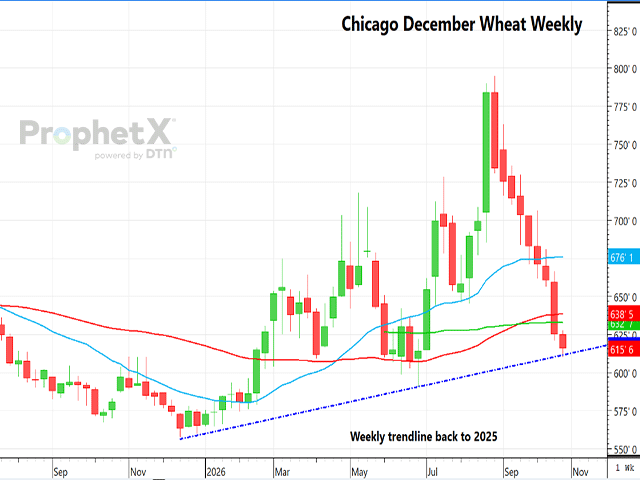
Since the week of Aug. 24, Chicago December wheat has now fallen $1.80 per bushel. The break comes despite the U.S. winter wheat crop falling to the lowest level in some 50 years at a time when world wheat production was also falling significantly. This happened at a time when the Russia-Ukraine war, now going on for four and a half years, expanded with mutual drone and missile attacks on port and energy structures and even vessels in the Black Sea. The resulting increased hostilities had and still have the impact of reducing Black Sea wheat exports to 40-50% of normal. One would think that would automatically shift at least some demand to the U.S. So far, that has not been the case, with U.S. exports roughly 35% lower than a year ago. Adding to the bearish pattern has been recent talk of the U.S. and European countries urging more peace talks and a restart of Black Sea shipping.
The break saw funds liquidate what was a net long in Kansas City wheat while increasing their bearish bet on Chicago wheat. Fund watchers at the start of Tuesday's trade figure managed money funds are now net short close to 65,000 contracts of Chicago wheat.
P[L1] D[0x0] M[300x250] OOP[F] ADUNIT[] T[]
The wheat market is extremely technically oversold, which sometimes means little in a strongly trending market (which we certainly have). However, the oversold nature of the market when combined with December falling to a weekly trendline, which began in December 2025, should surely slow the selling down or encourage profit-taking. Although technical signals are hardly an exact science, without a solution to the ongoing Black Sea fiasco, I would expect wheat to stabilize, if not rally, from these depressed levels as world wheat importers move buying ideas to alternate origins, and hopefully the U.S.
CHICAGO DECEMBER CORN DAILY:December corn futures join Chicago wheat in being nearly as technically oversold. However, corn has a little thing to contend with called harvest. With 40% of the corn harvest left to go, including a large portion of Iowa, there could be more harvest pressure ahead with roughly 6.3 billion bushels (bb) yet to be combined.
December corn is working on a fifth consecutive weekly decline. Since the last week of August, or less than two months, December corn has plunged $1.00 per bushel. This market is also oversold, and there appears to be good support on the weekly chart in the $4.45 to $4.50 range. Tuesday, Oct. 27, low at midmorning is $4.50 1/4. We have been saying the market is oversold, but all of the peace talk in the Black Sea, when coupled with the advancing harvest and heavy fund selling, has pummeled corn. However, since the middle of September, managed money funds have liquidated roughly 290,000 contracts (1.45 bb). My guess is funds will hold onto some of their net long ahead of what could be a weather issue for Brazil, with the Super El Nino pattern potentially leading to dryness there. Corn should also bounce or stabilize once harvest pressure subsides and if no solution is reached in the Black Sea.
**
Comments above are for educational purposes only and are not meant as specific trade recommendations. The buying and selling of commodities, futures or options involve substantial risk and are not suitable for everyone.
Dana Mantini can be reached at Dana.Mantini@dtn.com
(c) Copyright 2026 DTN, LLC. All rights reserved.

