


Two Neighboring Ohio Farmers Lead U.S. Corn and Soybean Growers
Next-Door Leadership
Southwest Ohio is known for productive farmland, strong markets and some of the state's highest corn yields. It has also cultivated a deep bench of agricultural leaders.
One-year, member-elected terms typically place commodity association presidents in different corners of the country. In 2025-26, however, those paths converged in Ohio.
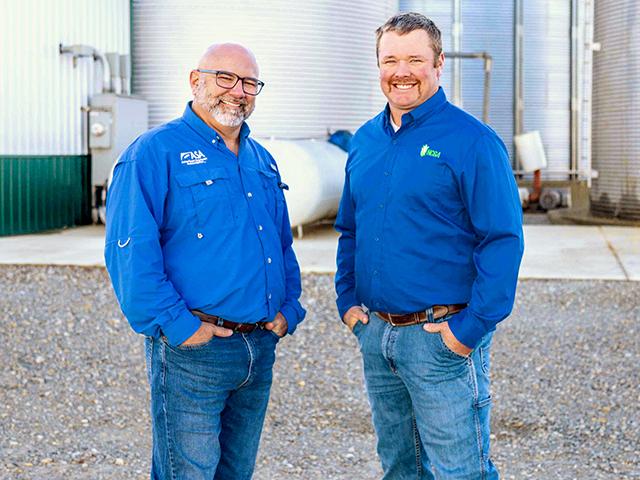
In the boardroom, Jed Bower and Scott Metzger lead two of the nation's largest commodity groups and represent farmers in the halls of power. Back home, they are neighbors, farming just 20 miles apart.
Bower, president of the National Corn Growers Association (NCGA), has spent the year advocating for fertilizer price transparency, expanded ethanol markets and keeping producers in business. He farms near Washington Court House, Ohio. Metzger, president of the American Soybean Association (ASA), has focused on the 45Z tax credit, trade access and solutions to strengthen the farm economy while raising crops near Williamsport, Ohio.
Their paths first crossed in leadership development programs as they were starting their careers, then again as young leaders in county meetings and on state boards. Now, they exchange ideas with Cabinet officials and White House advisers -- and occasionally share a rental car after a canceled flight home from Chicago.
Bower returned to farming in 2005 after serving in the U.S. Army. Metzger, a sixth-generation farmer, farms alongside three family members.
They aren't the first Ohio farmers to have overlapping presidencies. Nearly 25 years ago, Ohio farmers Tony Anderson and Fred Yoder led the ASA and NCGA, respectively.
Corn and soybean interests often overlap, but their proximity has helped build a relationship focused on solving problems. Bower and Metzger spoke with Progressive Farmer about their year of leadership, what it takes to speak openly about what growers need and finding a path forward for the farm economy.
Here's our conversation with the presidents.
(Editor's Note: Comments have been edited for clarity and context.)
P[L1] D[0x0] M[300x250] OOP[F] ADUNIT[] T[]
PROGRESSIVE FARMER: How does your background shape your approach to leadership?
JED BOWER: Being a smaller operation, there wasn't room for me on the farm when I got out of high school, so I joined the Army for six years. I came home from a deployment and helped Dad plant the crop in 2005. A week later, he passed away from a motorcycle accident. At 24 years old, I left the Army and started my career in farming. It strengthened me not to give up or back down from a fight.
As we have these fights now with input suppliers and margins being so out of whack for growers, I'm not afraid to take on that challenge or have those conversations. I feel it's my duty to call that out and do what we can to help fix a broken system.
PROGRESSIVE FARMER: How did you both meet?
SCOTT METZGER: Agriculture becomes such a small world so fast. Jed has become a friend of mine over the years through doing this. We both got started at the state level around the same time. One time, Jed and I ended up in Milwaukee, Wisconsin, on a panel together, and then our flights got canceled. Since we live so close, we rented a car and drove home together. We called it the "Planes, Trains and Automobiles" trip.
PROGRESSIVE FARMER: Do corn and soybean associations see issues differently?
BOWER: We respect that sometimes we're not on the same side of the fence on policy issues. But, we also understand that we both grow corn and soybeans, and our issues matter to both of us. Sometimes, they must be handled differently.
The number of acres we cover across the nation requires Congress to listen. We've heard for years that if you could get agriculture to come with one voice, you carry so much power. That was a conversation we had as we took over our respective organizations. Between the two of us, we represent about 180 million acres -- that kind of scale demands that somebody at least listens when we talk.
PROGRESSIVE FARMER: What has surprised you most about Washington this year?
METZGER: It's been very eye-opening. Sometimes, you take one step forward and two or three steps back. That's been a struggle with some of the issues we're constantly working on -- like the farm bill, trade opportunities or renewable volume obligations (RVO).
On the other hand, when Bayer developed Ruveon, its new glyphosate business, and then shortly afterward announced plans to impose countervailing duties on Roundup, we had the company's CEO at one of our meetings in Washington, D.C.
We had the opportunity to tell him, "ASA has supported you through all these lawsuits. We've been with you all the way." A couple of days later, they decided to drop those countervailing duties. It's little victories like that, that really make it worth doing. You know that you're helping farmers all over the U.S.
PROGRESSIVE FARMER: How has your approach to advocacy changed this year?
BOWER: We're in our fourth year of losses in the corn sector. Since I've taken over this year, I've taken a different path and shown a little more aggression. You can't apply Band-Aids anymore. We must fix this situation. Farmers and ranchers don't look at it as a job; it's truly a lifestyle. We look at things on a yearly and generational basis because we want to leave things better than we got them and make them more prosperous for the next generation.
PROGRESSIVE FARMER: What do you want farmers to know about commodity leadership?
METZGER: I want other farmers to know that we recognize and really look forward to hearing their input, whatever that may be. With the farm bill, there were several listening sessions, as well as sessions on the RVOs.
I want everybody to know that we do everything we can to make things better, whether that's improving the farm economy, working on input pricing or anything else. It may not look like there's a bunch going on from the outside, but there is -- it's usually constant chaos.
(Editor's Note: Bower's term ends in October 2026, Metzger's in December 2026, when both will move to the position of chairman for their respective organizations.)
**
-- Follow Jake on social platform X @jzajkow
[PF_1026]
(c) Copyright 2026 DTN, LLC. All rights reserved.