


Four Farmers Reveal Lessons From Cutting-Edge Tools
Tech Dollars Well Spent
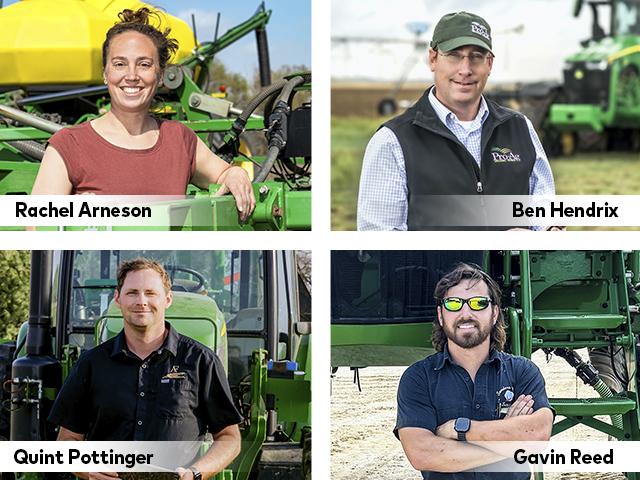
It's early June, and Gavin Reed is taking advantage of the first dry day in two weeks to spray weeds that rose a full foot tall in his cotton. His south-central Georgia farm runs a pair of John Deere 410R single-tank sprayers mounting Deere's See & Spray Precision Upgrade Kits.
It's his second year using See & Spray, and it's going smoothly now that he's found a workable way around one his biggest problems: The downward facing cameras struggled to identify weeds in nearly closed canopies of cotton and soybeans.
Reed didn't go through the problem-solving process just because he loves new agricultural technology.
"I needed 40% [herbicide] savings to pay for the See & Spray Precision Upgrade Kit. And, that first year, we had over 60% savings. So, it paid for itself within that first year," he says.
Like most farmers, Reed expects a clear return on every tech dollar -- higher yields, lower costs, real savings and enhanced ability to act when the time is right. Just as farmers have for generations, today's operators search, struggle and adapt new tools not for the wow factor but for the return. The goal is always the same: greater efficiency, resilience and long-term profitability.
Here are four farmers who bring that same discipline to every technology decision on their operations -- and the key moments that moved their farms forward.
GAVIN REED: ADAPT
Reed may be a sixth-generation farmer working the family's Sanders Farm Service Inc., outside Vienna, but there's nothing old-school about his approach. He's an avid hunter of technology and a self-described John Deere Operations Center junkie.
He regularly taps into Deere's cloud-based management platform called Harvest Profit, which helps him plan, execute and analyze the season, and is integrating Deere's Harvest Identification, Cotton Pro into his operation, which documents module production from the cab and tracks modules from farm to gin.
"I look for efficiency. Is it adaptable? Can I can make better yields, do more with less, upgrade it?" he asks.
In addition to data tools, Reed was an early proponent of See & Spray. He saw it as a much-improved tool for managing the last herbicide application of the season in cotton, or lay-by. Even with hooded sprayers -- which shield plants during the application -- lay-by is a laborious process that still damages cotton plants.
Reed's initial challenge with See & Spray was boom height. The See & Spray boom operates within specific height ranges. Weeds in a closing canopy environment may challenge See & Spray.
"We were trying to spray escape weeds when they got taller. You could physically see that the cameras were picking out the weeds, but the software would not allow enough boom height above the canopy and still do its job," Reed says. The sprayer would revert to its fallback mode -- pause the spraying activity or go full broadcast.
Deere created a software upgrade for the 2026 season to include a new "canopy" option. The canopy option uses the top of the observable crop as the base for setting crop height and adds an additional 47 inches above the canopy on the boom wings to achieve a good spray pattern and droplet distribution. The center frame still goes into fallback because of the fixed height of the chassis.
Deere's canopy option gives Reed the ability to treat his cotton and soybean crops later into the season -- at canopy -- targeting weed escapes and volunteer corn.
Reed already has an eye on new planter technology. Deere will release the ExactDepth electronic depth-control system technology for some planter models in 2027.
"We have precision planters," Reed says. "But, we still have to manually adjust our depth."
ExactDepth looks to allow farmers to make adjustments from the cab. "Right now, we can clearly see what that would have helped this year," Reed says. "We've got cotton in all different stages of life, and I'm attributing it to seed depth."
With any problem, "It is always adapt and overcome," Reed says.
RACHEL ARNESON: EFFICIENCY
"High efficiency is usually what gets my ear," says Rachel Arneson, who is the fifth generation to run Arneson Farms, in Halstad, Minnesota. She produces soybeans, wheat, corn and sugar beets.
P[L1] D[0x0] M[300x250] OOP[F] ADUNIT[] T[]
While Arneson returned to the farm full time in 2012, she was in junior high when her father took her to a local meeting to learn how to use new mapping software. "I quickly realized the expectation was that I was to become the steward of that technology," she says.
She still applies lessons she learned then to today's problems. "We can't just rely on a program to tell us what to do. We need to be able to ask the right questions and understand what any technology can and can't do. Will it be here in the long run?"
Arneson says asking the right questions about technology solved a costly deficiency in her air seeder. The seeder produced skips for years, and Arneson replanted them with a 10-foot drill. She credits her Deere dealer for recommending an upgrade to a third-party sensor package.
That fix generated a quick payback. "That first spring, the sensors were showing a section wasn't dropping seed," she says. "It saved me so much lost revenue had the skip not been discovered."
Efficiency gains were also apparent when she traded in an old sprayer with a 90-foot boom for an Apache sprayer, its 132-foot boom outfitted with Pulse Width Modulation (PWM). PWM brings individual nozzle control for greater precision compared to boom-section control -- which is especially effective in her irregularly shaped river bottom fields.
"Wow, we are able to cover a lot more ground more quickly, and therefore beat a rain event or an insect pressure event," she says. "When we're spraying our sugar beets for Cercospora [leafspot], we can get that done in a day versus stretching it out for two long days."
Arneson knows there are other technologies that would benefit her farm, but it has to pass her test. It has be the right fit for her farm, provide a calculable return on investment and be compatible with her current technologies.
Efficiency and timeliness don't only preserve yield, they give her more time for important things, like scouting and spending time with her young daughter. "Maybe you can even go to the lake with the family over the weekend," she says.
BEN HENDRIX: TRUTH
"We are eager to look at technological solutions that can help us be better farmers," says Ben Hendrix, CEO of Pro-Ag Organic Farms, in Wray, Colorado. "We start with a business case: What problem we are trying to solve?" Hendrix's operation runs along the Colorado-Nebraska state line and produces organic alfalfa, corn, popcorn, peas and cereals.
Up until a few months ago, Pro-Ag's big problem was that it was managed by spreadsheets -- one on top of the other, a confusion of varying versions. "There was no one truth," Hendrix says. He found the solution in a custom-built AI (artificial intelligence) platform.
Farmers receive a lot of paper source documents, he says, like weight scale tickets for the compost fertilizer or scale tickets and bills of lading when selling grain or forages.
"A year ago, we were hand-keying all those into spreadsheets and copying, pasting and managing multiple spreadsheets," Hendrix says.
It felt ancient.
Today, Pro-Ag works from its own farm enterprise resource planning (ERP) application. The operation's ERP app is a centralized platform connecting business processes -- finance, HR, supply chain and inventory -- into a single database. Its value is that it creates "one truth," eliminating multiple spreadsheets and data silos.
Picture Hendrix's ERP as a highly organized digital filing cabinet. Instead of consulting dozens of spreadsheets, everything lives together in one secure, searchable system. "It's extremely fast and good at connecting data," he says. "It's all key fields, it's related data, we can mix and match, and make our own reporting, and it's all in one spot.
"So, if we change a crop rotation, I change it in one place. It filters through everything so we're not managing a dozen spreadsheets, trying to remember which version of what we're working with," Hendrix adds.
The app allows the operation to match functions with external sources using application programming interfaces, or APIs.
"We are working with vendors on equipment and irrigation, bringing their data into our pool using APIs. It's wild on how much is changing and how quickly all this is moving," he says.
For example, Hendrix couldn't find a good way to analyze his farm's soil tests. "We test our soils every year, and our [records] go back to 2012. We've got soil tests on every field from then, but I couldn't match it to the fertility we were applying." The app brought the separate data sets together.
The app also creates Gantt charting, a management tool that visually illustrates schedules. Hendrix can see an entire season displayed in front of him. It shows timelines and conflicts, envisions equipment availability and adjusts for delays.
For his agronomists, Hendrix produces a weekly summary of conditions reports written by his crop scouts using the capabilities of the app.
"From that we have one single truth," he says. "What's getting fun is the number of bespoke solutions you can build for yourself that addresses problems specifically."
QUINT POTTINGER: POTENTIAL
Quint Pottinger took a giant swing at technology and used it as the lever to shed nearly $500,000 worth of iron from his operation, Affinity Farms, in New Haven, Kentucky.
Pottinger planted 900 acres of corn autonomously and, at last check in early June, was moving onto soybeans.
"My family has been farming this land since 1788, eight generations of American agriculture," he says. "Every generation addressed the challenges of their time. Our move to automation is much deeper than advancing technology in the ag industry or on the farm; it is about addressing structural shifts in the farm economy."
Autonomous farming is not something that simply satisfies Pottinger's inner geek. "I had to put money back into the farm," he says, convinced his equipment inventory would threaten the survivability of his farm. Working more acres was not an option. "Our goal was to try to return almost a half a million dollars back to the farming operation in equipment sales," he says.
Autonomy looked attractive. "If we can automate sections of the farm with smaller pieces of equipment, then we can eliminate this need to maintain a larger equipment fleet," he adds.
That became his strategy. Pottinger purchased a Deere 6130E tractor and JD1745 8/15 split-row planter. He purchased AGCO's PTx brand Precision Planting Gen3 20|20 monitor (performance and field conditions in real time) with Panorama (view data remotely). Pottinger spent $70,000 on an autonomy kit from Sabanto Inc. that included antennas, dual global navigation satellite system receiver, obstacle detection sensors and video cameras.
Pottinger sees tractor and planting alerts on his iPad. "We can see remotely exactly what the monitor displays and make changes remotely as we would on the monitor in the tractor."
Spring 2026 is actually "autonomous season" No. 2 for Pottinger. Last fall, he employed the Deere tractor and a 15-foot JD750 seed drill, also powered by Precision Planting and Sabanto, to autonomously plant 500 acres of winter wheat, cereal rye and barley.
That experience convinced him to sell a pair of 40-foot planters, two large-frame tractors and a combine. The combine was a surprise. "We found a point last fall where we could get one crop out [with one combine] and another crop in [autonomously]," he says. "This is the labor story of automation. With one tractor running remotely, we gained two guys -- a seed runner and tractor operator -- back to the harvest. We realized we didn't need the [capacity of an] extra combine."
Pottinger did learn one valuable lesson last fall. "It seems obvious now, but when we started, it was 'Let's get this thing running and address fuel, seed and maintenance as needed,'" he says. But, that was full of logistical inefficiencies. Toward the end of fall planting, Pottinger began setting acre limits to match seed with fuel needs and general machinery maintenance.
Pottinger's goal is not to run around the clock. He wants to set up planting times for maximum efficiency -- in central Kentucky, those times can differ drastically from day to day.
"Our goal is to take advantage of the most efficient planting window. If that means starting at 8 a.m. and stopping at 10 p.m. one day, and starting at 2 a.m., stopping at noon another, then so be it," he says.
Pottinger is one of a few dozen farmers in the U.S. who planted crops this spring without a human operator working from the cab of the tractor.
"I'm not sure where autonomy takes us in the next five years," he says. "What I know today is that the shift returns the needed and necessary capital back to the farm to build food systems our community is demanding. For us, this is not about eliminating labor or [capital expenditure]. It's about using the technology to leverage them both into something that will benefit our neighbors and community."
**
-- Mark Moore contributed to this story.
-- Follow Dan Miller on social platform X @DMillerPF
[PF_0826]
(c) Copyright 2026 DTN, LLC. All rights reserved.