


USDA Cattle on Feed, Inventory Reports
July 1 Cattle on Feed Up 2% From Year Ago; July 1 Cattle Inventory Up Slightly
This article was originally published at 2:11 p.m. CDT on Friday, July 24. It was last updated with additional information at 2:49 p.m. CDT on Friday, July 24.
**
OMAHA (DTN) -- Cattle and calves on feed for the slaughter market in the United States for feedlots with capacity of 1,000 or more head totaled 11.4 million head on July 1, 2026. The inventory was 2% above July 1, 2025, USDA NASS reported on Friday.
The inventory included 7.12 million steers and steer calves, up 3% from the previous year. This group accounted for 63% of the total inventory. Heifers and heifer calves accounted for 4.25 million head, up slightly from 2025, USDA said.
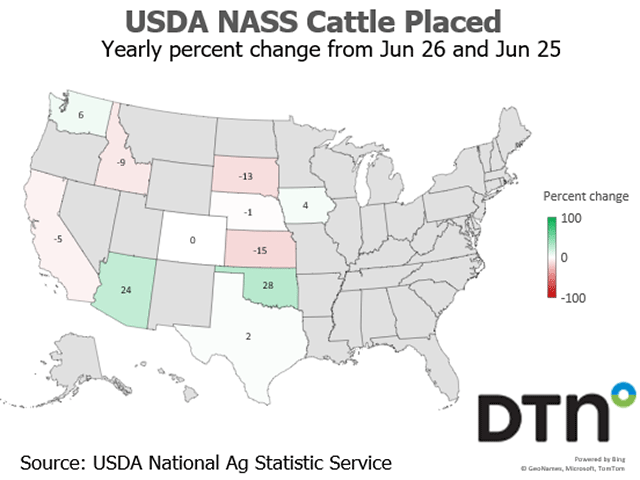
Placements in feedlots during June totaled 1.40 million head, 3% below 2025. Net placements were 1.35 million head. During June, placements of cattle and calves weighing less than 600 pounds were 325,000 head, 600-699 pounds were 225,000 head, 700-799 pounds were 300,000 head, 800-899 pounds were 309,000 head, 900-999 pounds were 160,000 head, and 1,000 pounds and greater were 80,000 head.
Marketings of fed cattle during June totaled 1.66 million head, 3% below 2025. Marketings were the lowest for June since the series began in 1996, USDA said.
Other disappearance totaled 50,000 head during June, 6% below 2025.
DTN ANALYSIS OF CATTLE ON FEED REPORT
Friday's Cattle on Feed report will likely be viewed by and absorbed by the market as a neutral report, DTN Livestock Analyst ShayLe Stewart said following the report's release.
"From a 'logistical' point of view, someone could argue that the report should be found as bearish, given that the U.S. beef cow herd sits at a historic low. Yet, at the same time, we are slowly building up increased inventory in the feedlot sector as cattle are being fed to greater weights and as they're spending more time on feed.
P[L1] D[0x0] M[300x250] OOP[F] ADUNIT[] T[]
"But traders seem to only look at one thing, and that's whether or not the pre-report data varies from the actual data released. And given that the pre-report estimates were nearly spot on, it's likely that Friday's COF report will be glanced at and given little afterthought, and traders and cattlemen alike will likely spend more time mulling over the Cattle inventory report.
"The only specific line item that is worth noting from the report is that all of the placement weight classes were lighter than compared to a year ago, except those weighing under 600 pounds, which was up 5,000 head than compared to the June 2025 data. This is likely a result of cow-calf producers needing to sell and market their calves earlier than in years past as a vast majority of cattlemen in the West continue to struggle with drought conditions."
**
JULY 1 CATTLE INVENTORY UP SLIGHTLY
All cattle and calves in the United States on July 1, 2026, totaled 94.2 million head, slightly above the 94.0 million head on July 1, 2025, USDA NASS reported on Friday.
All cows and heifers that have calved totaled 38.1 million head, unchanged from the 38.1 million head on July 1, 2025. Beef cows, at 28.5 million head, are down 1% from a year ago. Milk cows, at 9.65 million head, are up 2% from the previous year.
All heifers 500 pounds and over on July 1, 2026, totaled 14.7 million head, 1% above the 14.6 million head on July 1, 2025. Beef replacement heifers, at 3.80 million head, are up 3% from a year ago. Milk replacement heifers, at 3.60 million head, are up 3% from the previous year. Other heifers, at 7.30 million head, are 1% below a year earlier.
Steers 500 pounds and over on July 1, 2026, totaled 13.9 million head, up 1% from July 1, 2025.
Bulls 500 pounds and over on July 1, 2026, totaled 1.90 million head, unchanged from the previous year.
Calves under 500 pounds on July 1, 2026, totaled 25.6 million head, unchanged from a year earlier.
Cattle and calves on feed for the slaughter market in the United States for all feedlots totaled 13.2 million head on July 1, 2026, up 2% from the previous year. Cattle on feed in feedlots with capacity of 1,000 or more head accounted for 86.1% of the total cattle on feed on July 1, 2026, up 1% from the previous year. The total of calves under 500 pounds and other heifers and steers over 500 pounds (outside of feedlots), at 33.6 million head, is down 1% from the 33.8 million head on July 1, 2025.
CALF CROP DOWN 2%
The 2026 calf crop in the United States is expected to be 32.5 million head, down 2% from last year. Calves born during the first half of 2026 are estimated at 23.9 million head, down 2% from the first half of 2025.
An additional 8.60 million calves are expected to be born during the second half of 2026.
DTN ANALYSIS OF CATTLE INVENTORY REPORT
"Friday's Cattle inventory report will likely be absorbed as a mixed to slightly bearish report, as the two big line items (the total number of beef cows and the total number of beef replacement heifers) were revealed to be in opposite directions," Stewart said.
"The total number of beef cows totaled 28.5 million head, which was down 1% from a year ago (a bullish finding). But the total number of beef replacement heifers totaled 3.80 million head, which is up 3% from a year ago (a bearish note to mark).
"When we step back and think about the data and how it fits into the grand scheme of the market, both line items seem logical. It's likely that the total number of beef cows hasn't increased, as many producers in the western part of the U.S. continue to struggle with drought conditions or are struggling to find a way to afford hay for this upcoming winter.
"But on the opposite side of the spectrum, there have also been those who have been blessed with rollover feed and know that opportunity lies ahead in the market for those with young stock. Whether that's to keep the young females as replacements for their own operation or to have them to market when the time is right -- it's fun to have an ace in the hole when the pot is building.
"Therefore, it's likely that Friday's July 1 Cattle inventory report will be absorbed as either a neutral or somewhat bearish report, simply given the uptick in beef replacement heifers."
**
DTN subscribers can view the full Cattle inventory and Cattle on Feed reports in the Livestock Archives folder under the Markets menu. The report is also available at https://www.nass.usda.gov/….
| USDA Actual | Average Estimate* | Range | |
| On Feed July 1 | 102% | 102.2% | 101.1-102.5% |
| Placed in June | 97% | 98.0% | 93.7-99.8% |
| Marketed in June | 97% | 97.0% | 94.9-98.0% |
| * Estimates compiled by Dow Jones | |||
**
| U.S. Cattle Inventory by Class and Calf Crop -- July 1, 2025, and 2026 | |||
| Class | 2025 | 2026 | Percent of |
| (1,000 head) | (1,000 head) | Previous year | |
| Cattle and calves | 94,000 | 94,200 | 100 |
| Cows and heifers | |||
| that have calved | 38,100 | 38,100 | 100 |
| -- Beef cows | 28,650 | 28,450 | 99 |
| -- Milk cows | 9,450 | 9,650 | 102 |
| Heifers 500 pounds and over | 14,600 | 14,700 | 101 |
| -- For beef cow replacement | 3,700 | 3,800 | 103 |
| -- For milk cow replacement | 3,500 | 3,600 | 103 |
| -- Other heifers | 7,400 | 7,300 | 99 |
| Steers 500 pounds and over | 13,800 | 13,900 | 101 |
| Bulls 500 pounds and over | 1,900 | 1,900 | 100 |
| Calves under 500 pounds | 25,600 | 25,600 | 100 |
| Cattle on feed | 13,000 | 13,200 | 102 |
| Calf crop | 32,995.6 | 32,500 | 98 |
(c) Copyright 2026 DTN, LLC. All rights reserved.