

Steps To Reverse Unproductive Salinity Soils
Revitalize Unproductive Salty Soils
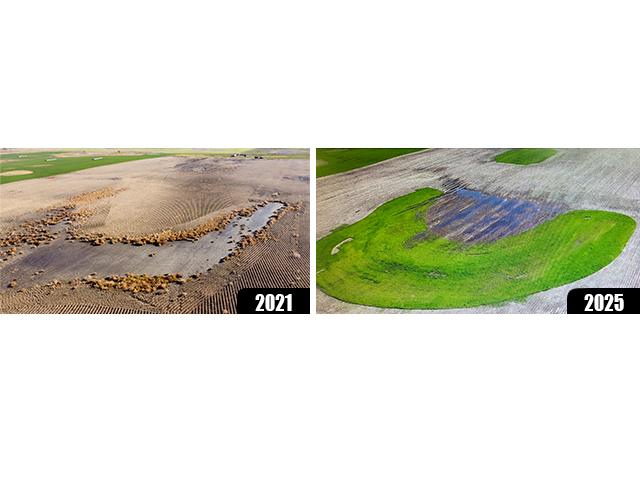
Tilling and planting through salt-crusted soils in hopes of gaining some yield is mostly a fool's errand, especially in the Dakotas. It just expands nonprofit acres.
North Dakota crop consultant Lee Briese talks of high-salinity areas as "lean acres." He compares these inefficient, barren soils to keeping workers who consistently fail to show up to work. Both are inefficiencies that shouldn't be tolerated in a farming operation. These lean, unproductive acres persist across 14 to 15 million acres in the Dakotas.
Fortunately, farmer experiments and on-farm soil data research show that these salty sea remnants can be pushed deeper into the soil, allowing plants to begin to grow again.
To succeed with recovery, soil salinity areas require patience, salt-tolerant perennial plants and a soil-health mindset. "Given the proven results we've seen on the Cain Creek farm, I believe more producers will reclaim their land if they latch onto this opportunity," says Kent Vlieger, state soil health specialist, NRCS South Dakota.
PREHISTORIC BEGINNINGS
These ancient salts were left behind in shale and sediments when the Western Interior Seaway that split North America receded 65 to 70 million years ago. The natural salts can rise from deep in the soil profile to the root zone and the soil surface during dry periods because of capillary rise and evapotranspiration.
To reduce capillary rise of salts, it's critical to maintain plants with root depth diversity and growth beyond the corn/soybean cropping cycle -- one of the principles of building soil health.
Without plants to use and transpire moisture, salts will rise and accumulate, turning once-productive soils into dying, barren nonprofit acres. And, without healthy soils with reasonable infiltration rates, even rainfall can't push salts back down the soil profile.
P[L1] D[0x0] M[300x250] OOP[F] ADUNIT[] T[]
RESEARCH PROVES SOLUTIONS
Most farmers know precisely where these salty, unproductive areas exist in their fields, especially if they're only seeing weeds that tolerate higher saline levels, like kochia, prairie cordgrass or foxtail barley. Such was the case on the 400-acre Cain Creek Demonstration Farm, owned by the Beadle County Conservation District, near Huron, South Dakota.
Beadle Conservation District bought this degraded cropland to showcase grass pasture and no-till crop plot rebuilding projects. Vlieger has worked with the district board and the producer to remediate a low-production 12-acre area.
"In 2015, we began to reseed this 12-acre plot with salt-tolerant hybrid green wheatgrass (AC Saltlander) and alfalfa (SalinityMax) knowing it may take up to a decade to push the salt down in the soil profile," he says. "The plan was to use it as hay ground. The challenge was that nothing was growing, and the soil tests in the top 6 inches showed extremely high salinity. The electrical conductivity (EC) reading was 31, almost eight times higher than a 4 EC, which is considered a saline soil."
Just four years later, the extreme salinity had dropped from 31.1 EC to 1.8 EC. As plant growth and root depth improved soil health each year, alfalfa/grass production increased from 1,400 pounds per acre (one 2015 hay cutting) to 15,400 pounds per acre (three 2019 cuttings).
"The plant growth success achieved on saline soils at Cain Creek provides hope for many producers with saline issues. By adopting this practice, soils, crops, livestock and wildlife can benefit," Vlieger says.
To learn how the salt moved within the soil profile, soil samples were collected from the zero- to 6-inch and 6- to 24-inch zones. Over the years, Vlieger watched as the perennial plants' establishment and growth used more water, improved soil structure and increased water infiltration.
"As salt levels in the zero- to 6-inch layer decreased, the subsequent years saw increased salts in the 6- to 24-inch zone. Several years later, the salt levels were even moving deeper than 24 inches where we were testing," Vlieger says. "Essentially, we've watched in slow motion how these salts were pushed down below the crop germination and growth zones. Today, the plot could realistically return to row crops if cover crops are used to armor the soil and keep roots growing between cash crops."
GROWERS BEAT SALINITY
Thirty miles northwest of the demo farm, brothers Jeff and Scott Hamilton began 20 years ago their journey to reduce saline soil. They couldn't raise any crop in their saline spots, and the areas kept expanding on their farm, near Hitchcock, South Dakota.
Rather than continue to invest valuable input dollars across these nonprofit acres, the Hamiltons started seeding a saline-tolerant wheatgrass mix in 2016. Given the slow emergence, they decided to add Garrison creeping foxtail and SalinityMax alfalfa.
This new mix became so prolific in saline soils that nearby Millborn Seeds named this blend "The Hamilton."
"Multiple species really helped us overcome salinity and sodic soils, high pH and saturated soils," Jeff Hamilton says. "After three years, we were cutting 3 to 3.5 tons per acre of quality forage in areas that hardly grew weeds."
Another critical piece learned along this journey to reduce these white desert areas is to seed beyond the edges of salinity. "We had the best success when we made several drill passes upland from the low saline spots to intercept and use the water before it drains into and expands the low saline spot," Hamilton says.
The brothers believe their system has overcome the broken water cycle caused by the monoculture corn/soybean rotation, which uses water for only five months of the year.
"Having living plants/roots/biology, and allowing the plants to be removed with periodic haying or grazing is very important in the remediation of these areas," Hamilton says. "We have seeded Japanese millet, cereal rye, Italian ryegrass, barley and have even let kochia grow and then cut it while vegetative. All these plants tolerate salt well and speed up the remediation process."
Hamilton admits it took a mindset change and realizing longer-term thinking was needed to overcome some of the short-term ag policies that have contributed to the expansion of these areas. "We encourage other producers to apply management that needs to go beyond the scope often limited by acres that are covered by crop insurance or CRP [Conservation Reserve Program]," he says.
[PF_061026]
(c) Copyright 2026 DTN, LLC. All rights reserved.