


Postseason Maintenance Routine Keeps Planter Running Smoothly
Postseason Maintenance Puts Bushels in the Bin
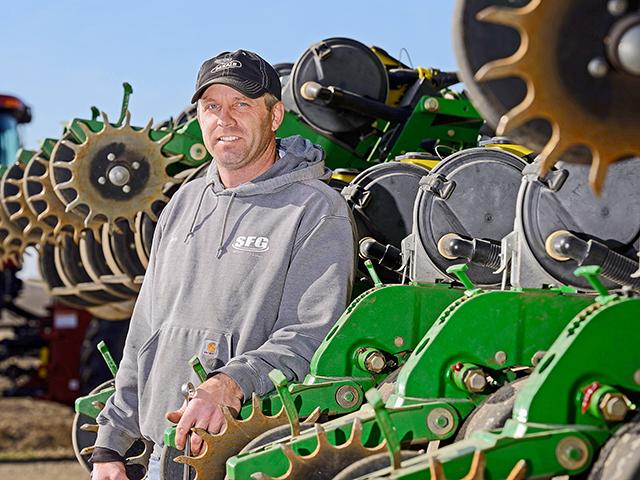
Shortly after field activity slows down and his corn is sidedressed, Iowa no-tiller Kevin Smith has an annual maintenance date in the shop with his planters.
"I like to get the planters ready to go again as soon as we quit using them for the year while everything about the planting season is still fresh in my mind," Smith explains. "I've developed my own postseason maintenance routine and try to keep the planters as close to factory specifications as possible."
An ardent proponent of precision agriculture, Smith says he wants a "picket fence" corn stand, and keeping his planters in top shape is the way to ensure his investment in precision-farming tools translates into consistent corn yields in the 240-bushel-per-acre (bpa) range. Last year, he binned 242 bpa of corn on his 6,100-acre farm, near Knoxville, Iowa, where he splits his production 50/50 with no-till corn and soybeans. His soybean yield average was 73 bpa.
For corn planting, he uses a 24-row Harvest International toolbar decked out for high-speed operation with a full complement of Precision Planting systems, including DeltaForce Downforce Control, SpeedTubes, FurrowForce Closing System and frame-mounted Reveal residue managers. Soybean-planting chores are split between a 40-foot Case IH 2140 16/32 split and a 60-foot Case IH 2160 set up to plant 36 20-inch rows.
"The 2140 has Precision Planting's CleanSweep and DeltaForce so I can plant corn if I get in a bind, but it's not a high-speed planter," he says. "The 20-inch planter has in-cab-controlled pneumatic downforce but otherwise is a basic Case IH setup."
MAKE THE INVESTMENT
Smith says he'll spend a minimum of about two days each and, on average, $1,000 to $5,000 per planter for parts each year, depending on whether he must replace disc openers.
"It may seem like a lot to some people, but to ensure a uniform stand emergence, all systems on the planter have to be running as they were designed," he says. "I know how important it is to have a planter running at 100%. If it's not, it's costing me yield."
Smith says his maintenance routine changed significantly when he replaced planters equipped with roller chains for those with electric meters and singulation.
"Now, we remove all the seed discs to clean and inspect them before spraying them with dry graphite. We also check the rubber seals on the meters and singulators.
"We check all the closing wheels and their linkages for play and alignment, and check all trash wheels for bearing wear," he continues. "While we're at it, we inspect all hydraulic hoses, then check disc openers, looking for the proper gap and diameter measurements, along with disc scraper condition as they wear."
CHANGE IN TIME
"Disc openers are 15 inches new and can wear down to 14.5 inches before they are out of specs," he explains. "We tend to replace them before they get to that 14.5 measurement. Normally, we inspect them throughout the planting season, but whenever we replace a disc opener, we always include new scrapers with it.
"After planting, we also take special pains to make sure certain gauge wheels are tight and within specifications to disc openers while we're working under the planter."
Smith says his motto is: "If you're not sure if you should replace something on a planter, you probably better replace it during the off season."
His maintenance list includes careful inspection of all row-unit parallel linkages and repairs, where needed.
On the high-speed planter, Smith looks at each SpeedTube for wear or damage, and replaces them, as needed.
"We normally replace them once a year, but we always check to make sure they aren't missing any flights and that the feeder wheels are in good condition," he explains.
P[L1] D[0x0] M[300x250] OOP[F] ADUNIT[] T[]
On the other planters, Smith pulls all seed tubes to remove debris and dirt, and to inspect them for wear or replacement.
OFF-SEASON ROUTINE
Postseason maintenance also includes oil and filter changes on air compressors and systemwide checks for air leaks and potential problems developing with electrical wiring.
"On the planter equipped for liquid application, I always clean all the screens, flush the tank and winterize it before we store the planter," he says.
Before the seasonal planter maintenance session ends, Smith ensures each grease fitting will take grease and checks a host of "little things" -- from fasteners to flex points right down to the proper air pressure in the tires.
"The strict maintenance regime cuts down the number of surprises we have at planting and helps us take advantage of the yield potential we buy in every bag of hybrid," he says.
"When we take the planters out of the barn in the spring, all I have to do is do monitor updates and check the tire pressure," he says.
Smith's preplant routine on his monitor updates includes deleting all seed prescriptions, along with old boundaries and nutrient application maps.
"I start fresh each spring, even if nothing's changed, I reload all of our field boundaries and prescriptions so the planter won't be planting where it is not supposed to plant. If we add new farms or boundaries, we add those before planting."
MAINTENANCE ROI
Phil Jennings, service manager at Kinze Manufacturing, says growers have become more aware that the mechanical condition of their planters has a direct bearing on their bottom line. He cites the significant number of growers taking advantage of off-season maintenance plans and parts sales.
"Looking at off-season planter maintenance from a dollars and cents standpoint, it's pretty easy to sit down with a dealer and do the math about the cost of rebuilding a planter," he explains. "I can easily spend $300 to $400 per row to install disc openers, tube guards and work the meters, and that's nearly $7,000.
"But, when we look at what that costs over the number of acres farmed, you have a different perspective on the cost of that overhaul," he says. "If I'm amortizing that $7,000 over 2,500 acres, that's nearly $3 per acre. What's my risk if I don't make that expenditure?"
Jennings says growers can easily amass a 3 to 5% yield reduction because of inconsistencies in seed-to-soil contact, seed spacing and depth control -- all directly attributable to the mechanical condition and adjustment of the planter.
"Even at today's prices, a 5% yield loss costs far more than the $7,000 investment in your planter to correct those problems," he says. "It just shows planter maintenance is cheap insurance."
Jennings says growers should use their own experience along with manufacturer maintenance guides to develop a "hitch pin to closing wheel" year-end maintenance routine -- and follow it.
CHECKLIST
"Following a set checklist will help combat complacency," Jennings explains. "Let's face it, no matter what color planter you're pulling, there's been no major changes recently in terms of general mechanical design and soil-engaging technology. It's easy to start thinking, 'We've had this planter five to seven years and are very comfortable with it.' But, did you check the bearings on the transport wheels? Are your row unit openers within specifications? Are the lights and flashers working? What about flex points and pivot points?"
Similarly, David Brennan, planter marketing manager for CNH, says a planter's job is to put seed in the ground as consistently as possible across its width to ensure the plants in every row emerge at the same time.
"As soon as that expensive hybrid is placed in the seed slot, it's being dinged by risk factors which cost yield. For a crop to get the best start, consistency is a must," he says.
"If you have worn openers, replace all of them across the planter to maintain consistency in performance of all your row units," Brennan continues. "Also, when you're working on row units, index them. If you have unit No. 1 set at 1.5-inch seeding depth, make sure Rows 2 through 16, or 24 are indexed to it. If some are shallower than others, you won't have a consistent emergence."
THE DIGITAL CHECKUP
Since a big part of a planter's performance in precision agriculture comes from electronic controls, "digital checkups" are also important, Brennan and Jennings agree.
"Various electronic and digital components of the tractor/planter unit should be checked for proper function, as well as ensuring one is using the current versions of operating software," Jennings says. "Most precision companies are providing regular updates, so visit with your dealer to stay current."
Brennan says the digital revolution has rapidly changed the way growers, dealers and software companies interact. Card-swapping and tech visits have been largely replaced by wireless data transfers.
"Our operating manuals, Case IH Productivity Guides and the local dealer are always great resources; however, virtual help from sites like YouTube are how we are communicating service tips to growers today," he explains. "We have a very effective 'How-To' section on our Case IH YouTube channel for each and every subsystem on the planter, as well as for display operation."
Brennan says advancements in precision agriculture have placed increased attention on the work of the planter.
"We're essentially farming by seed today," he explains. "If you're planting 34,000 seeds per acre over an 80-acre field, that's 2.7 million seeds. We're no longer farming 80 acres. We're farming 2.7 million seeds.
"To do that on a cost-effective basis with today's very slim margins, every component of the planting process must be working properly."
PLANTER MAINTENANCE CHECKLIST:
1. Check for bearing play, and ensure hardware is tight.
2. Check seal on vacuum meters.
3. Update planter operating system.
4. Check meters for wear.
5. Check planter drive components, if applicable.
6. Check for wear and adjustment to ensure proper seed singulation.
7. Check seed discs for wear.
8. Check for seed firmer wear.
[PF_061026]
(c) Copyright 2026 DTN, LLC. All rights reserved.