



Missouri Farmers Use 15,000 Volts to Zap Herbicide-Resistant Weeds Out of Existence
Amped-Up Weed Control
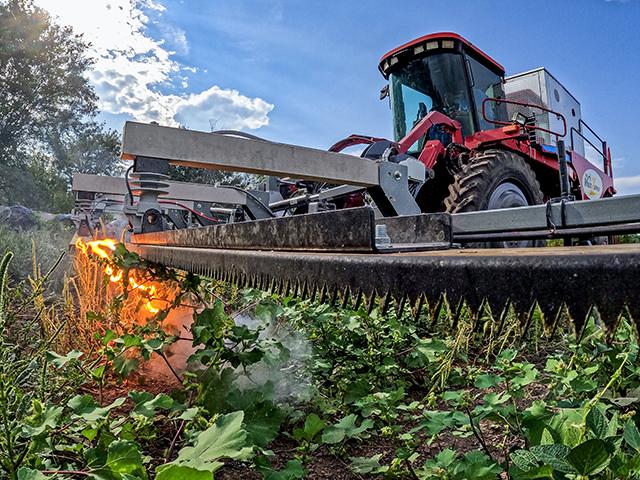
The sounds "snap, crackle, pop" may be most associated with breakfast cereal, but on a mid-September afternoon in west-central Missouri, it was weeds in a soybean field that were getting crispy. The marestail snapped, the cockleburs crackled and the pigweeds popped as Ben Kroeger delivered 15,000 volts of weed-killing current to those that dared to rise above the crop canopy.
Kroeger is co-owner of Old School Manufacturing, makers of The Weed Zapper brand of electrical weeders. While using electricity to kill weeds isn't a new concept, and other companies around the world sell similar machines (see "ELECTROCUTION SOLUTIONS," below), what makes The Weed Zapper unique is that it was developed by Missouri farmers whose own search for a weed-control solution sparked the growing family business.
FROM HOGS TO HIGH VOLTAGE
Generations of the Kroeger family have been involved in farming. Ben's grandfather, Sonny, was a row-crop farmer and pork producer for more than 50 years. His father, Tony, also had a farrow-to-finish hog operation but eventually left agriculture behind after starting a commercial heating, ventilation and air-conditioning (HVAC) business in the late 1980s.
Ben and his brother, Mike, joined their father's HVAC and electrical company in 2007, but they also farmed about 300 certified organic acres together on the side.
"When you're certified organic, it's not a matter of if you'll have weed trouble. It's a matter of when," Ben says. "We were looking for new solutions. Then around 2016, Mike came across an article talking about how the railroads tried electricity back in the late 1800s to keep their tracks clear. We said to ourselves, 'Hey, we know a little about electricity and a little about farming. Let's see if we can put both of them together and learn something.'"
As the Kroegers started building their own electric weeder, they discovered that another farming family in Illinois had already started down that road. So, rather than recreate the proverbial wheel, Ben says they called and inquired about buying a unit.
"They told us they'd never actually sold one. They just had a prototype, and it wasn't for sale," he recalls. "That was kind of the end of the phone conversation."
Two days later, however, Ben's phone rang. The narrative had changed.
"They had a patent pending and said they were willing to sell us the prototype if we bought the whole business," he says. "Three weeks later, we were in Illinois bringing that machine home."
The Kroegers established Old School Manufacturing in 2017 and sold the first Weed Zapper in 2018. In the years since, they've sold nearly 700 units in the United States, as well as Argentina, Canada, France, Germany, Italy and Romania.
WEED-WHACKING WATTS
The original Weed Zapper, which the Kroegers dubbed the Annihilator Series, consists of an electrode boom and tractor-mounted cart containing a generator and transformer. The tractor's PTO spins the generator to create electricity, which is then stepped up through the transformer and fed as a positive charge to the electrode boom. Coulters contact the soil and ground the machine. When the electrode touches a weed, it completes a circuit, sending as many as 15,000 volts through the plant -- enough energy to power five or six all-electric homes. The electricity causes moisture in the weed to expand, rupturing cell walls and leading to plant death.
The Weed Zapper Terminator Series is the company's self-propelled line of high-clearance machines that allow for later-season weed control. They operate with the same principles for electrocuting weeds, but the system has a dedicated engine for producing power. All Weed Zappers are equipped with redundant systems to ensure safe operation.
The system is nonselective, which means that if it touches a plant -- whether it be a weed or the cash crop -- it can deliver a lethal dose of electricity. Ben says they suggest running the boom about 3 inches above the crop. While operating at that height won't contact every weed, research has found the system to be highly effective at killing the weeds that it does touch.
Weed scientists at the University of Missouri found that The Weed Zapper provided greater than 95% control of weed species such as waterhemp, marestail, common ragweed and giant ragweed in soybeans when the weeds were above the crop canopy. They also found that electrocution decreased weed seed viability by 54 to 80%, depending on the species, reducing the number of future weeds from sprouting from the seed bank.
Farmers who've used the machines offer similar success stories. Jim Jacobs operates Thistledown Farms, a 350-acre operation raising certified organic corn, soybeans, wheat and sunflowers near Napoleon, Ohio. He purchased a Terminator Series Weed Zapper four seasons ago and shared his experiences with the machine during a webinar hosted by the scientist-led GROW (Getting Rid of Weeds) network in 2025.
P[L1] D[0x0] M[300x250] OOP[F] ADUNIT[] T[]
"The three weeds I battle consistently are common foxtail, Canada thistle and giant ragweed," Jacobs says. "It's hard to even imagine or comprehend unless you've seen it in person, but if you make one pass through the field, through the giant ragweed, by the time you turn around and start heading back the other direction, those ragweeds are already doubled over and starting to die."
Aaron Cooper, of Cutfresh Organics, in Eden, Maryland, also participated in the GROW webinar. He runs an Annihilator Series Weed Zapper on his 450-acre farm, where he grows certified organic corn, soybean, barley, sorghum and fresh market green beans. He says they were struggling with increased weed pressure and bought the electrical weeder to turn the tide.
"It was just one more tool in the toolbox to increase our timing and our ability to get after these weeds," he says. "Now, I have all the tools I feel like I need."
While the system has been popular with organic farmers, interest continues to grow among non-GMO and even conventional farmers who find themselves battling herbicide-resistant weeds such as waterhemp and Palmer amaranth.
"We sold a unit to a guy farming down in Arkansas this past season growing 100% conventional soybeans," Ben says. "He was losing the battle against waterhemp, and the cocktail of chemicals kept getting more expensive. A conventional farmer still would want to put down a preemergent herbicide program, but the Zapper can eliminate those late-season weed escapes that herbicides can't."
SCRATCHING THE WEED-CONTROL SURFACE
Thanks to growing demand for alternative, nonchemical weed control, Old School Manufacturing continues to innovate and expand. In 2025, the company introduced a new electrode called the Scratch Pad Applicator. Made of aluminum and featuring an aggressive sawtooth design, it can replace the original smooth copper bar on the company's newer models.
"It literally scratches the weeds, which brings plant sap to the surface and improves conductivity," Ben explains. "We've seen increased kill rates on some of the tougher weeds like lambsquarters and johnsongrass even later in the season when plant stems get tougher. We've also had customers tell us they're covering acres faster with the new applicator."
Earlier this year, the company moved Weed Zapper production from its 13,000-square-foot shop in Sedalia, Missouri, to a brand-new 30,000-square-foot building west of town. The new facility sits on 140 acres that the Kroegers plan to farm and use as testing grounds for future Weed Zapper models. That includes a new electric weeding system that also debuts this year: the Terminator Series Digital Cultivator.
"The original Weed Zapper was designed to kill weeds that had broken through the canopy, but it couldn't get to weeds between the rows," Ben says. "The Digital Cultivator uses energy on a different voltage range and allows us to control those weeds between the rows when they're smaller. We think it's going to be a real game changer."
Kroeger notes that some preliminary testing at the University of Wisconsin found that the new machine reduced in-row weed pressure when compared to two different camera-guided cultivator systems, reduced weed seed germination and increased crop yields.
"During single-pass testing on fallow ground, the Digital Cultivator eliminated weed biomass by 90% at 1.5 mph and by 70% at 3 mph," he adds. "This year, our primary focus is to improve that speed to 4 mph or more."
This year, Weed Zappers range in price from around $80,000 for a tractor-mounted, PTO-driven Annihilator Series model with a 20-foot boom to around $305,000 for a self-propelled Terminator Series with a 60-foot boom.
"We've had organic farmers tell us that they've paid for a machine in one year," Ben says. "I had a conventional farmer in Minnesota growing 400 acres of sugar beets and 200 acres of soybeans tell me that if he could cut out 70% of his chemical cost, the Zapper would pay for itself in five years."
Speed of operation also has increased on newer models running the Scratch Pad Applicator, and after the initial purchase, the cost of operation is minimal, he explains.
"New units can run 5 mph, and with a 40-foot boom, you're able to cover 25 to 30 acres per hour easily," Ben says. "Diesel consumption ranges from 1 gallon to 1.5 gallons per acre, so if you don't bend something or back into something, that's really your only cost to operate. Make two or three passes, and the machine will make money using it as a maintenance tool."
ELECTROCUTION SOLUTIONS
When it comes to using electricity to control troublesome weeds, there's more than one way to go about it. Today's commercially available machines use one of two methods for delivering the killing current: spark-discharge or continuous-contact, which differ in how the electricity is transmitted.
Units using the spark-discharge method, which was the initial design for this technology, deploy a high-voltage current when weeds come into contact with a single, unshielded electrode, such as a copper bar or The Weed Zapper's Scratch Pad Applicator. This method is effective at killing weeds in row crops such as soybeans, sugar beets and some vegetables when the weeds are taller than the crop canopy.
Machines that employ the continuous-contact method create a circuit between two sets of electrodes, the weed and the soil. The electrodes drag along the ground, delivering current to any plants that come into contact. Continuous-contact electrical weeders can be used for burndown prior to planting or, if shielded, can target weeds between crop rows. They are often designed to be deployed in orchards and vineyards.
Several companies around the world offer electrical weeding machines:
crop.zone:
The German company offers a continuous-contact electrical weeder that combines three components: a generator attached to the tractor's PTO, a "boom" that delivers electricity and a proprietary conductive liquid said to improve effectiveness. In 2025, it was reported the company was expanding into the U.S. market through a partnership with Big Iron Equipment.
https://www.thefarm.zone/…
Lasco Lightning Weeder:
Available in the U.S. and designed for row crops, the company's LW-10 is a commercial, tractor-mounted, PTO-driven spark-discharge unit. The power unit hooks to a 3-point attachment, and the applicator bar can be mounted in front or used as a pull-behind. Lightning Weeder requires a tractor that delivers a PTO with at least 120 horsepower.
https://lightningweeder.com/…
RootWave:
With distribution in Austria, Belgium, Germany, the Netherlands, Switzerland and the U.K., the RootWave system is a continuous-contact electrical weeder for use in orchards and vineyards. Designed for smaller tractors, RootWave's design has electrodes on spring-loaded arms, allowing weed control around the base of trunks. These units require between 64 and 107 PTO horsepower.
https://rootwave.com/…
The Weed Zapper:
Based in Missouri, Old School Manufacturing is the only company on this list that offers both spark-discharge options with its Weed Zapper Annihilator and Terminator series, and a continuous-contact option with its Terminator Series Digital Cultivator.
https://theweedzapper.oldschoolmanufacturing.com/…
Zasso:
The Swiss-based company manufactures the Zasso XPower series of continuous-contact electrical weeders for use in various specialty crops, such as citrus, orchards and coffee. The XPS system features either fixed or movable electrodes with a spring-loaded design that allows passive rotation around the stem or trunk of vines and trees. Zasso also has a line of electrical weeders for residential, commercial and other noncrop areas.
https://zasso.com/…
**
-- Follow Jason on social platform X @JasonJenkinsDTN
[PF_0526]
(c) Copyright 2026 DTN, LLC. All rights reserved.