


Canada Markets
Canola Crush Margin Sets Record Amid Soybean Oil Rallies
Everyone needs to share in the profits to some extent, or everyone begins to suffer as weak links in the industry and lose confidence and inspiration. That concept may be lost on canola traders and the crushing industry currently given the record margins being set last week. Meaning canola producers are not being awarded their share of the (profit) pie, which improvements in biofuel demand and surging energy markets are inspiring. Something that would be helpful in retaining acres amid soaring fertilizer and fuel costs.
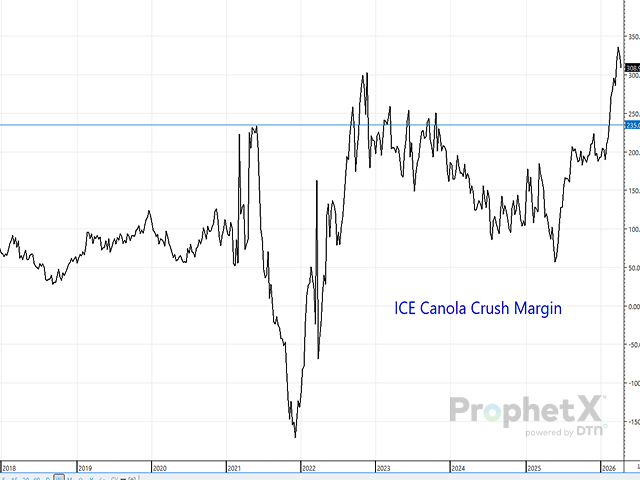
To step back for a moment, these are not absolute profitability measures. The Intercontinental Exchange (or ICE) publishes a gross canola crush margin based on the value of soybean oil and soybean meal futures (in their respective proportions) converted to Canadian dollars, less the value of canola seed futures. With fixed and variable expenses only increasing over time, it makes sense that the gross margin would need to continually improve for the crush industry to remain healthy; but this may be a bit extreme.
According to ICE data, April 6 canola crush margins hit a record high over $350/metric ton (mt) compared to under $60/mt at the end of last May. That exceeded the previous record of just over $300/mt set during the price spike that accompanied the Russian invasion of Ukraine. Prior to Covid (or 2021), canola crush margins spent most of the time in a range from $50 to $125/mt.
P[L1] D[0x0] M[300x250] OOP[F] ADUNIT[] T[]
The most concerning part is that as recently as the end of January, the crush margin had finished a five-month consolidation period around the $200/mt range, still exceptionally profitable for the canola crushing industry. Which helped inspire record domestic use of 8.338 million metric tons (mmt) as of April 6, compared to 7.908 mmt last year (according to the CGC's grain statistics weekly report). But I'm sure producers wouldn't mind having some of the extra $150/mt or $3.40/bushel margin improvement seen since January passed on to them. Especially considering the extra costs they are about to incur thanks to the same war-inspired price spikes.
This is where everyone needs to take it more seriously. Canola traders and the crush industry must realize if canola producers are not allowed to share in the additional profits record-biofuel use will inspire, especially with soaring fuel and fertilizer expenses, they may well look for alternative, cheaper crops to grow, and less-risky cropping alternatives. Reduced production is the last thing the canola crush industry (or exporters for that matter) want right now.
Producers, on the other hand, should be very aware of the crush margin levels when setting up marketing strategies for the year to come. With it looking like strong soybean oil values are likely to remain, above-average crush margins should remain as well. As a side note, USDA increased its estimate of the annual soybean oil cash price from 55 cents/pound to 59 cents in one adjustment (in last Tuesday's WASDE update). Quite an unusually aggressive move by such a conservative entity.
And it's not just canola. Soybean crush margins are close to setting records themselves -- topping $3/bushel compared to less than $1.30/bushel just this past October and the previous spike record high of $3.10/bushel set very briefly in the fall of 2022. The normal soybean crush margin range prior to Covid was $.60 to $1.80/bushel with $.80 to $2.20/bushel more common over the past five years.
In the case of soybeans, the crush industry may not feel the need to improve the profitability for farmers given the corn situation makes soybeans look good enough as it is. With soaring costs of fertilizer and fuel, along with potential shortages of the former, acres may be switched from corn to soybeans without any further price incentive. That said, in the long run, producers should be aware of the fact crushers can certainly afford to improve their bids should they choose to.
I welcome feedback along with any suggestions for future blogs. My daily comments can be found in Plains, Prairies Opening Comments and Plains, Prairies Quick Takes on DTN products.
Mitch Miller can be reached at mitchmiller.dtn@gmail.com
Follow him on social platform X @mgreymiller
(c) Copyright 2026 DTN, LLC. All rights reserved.