

Population Decline in Rural America Is Reversing
Rural Reversal
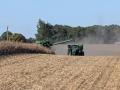
Iowa farmer Tim Youngquist has seen the grass on the other side of the fence, and it turns out it wasn't greener.
The Iowa State University (ISU) agricultural specialist originally left the farm to seek opportunities in the AmeriCorps program on the West Coast, but his Iowa family farm kept calling him back.
"The year I lived in Southern California is the only year of my life I couldn't return to help with harvest," Youngquist says. "It was always in the back of my mind that I would return to take over the farm. It's been in our family since 1873. I am proud about that and had no intention of it stopping with my generation."
He says that although there are fewer opportunities in many rural areas, he couldn't turn his back on the lifestyle.
"My wife, Amanda, and I met during college at ISU," he recalls. "We first started hanging out after graduation when I was living in Minnesota. During one pivotal conversation, she said to me, 'Good luck finding your farm wife in Minneapolis.' This hit me like a lightning bolt and made me realize the wheel was turning, and it was time for me to return home. We may be further away from a grocery store, but that pales in comparison to being able to be on the same land and be in the same barn and outbuildings where my ancestors have been for over 150 years."
Youngquist's journey back to Iowa is part of a profound transformation reshaping rural America -- one that rural sociologist Shoshanah Inwood has been tracking for years.
When Inwood drives through rural America, she sees something most people miss. Where others might see emptying towns or aging populations, the Ohio State University rural sociologist sees a fundamental transformation rewriting the very definition of what it means to be rural in America.
"Rural sociologists love to say, 'If you've been to one rural community, you've been to one rural community,'" Inwood says.
It's a simple statement capturing a complex truth: The traditional narrative of a uniformly shrinking rural America no longer holds. Instead, there are multiple rural Americas, each following vastly different trajectories, each facing unique challenges and opportunities.
CHANGING AGRICULTURAL LANDSCAPE
Inwood says changes in agriculture have been an impetus for an evolving rural America.
"One of the things that we've seen over the years is concentration and consolidation in agriculture, and so there's fewer farms and larger farms," she says. "Sometimes there are gains in efficiencies. But, then when you require less people, then you lose out on those community services and those regional economies and dollars circulating, and that has multiple impacts."
This hollowing out of rural America accelerated with the farm crisis in the 1970s and 1980s. Research documenting it dates to the 1940s, when Congress commissioned a report to understand post-World War II economic changes. An anthropologist compared communities dominated by large farms versus those with more small- and medium-sized farms.
"What he found is that the communities with small- and medium-sized farms really had better-quality services, more civic engagement, lower crime rates, better education, better outcomes all around," Inwood says. "You had more local regional economies. You've got more tax dollars coming in. You have more people who are also able to participate in community life, whether they're participating in 4-H, they're acting as advisers, they're sitting on school boards, they're able to be on their town council, their volunteer fire departments. All of these things take people."
POPULATION TRENDS REVERSE
P[L1] D[0x0] M[300x250] OOP[F] ADUNIT[] T[]
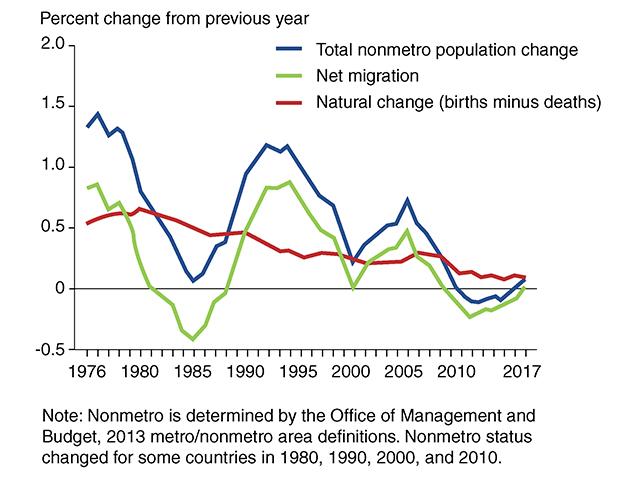
Following a decade of population decline starting in 2010, rural America saw the trend reverse around 2016-2017, according to a 2019 USDA Economic Research Service study. The reversal has continued, with nonmetropolitan populations increasing by 0.29% between 2023 and 2024, though growth remains slower than metropolitan areas, at 1.1%.
However, a fundamental demographic shift has occurred. Since 2017, rural areas recorded more deaths than births, with natural decrease now widespread across 76% of nonmetro counties. Between 2020 and 2024, this natural decrease reduced the nonmetro population by 563,550 people.
Recent rural population growth has been entirely driven by migration. Between 2020 and 2024, migration added 974,379 people to nonmetro populations -- 69% from domestic migration, and 31% from international migration, according to USDA.
The COVID-19 pandemic significantly accelerated that trend, with rural net migration rates jumping from near zero in 2017-2020 to 0.47% in 2020-2021, partly because of increased remote work opportunities.
AGING AND DIVERSIFYING
Rural populations are aging significantly faster than urban populations. In 2023, 21% of nonmetro residents were over age 65 compared to 17% in metro areas. Counties with at least 20% of residents over 65 expanded from just 15% of nonmetro counties in 2000 to 66% in 2023.
Rural counties consistently lose young adults aged 15 to 29 to out-migration while gaining migrants in their 30s, 40s, 50s and 60s, contributing to both the aging population and the decline in working-age residents.
Meanwhile, rural America is becoming more racially and ethnically diverse. By 2020, 24% of rural Americans were people of color, according to a 2022 Brookings Institute study. Latino populations have driven much of this diversity, with rapid growth along the Pacific Coast, High Plains oil and gas regions, and areas with meatpacking, farming and construction industries.
"The agricultural workforce particularly relies on immigration," Inwood explains. "There are some places that have seen increases in population that are coming from immigrant workforces, and those can contribute to local and regional economies."
A 2023 immigration study by FWD.us, a policy organization working to advance better and more politically resilient solutions on criminal justice and immigration, says rural demographic stability can be gained with just a few hundred new immigrants settling into a rural county each year, offsetting population losses.
GEOGRAPHIC DISPARITIES
USDA studies show uneven distribution of population growth across rural America. Most growth is concentrated in counties adjacent to metropolitan areas, counties with recreation economies and regions that are retirement destinations, largely driven by baby boomer retirement and amenity migration.
About 829 rural counties experienced net domestic out-migration, often in high-poverty areas, the Great Plains and regions dependent on oil and gas. Remote and sparsely populated rural areas continue to lose population.
A 2019 USDA study finds that improving economic conditions in rural areas were linked to net migration, including declining unemployment, rising incomes and declining poverty since 2013.
MULTIPLE RURAL AMERICAS
A 2022 Brookings study says the traditional narrative of a uniformly shrinking rural America oversimplifies a complex reality: Some rural areas are growing, and others continue to decline. There isn't a single rural America but rather multiple rural Americas with vastly different trajectories. Such fragmentation has significant implications for policymaking, as one-size-fits-all rural policies may be increasingly ineffective.
Economically, there's been a shift from valuing rural places for productive capacity -- agriculture and resource extraction -- to valuing them for amenities like natural beauty, recreation and lifestyle.
BUILDING RESILIENCE
When Inwood talks about investment in rural America, she's thinking about more than just agriculture or any single industry.
"It's like a good stock portfolio. We don't put all our eggs in one basket," she says. "When we have lots of different types of farms with lots of different sizes, that means that when there's a downturn in the market, or if there's a shock from weather events, not every farm is going to be as vulnerable as the other, because their business structure is different. They're in a different location. So, you're creating that resilience by having a lot more diversity on the landscape."
This principle extends beyond farm size to the broader community. Regional and local food systems provide more than economic benefits.
"They provide community connections," she says. "They can be really important places for getting information, for building social relationships -- those third places, you know, like the cafes, places where maybe you're not best friends with folks, but you're seeing people that you know."
THE PATH FORWARD
As rural America stands at this inflection point, the question isn't whether change is coming -- it's already here. The question is what kind of rural America emerges from this transformation.
Some communities are finding their path forward by investing in broadband, childcare, good schools and vibrant downtowns. They're welcoming new populations -- whether domestic migrants seeking remote work opportunities, retirees looking for amenities or immigrants filling crucial roles in the workforce. They're building diverse economies that don't depend on a single industry or demographic group.
Other communities struggle, caught in a cycle of population loss, aging and declining services that makes it harder to attract the very people and investments they need to reverse course.
"I think it's places that really focus on this quality-of-life issue and childcare, investing in broadband and investing in downtown, good schools -- these kinds of things -- are places where people want to live," Inwood says.
**
-- Follow Todd on social platform X @DTNeeley
[PF_0426]
(c) Copyright 2026 DTN, LLC. All rights reserved.