

Ask the Vet
Cattle Hoof Problem Is Genetic
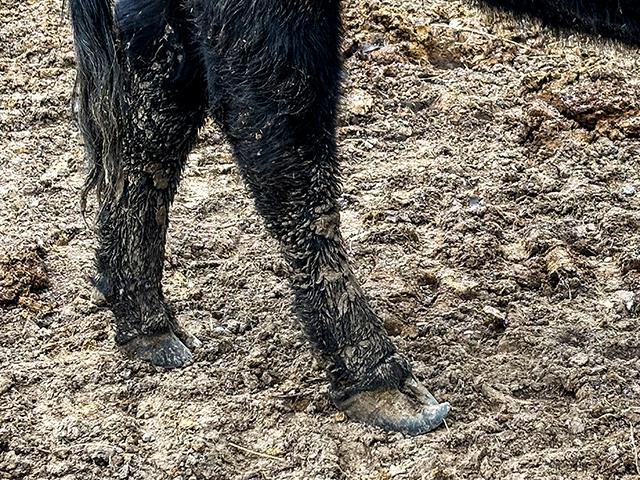
READER: You will notice (from the photo accompanying this article) this cow's right rear hoof is growing out and turning up. My dad always thought this was a condition caused by a cow getting "foundered" from eating too much grain while not being accustomed to having grain. To my knowledge, this cow has not had the opportunity to ever eat an excessive amount of grain at one time. This leads me to believe there is something else which causes this condition, and I am hoping you can tell us what it is?
DR. McMILLAN: This is a great picture. There are not many times I can say for certain what is going on from a picture, but this is classic screw claw, also known as corkscrew claw (CC).
It is most commonly seen in cattle older than 3 1/2 years of age, and it almost always affects the lateral claw of the rear leg. Most experts feel it has a strong heritable influence related to a misalignment of the second and third bone in the digit. Nutrition, management, foot disease or lack of proper foot care have also been linked to CC.
Because of the malalignment, the third digit, known as P3, will often rotate inward and turn under, leaving the excessive weight bearing on the outside wall. This can lead to separation at the white line or the area where the hoof wall and sole meet, which increases the potential for infection within the claw. There is also evidence that the back and mid walls grow faster in cattle with CC. This often leads to lameness from bruising, infection and sole ulcers.
Hoof trimming can help some cattle, but it is not a simple task and must be done by a veterinarian or very knowledgeable hoof trimmer or farrier. Correction is not the goal. This should be viewed as a salvage procedure to get the cow or bull to the point it can be sold.
P[L1] D[0x0] M[300x250] OOP[F] ADUNIT[] T[]
This condition has been reported to be highly heritable, and calves from cows and bulls with the condition should not be kept or at least should be watched very closely for problems.
Founder, or laminitis, is a very different disease. It is most commonly caused by rumen acidosis, which leads the rumen microbes to produce toxins that cause swelling and inflammation within the hoof. This leads to a separation of the lamina, which holds the hoof wall to P3, and P3 rotates downward.
It is commonly linked to diets high in fermentable carbohydrates, but sudden changes in rations, very lush pasture and other factors can lead to laminitis, as well. Hoof appearance is very different, often affecting both claws, but lameness and infection are common signs. Over time, the claws may grow out to be very long and, in some cases, turn upward. While still difficult, hoof trimming can be more successful in these cases.
READER: We took some calves to the sale barn and saw a really nice bull there and bought him. We saw him try to breed a cow, and he had a swelling about the size of a baseball on his penis right where it came out of the sheath. I'm not sure he can breed cows. What do you think is going on, and what do I need to do?
DR. McMILLAN: Rule No. 1 for me is never buy a bull from a sale barn. He is there for a reason, and selling the best bull a guy ever owned for cash-flow reasons is probably not at the top of the list. You are always taking a chance with injury, disease, libido, fertility and other soundness factors.
Rule No. 2, and this is where you are: Always do a Breeding Soundness Exam by a competent veterinarian on every bull before every breeding season. This exam will check all the reproductive organs, including the prepuce and penis, semen motility and morphology (normal or abnormal), as well as his physical condition.
Without seeing the bull, I expect he developed a hematoma of the penis from a breeding accident. When he thrust and missed, the penis bent, and the tunic holding the blood inside the penis ruptured, creating a blood pocket or hematoma. This can be corrected surgically early on, but I am not a fan of that because, as I always say, I think everything has some heritability to it. Surgery is expensive, and you lose the bull for the breeding season. Some bulls will heal without surgery and be able to breed cows, but he needs a complete examination or needs to go back to where he came from.
**
-- Please contact your veterinarian with questions pertaining to the health of your herd. Every operation is unique, and the information in this column does not pertain to all situations. This is not intended as medical advice but is purely for informational purposes.
-- These are only my thoughts and general guidelines. Please get with your veterinarian and together develop the best program for your herd.
-- Email Dr. Ken McMillan at vet@dtn.com
[PF_0326]
(c) Copyright 2026 DTN, LLC. All rights reserved.