


Canada Markets
Commodity Index Trader Buying on Inflation Fears Could Support Grains Ahead
Now that USDA has weighed in with their assessment of the record-breaking crops of 2025 - resulting in significant declines in the corn market in particular -- is all hope for a price recovery lost? Commodity index traders (CIT) may have something to say about that.
With it very clear President Trump and his administration want lower interest rates regardless of the impacts on inflation -- at a time when inflation indicators continue to creep higher -- the situation is setting up eerily similar to the beginning of the decade.
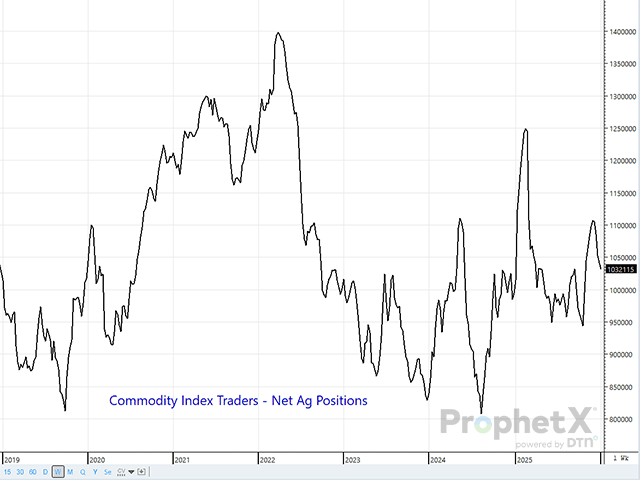
As a refresher, by late 2019 those with significant wealth were increasingly worried about the Federal Reserve's view that early inflation indications at the time were merely "transitory." With inflation destroying real returns on investments, they began buying commodities as a hedge against inflation through CIT funds. Futures markets provide an excellent form of leverage and liquidity for such a purpose, attracting their interest. As the accompanying chart shows, from the fall of 2019 to March of 2022, CITs went from 812,206 contracts net-long ag markets (corn, Chicago and Kansas wheat, soybeans, meal and oil, feeder cattle, live cattle and lean hogs) to 1,398,356 contracts net-long. As an example of the moves seen during that period, the price of corn went from $3.09 per bushel in the spring of 2020 to $8.24 per bushel by April of 2022.
This time it's not the current Federal Reserve that is ignoring the increased risk of inflation but the president himself and his loyal followers who are being appointed to the Fed Board of Governors -- and ultimately the chair position when Jerome Powell's term expires in May -- who are ignoring the risks. The president has gone as far as saying "Anybody that disagrees with me will never be the Fed Chairman!"
P[L1] D[0x0] M[300x250] OOP[F] ADUNIT[] T[]
With the lowering of the overnight Fed Funds rate in the fall, CITs began buying ag markets as a hedge. That helped with the grain and oilseed market rally from mid-October to the start of December. But when Powell presented a defiant, much more hawkish tone to start December, suggesting the Fed was in a good position to pause on any further cuts until inflation was clear of any tariff-related impacts and falling back toward the 2% target, some of the CIT purchases were liquidated.
Now that data has started to flow properly again following the government shutdown, it is clear inflation is still a problem. Wednesday's Producer Price Index came in hotter than expected with a 3% annual gain compared to pre-report estimates of 2.7%. More importantly, core PPI (minus foods, energy, and trade services) came in at 3.5%, well above expectations and the highest since March. With that, hedging against further increases is likely to gain traction.
It is far too late to use the traditional hedge that gold or silver used to provide. With silver setting a new record high Wednesday at $92.195/ounce compared to being worth just $27.545/ounce on April 7, it is not only too far gone for that purpose, it also inspires a sense of urgency to find another alternative. Gold is similar with a new record set Wednesday at $4,650.10/ounce after starting 2025 at just $2,641/ounce.
Interestingly enough, the precious metals may be signaling something even more troublesome -- declining confidence in the value of traditional currencies. If they (precious metals) represent the new world reserve currency, then other commodities quoted in nominal U.S. dollar terms are losing absolute value if their price is not gaining. A concept not likely lost on wealth-management professionals.
Adding to the credibility of the theory, the Bloomberg Commodity Index is accelerating out of one of the best-looking examples of a saucer bottom to be found (on its weekly continuation chart). Gains of over $6/barrel for crude oil in five trading sessions on increased geopolitical risks are just another example of commodity buying interest fueling the breakout.
So, despite the larger stocks USDA is estimating, it may be wise to keep an open mind as to what influence the macro-economic factors might play. If CITs add nearly a half million net-long ag market positions as a hedge against inflation, it will almost certainly have an impact on price.
I welcome feedback along with any suggestions for future blogs. My daily comments can be found in Plains, Prairies Opening Comments and Plains, Prairies Quick Takes on DTN products.
Mitch Miller can be reached at mitchmiller.dtn@gmail.com
Follow him on social platform X @mgreymiller
(c) Copyright 2026 DTN, LLC. All rights reserved.