



Ag Weather Forum
NOAA Study Finds Southern Plains 2020-2025 Drought Cost Ag $23 Billion
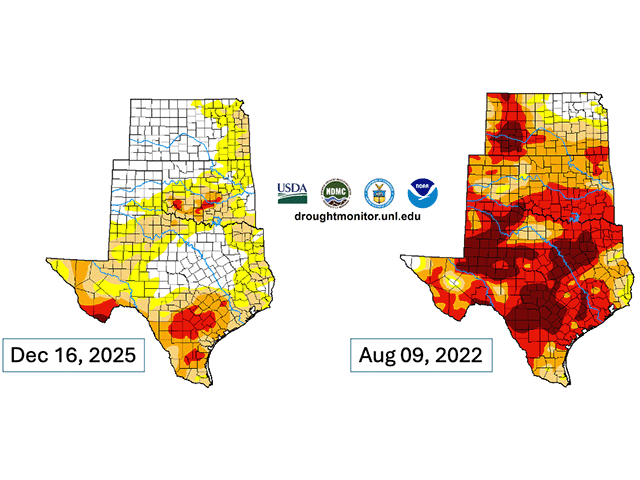
A new report by NOAA's National Integrated Drought Information Service (NIDIS) and the Southern Regional Climate Center (SRCC) finds that drought in the Southern Plains during the first five years of the 2020s brought on an economic loss of more than $23 billion to agriculture in Kansas, Oklahoma and Texas. Production losses in wheat and cotton crops, along with forced cattle herd selloffs because of a lack of feed and water, are especially noted in the report's comments on agricultural impact from the drought.
This five-year event is a summation of two separate droughts. The first began in mid-June 2020 and ended almost a year later, in early June 2021. The second drought began in late October 2021 and extended until early June 2025. The brief four-month period between these two droughts led to the assessment of the entire five-year time frame as a single drought event.
A long-standing La Nina cool-water phase in the equatorial Pacific Ocean is the primary cause noted in this report for the multi-year drought. The large-scale air flow over the United States during La Nina leads to drier conditions in the Southern Plains. The La Nina influence may have been enhanced by the Pacific Decadal Oscillation (PDO) in the North Pacific Ocean being in its own cool phase during the 2020-2025 period. A long-term warming trend also played a role in the region's drought.
P[L1] D[0x0] M[300x250] OOP[F] ADUNIT[] T[]
In terms of agricultural impact, Texas bore the biggest load. The report notes that in the peak year of the drought, 2022, Texas had "25% abandonment for corn, 45% for soybeans, and 74% for cotton. The cotton crop in Texas would have been valued at around $2.4 Billion in 2022; but, with the 74% abandonment rate for cotton (assuming stable market prices), the cotton crop in Texas in 2022 was valued around $640 million."
Cow herd numbers declined from the drought's beginning to end as well. The combined Texas-Oklahoma-Kansas beef cow herd totaled 24.9 million head at the start of 2020. By the end of the drought, the herd total was 22.9 million head -- a decline of 2 million head or 8% from the 2020 total.
Water supplies also shrank to very low levels. Several long-term river gauges logged the lowest flows on record. Groundwater and reservoir levels declined near the point of supply restrictions. Some reservoirs, notably in southwestern Texas, still have critically low levels.
The Southern Plains region, of course, has a history of harsh droughts. The 1930s Dust Bowl is a very familiar event. Many locations in the region also had a drought of record in the 1950s. More recently, the time frame from 2010-2015 was another damaging five-year drought period. The report points out that some areas of the Southern Plains had not fully recovered from that 2010-2015 drought when the 2020-2025 drought began.
As we look to the end of the year, much of the Southern Plains are drought-free. However, severe to extreme drought are still featured in western and southern Texas along with central and southern Oklahoma. Whether these dry spots expand and encroach on less drought-stressed areas will be a detail to closely monitor during this winter.
The full Southern Plains Drought Assessment report is available here: https://www.drought.gov/….
Bryce Anderson can be reached at bryce.anderson@dtn.com
(c) Copyright 2025 DTN, LLC. All rights reserved.