

An Urban's Rural View
All Hail the Panama Canal
To a farmer in Nebraska or a retailer in New York, the Panama Canal is like air -- noticed mainly when missing. Farmers noticed it in 2023.
Drought lowered water levels in the canal. Ships carrying American ag exports couldn't use it. By some estimates, 25% to 30% of United States grain exports normally pass through the canal. During the drought almost none did. Shipping costs soared, farm-gate prices slipped.
Eventually the rains returned, the waters rose and ships resumed transiting. The canal went back to being taken for granted.
That's too bad -- and not just because the canal confers so many economic benefits. What's especially underappreciated is the herculean effort it took to build it. The canal is, without doubt, one of the greatest engineering and construction feats of all times.
My wife and I recently returned from a 10-day trip to Panama. The country is a birder's paradise and during our six-day birding tour we saw 139 species we'd never seen before, including the wonderfully named Keel-billed Toucan, Mustached Antwren and Southern Beardless Tyrannulet.
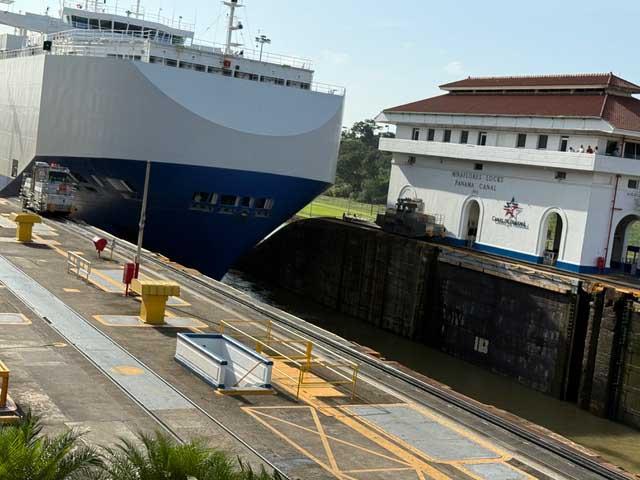
But the day we spent watching locks lift ships 85 feet above sea level and other locks lower them back down was in many ways the highlight of the trip.
P[L1] D[0x0] M[300x250] OOP[F] ADUNIT[] T[]
In preparation for the tour, we read David McCullough's 1977 book, "The Path Between the Seas: The Creation of the Panama Canal 1870-1914." McCullough starts the epic tale with detailed accounts of France's failed 20-year attempt at construction and the political battle in Washington over where and what kind of canal to build. Only then does he detail the grueling 10 years it took to make the canal a reality.
Between 1904 and 1914, more than 232 million cubic yards of dirt and rock were excavated, 25 million cubic yards just to compensate for the continuing landslides. At one point the excavators had to dig down nearly 300 feet.
The three sets of locks the Americans built were a structural triumph. These big water elevators operate by gravity, not pumps, using tunnels to move the water. Their massive miter gates can open and close in just two minutes.
To create the artificial lake that feeds the system, they built what was then the world's largest earthen dam. The 2 million cubic yards of concrete poured for just the set of locks nearest the Caribbean Sea could have built a solid wall 8 feet thick, 12 feet high and 133 miles long.
The work cost $352 million (roughly $10.8 billion in today's money) and killed 5,600 -- mostly black workers from the Caribbean islands.
As terrible as those casualties sound, the French effort had taken 20,000 lives. That death toll was a big reason for France's failure. (Another was its unrealistic plan for a sea-level canal, without locks, through Panama's mountainous terrain.) One reason for the American success was the ability of a doctor from Alabama, William Gorgas, to eradicate yellow fever and control malaria.
Thanks mainly to the organizational ability of Major General George Washington Goethals, the project's third chief engineer, the canal was finished ahead of schedule and $23 million under budget. The work was so good that the original locks and control system are still in use today. (Between 2007 and 2016, Panama built a new, parallel set of locks to accommodate today's largest ships.)
In addition to a canal, the U.S. helped build a nation -- Panama. The Panamanian isthmus had been part of Colombia. When Colombians negotiating with the U.S. proved recalcitrant, an impatient President Theodore Roosevelt sent warships in support of the Panamanians' declaration of independence.
Many in Congress, including the chair of the key Senate committee, wanted the canal built in Nicaragua. William Cromwell, an American lawyer representing French interests, and Philippe-Jean Bunau-Varilla, the key French investor, intervened with Roosevelt to get it built in Panama. This classic piece of lobbying saved the French company's bacon. The U.S. bought its assets in Panama.
This wasn't the last controversy connected with the canal. The Panamanians were unhappy with the U.S. controlling the canal and the 10-mile-wide canal zone. In 1977, President Jimmy Carter signed a treaty putting Panama back in control in 1999.
President Donald Trump reopened that controversy earlier this year by talking of taking the canal back, in part because the ports at both ends are owned by a Hong Kong-based company. A U.S. investment company is bidding to buy the ports. China is demanding that a Chinese company have a 51% stake.
Businesses may take the Panama Canal for granted. For the world's two superpowers it's very much front of mind.
Urban Lehner can be reached at urbanize@gmail.com
(c) Copyright 2025 DTN, LLC. All rights reserved.