



Women Worldwide Are Taking Larger Farm Leadership Roles
Taking the Reins
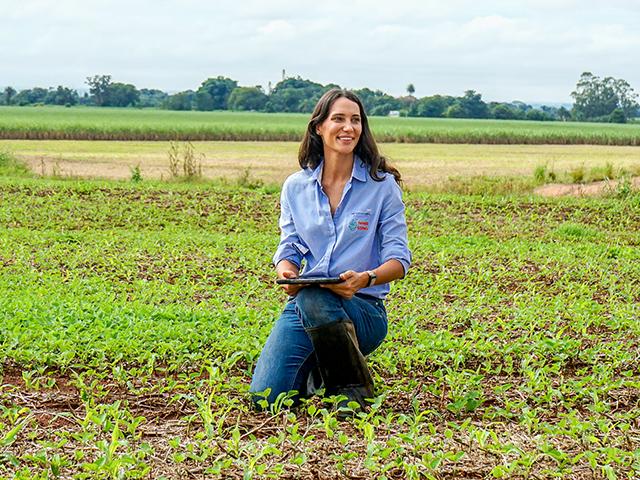
Aline Vick never expected to come home to farm.
The economist had built a career away from agriculture when her sister and retiring father encouraged her to return to the family operation, outside Sao Paulo, Brazil, where they grow soybeans and sugarcane.
Even after she returned, Vick and her father didn't necessarily see the future of the farm the same way. His instinct was expansion.
"My father still has this mentality that he wants to buy the neighbor land," she says. "I think it's generational. But, me and my sister, we don't want to buy more farms. We have a lot of work to do. We say, 'Let's just produce more and improve our yields on our land.'"
Vick's story is one version of a transition taking place on farms around the world.
From Brazil to the United States and beyond, women have long helped run farms and food systems. What's changing is their visibility -- as owners, decision-makers and formal leaders -- and a global initiative is putting new attention on the barriers that still separate participation from power.
P[L1] D[0x0] M[300x250] OOP[F] ADUNIT[] T[]
Women account for 42% of the global agrifood-system workforce, according to the United Nations Food and Agriculture Organization (FAO), although their access to land, resources and economic opportunities vary by country. Those disparities are among the issues receiving new attention in 2026, which the United Nations designated the International Year of the Woman Farmer.
In the United States, the number of female farm operators has risen in every Census of Agriculture since 2002, with women now accounting for nearly 37% of agricultural producers. USDA estimates 43 million acres of U.S. farmland will transfer to new owners within the next five years, while another 227 million acres are expected to eventually transition through wills or trusts. That massive generational transfer raises questions about who will own and operate the next generation of American farms as women's role in farm ownership and management continues to evolve.
"Agriculture around the world has flourished with the full support of women -- oftentimes behind the scenes -- but increasingly in leadership roles," says Isabella Chism, American Farm Bureau Federation (AFBF) Women's Leadership Chair, in a press release.
An AFBF survey of more than 4,300 female American farmers found that 62% of respondents own or share ownership of a farm or ranch, while 25% serve as the primary operator.
Nine out of 10 respondents say they're interested in taking on new leadership roles now or in the future. Women are increasingly visible in formal agricultural leadership, too, including commodity and farm organizations, where they were once largely absent from the top ranks. Take Kansas cattle icon Jan Lyons, for instance, who is featured on page 16 of the November 2026 issue of Progressive Farmer magazine.
While interested in leadership, the women who participated in the survey identified time constraints (59%), family responsibilities (42%), not feeling qualified or ready (40%) and lack of confidence (33%) among the barriers they face. Additionally, 60% hold jobs or other commitments outside the farm.
Chism says the survey results are just one form of feedback AFBF uses to determine content and programming to support farmers.
Training needs remain significant, with 44% seeking opportunities to build equipment or technical skills, and 56% interested in business and financial management training. More than half also expressed interest in education around farm succession and ownership transition.
The survey also highlights the importance women place on family, a connection that extends well beyond U.S. agriculture. For many women, taking on a larger role on the farm is intertwined with keeping a family business viable for another generation.
For Vick, that meant returning to her family's Brazilian farm as her father stepped back and building its future alongside her sister. That partnership is also part of what keeps her farming.
"She doesn't let me quit," Vick says of her sister.
**
-- Follow Jake on social platform X @jzajkow
[PF_1126]
(c) Copyright 2026 DTN, LLC. All rights reserved.