


Why Every Cattle Producer Should Test Their Hay Before Winter Feeding Season
Know Your Hay
Perry Mobley IV may put up tons of baleage and dry hay for his Simmental, SimAngus and Simbrah cows each year, but that doesn't mean he likes feeding it.
"Hay is a dirty word in my vocabulary," says the Shorterville, Alabama, producer, who is also a range and forage specialist with GreenPoint Ag. "It is an expensive thing to grow, especially today with fertilizer prices like they are. We need to be as efficient as we can in its utilization."
For Mobley and producers like him, the answer isn't feeding less hay, it's knowing exactly what's in the hay they're feeding. Forage testing takes the guesswork out of supplementation decisions, helps match hay quality to cattle nutritional needs and can mean the difference between cows that breed back on schedule and cows that don't.
RELATIVE FORAGE QUALITY
Dennis Hancock, director of the U.S. Dairy Forage Research Center, is a strong proponent of both testing forage and putting the numbers to work. The first metric he starts with is Relative Forage Quality (RFQ).
"RFQ considers both the energy content of the feed as well as a prediction of the dry matter intake, or the amount that the animals are likely to eat. It's a good combination of the two," he says, adding it's been proved to be a good measure of forage quality over the past 25 years.
Hancock says dry cows need an RFQ index of 100 or above, while lactating beef cows need 115 to 120 or more.
For Mobley, that means his best-quality bales go to lactating cows, especially if his cool-season annuals aren't ready to graze.
"The most expensive thing in any cattle operation is an open cow, and we're trying to get cows bred in a very tight window in the worst part of the year with big fall-born calves on them," he says. "Nutrition is hugely important if we're going to get those cows pregnant with artificial insemination or embryo transfer."
Because he has a small herd, he may end up feeding higher-quality baleage to all classes of cattle, but he tries to reserve it for really cold stretches when winter forage runs short.
P[L1] D[0x0] M[300x250] OOP[F] ADUNIT[] T[]
Dry hay, especially lower-quality hay, is fed to the bulls "strictly as roughage" alongside a daily concentrate at 2% of body weight. Cows receive it when necessary but require heavier supplementation. Replacement heifers, usually managed separately toward a 1 3/4-pound daily gain, get it paired with supplements. It also serves a tactical purpose during lush winter pasture, when they use it to "slow down the rate of passage" in cows.
TOTAL DIGESTIBLE NUTRIENTS
While RFQ is a good guideline, Hancock says it doesn't work for balancing rations.
"That's when you want to look at total digestible nutrients (TDN) and crude protein," he says. TDN is the standard measure of how much energy a forage actually delivers to the animal, not just what it contains. "If it's around 54% TDN or above, we're in really good shape for dry cows. But, if it's a lactating cow, we want that to be at a minimum of 58% and really around 60 to 62% TDN," enough to make milk while regaining body condition so she can be bred back.
Because energy is typically the most limiting nutrient in forage, Hancock says "crude protein is probably the most overrated measure for its quality and the most misunderstood." He sets minimum targets of 8% for dry cows and 12% for lactating cows.
Hay analyses will likely also include neutral detergent fiber (NDF). Hancock says that if cow/calf producers pay attention to the TDN and crude protein, the fiber component usually takes care of itself.
Mobley is not a nutritionist but looks at dozens of forage tests a year. He agrees that RFQ is a good indicator of forage quality, "but I feel NDF is vastly underutilized, especially with warm-season perennials like bermudagrass and bahiagrass."
He says hot weather can make the lignin content -- the undigestible part of forages -- shoot up, which drives NDF higher. For example, a cow eating hay with 12% crude protein and TDN in the low 60s could still drop weight if NDF is too high, because she simply can't eat enough to meet her needs.
INVENTORY MANAGEMENT
While the numbers are important, they're meaningless unless you have a system to keep an inventory.
"Some of the best producers I know print out their forage test reports for every individual lot of hay," Hancock says. A "lot" isn't a quantity; it's a single cutting from a single field.
For bales stored in a barn, he suggests tucking the printed report behind the net wrap or twine so it's easy to find when you reach that section of storage. For bales outside, a can of spray paint or turf paint works just as well -- marking the lot number and even key values like RFQ, TDN or crude protein directly on the bale.
Accessibility is just as important, Hancock says. A spring-calving herd may start the feeding season as dry cows, but by midwinter, calves are hitting the ground and nutritional demands spike sharply. If the highest-quality hay is stacked in the back of a barn and can't be reached, it doesn't matter how well it tested. The goal is simple: Know where your best hay is and make sure you can get to it when you need it most.
HAY-TESTING HOW-TOs:
Testing hay is a chore that doesn't take a lot of skill. Here's a guide:
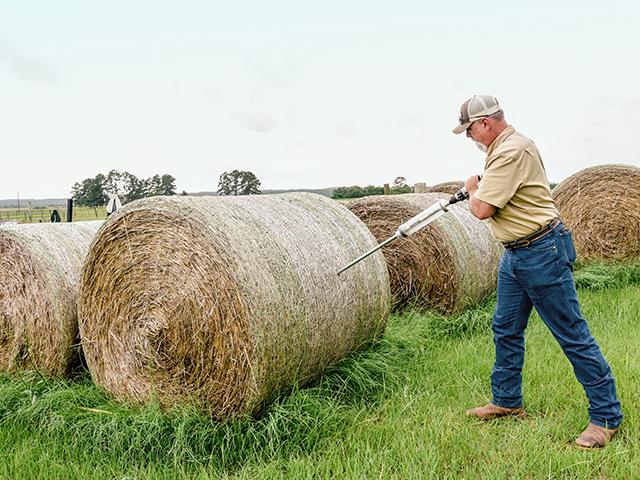
1. Get a hay probe. Many county Extension offices have one you can borrow.
2. Take a core sample from the rounded side of the bale. You want to sample through multiple layers of hay.
3. Sample around 10% of the bales from a lot (same field cut at the same time).
4. Mix the cores in a ziplock bag, label it and give it to the person sending it in for you (or send it yourself).
Alabama cattleman Perry Mobley says he keeps a cooler in his truck to store samples of high-moisture hay and baleage so they don't overheat and dry out. "We also have a rule that we don't ship any samples after Wednesday so they don't sit around over the weekend."
5. Finally, send it to a reputable lab for analysis.
Your state's land-grant university may also offer forage analysis services. Contact your local Extension office for details.
For a complete directory of certified forage-testing labs nationwide, visit the National Forage Testing Association at https://www.foragetesting.org/…
[PF_1026]
(c) Copyright 2026 DTN, LLC. All rights reserved.