


Blueprint for Growth: Short-Stature Corn
Short-Stature Corn Grows Up
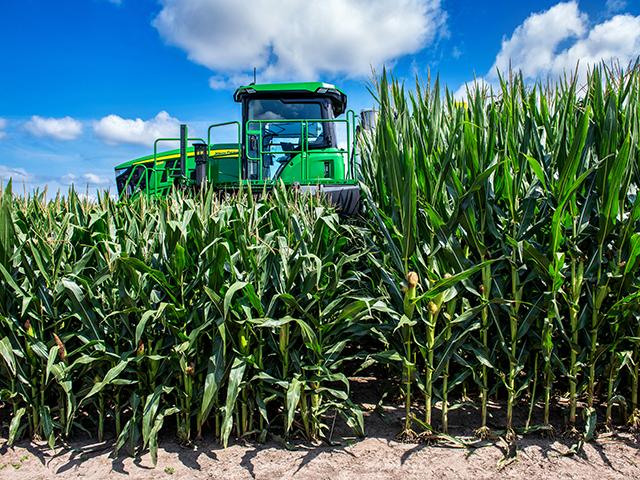
When Kevin Kalb looks over his Indiana corn fields, he sees a revolution on the horizon. In 2025, he pushed a short-stature corn hybrid to a 369.34 bushel per acre (bpa) yield in the National Corn Growers Association Yield Contest.
It was the sign he needed. "In a few years, I expect to be planting primarily short corn. It will stand better against our frequent wind events and give us a way to more easily apply inputs. Those are important management advantages when combined with yield," says Kalb, who farms near Dubois.
Of all of the potential changes to corn's future architecture, none looms larger than its height. Nearly every major seed company is currently working on the concept. And, there's more to the idea than merely shortening the stalk by 25 to 30%.
New studies show these efforts are also creating a plant that's more resilient and adaptable. Root attributes are beginning to explain why short corn is less prone to lodging. Lignin density appears to be reduced, improving whole-plant use for silage. Genetically modified (GM) hybrids in the pipeline promise to more consistently bring these advantages as plant breeders work to build plants that marry in-season access and management.
EVOLUTION OF CHANGE
A derecho put an exclamation point on the movement. Bayer Crop Science already had short-stature corn in its pipeline when winds snapped and leveled fields across Iowa and parts of Illinois in 2020. Wild weather has continued to push what the company has since branded as the Preceon Smart Corn System.
"By 2040, we expect 80% of our corn portfolio will be in the short-statured platform," says Andrew Penney, Preceon agronomy lead. "GM breeding brings a uniformity to the system that we expect to lead to widespread adoption."
Pioneer took a swing at developing "dwarf corn" in the late 1940s, according the company literature. Many of those early efforts found improved lodging resistance but challenges with yield and mechanical picking issues.
Corteva, which owns the Pioneer brand, currently has a Reduced Stature Corn (RSC) program that will see targeted demos in the United States in 2027 and continue through the end of the decade. Launch plans are pending completion of field testing and regulatory reviews.
Stine Seed Co. began testing for standability in the 1970s, and that led to a set of shorter genetics that excel in higher-than-average-populations, says its president, Myron Stine.
"For us, short corn is nothing new," Stine says. "We first started marketing higher-density hybrids in 2012, and since that time, we have sold more than 100 different hybrids that are considered short stature or high-population hybrids."
P[L1] D[0x0] M[300x250] OOP[F] ADUNIT[] T[]
In 2025, Bayer's Ground Breakers field trial program reached approximately 85,000 acres, and farmer participation expanded to 594 grain and 61 silage operations. In 2026, the product portfolio increased to 16 hybrids. Penney says the road map has been a deliberate scale-up as the company validates performance across acres, environments and management systems prior to commercial launch.
SCIENCE OF SHORT
More than 25 single-gene mutations have been identified that influence plant structure through hormone levels or hormone response. The dwarfed height in hybrids from Bayer's conventional breeding programs are partly achieved by limiting the internal transport of auxin -- a plant growth hormone responsible for cell elongation. By altering auxin distribution specifically within the stalk, the plant's internodes shrink, preventing the corn from growing too tall while keeping the ears the same size.
Penney says Preceon hybrids developed through breeding traits reduce node elongation below the ear leaf. The new GM offering depends on suppressing the plant's biosynthetic gibberellic acid (GA) genes and influencing every node both above and below the ear.
"Farmers probably won't see much of a visual difference between the two, but the plant is going to be much more consistent, especially around ear placement," he says.
Hybrids must have ears at least 24 inches off the ground to make it through Bayer's breeding program. The company goal is for short-stature plant height of 6 to 7 feet compared to 9 to 12 feet for traditional hybrids.
"We still see ranges in appearance based on the genetic background of the hybrid -- tassel size, greenness, leaf size and shape still differ just as they would in regular hybrids. And, there's going to be a range of height even in short-stature hybrids. Plus, Mother Nature still runs the show -- planting date and temperature continue to influence overall plant height," he says.
Daniel Quinn, Purdue University corn specialist, has been testing Preceon hybrids for three years. "They've gotten progressively better each year. In 2025, we had a conventionally bred short-stature hybrid that yielded comparable to tall hybrids in our trials," Quinn says.
Ear height emerged as a key factor influencing yield and harvest efficiency. Drought stress led to shorter plants and lower ear placement in 2023 Purdue studies. Harvested yields increased as ear height rose from about 18 inches to more than 24 inches. Height is measured from the soil surface to where the ear shank attaches to the main stem.
Purdue researchers have reported that shorter hybrids have more total root biomass and longer root systems that might help crops better withstand dry spells and scavenge for nutrients more efficiently. That has implications for fertilizer rates and placement as farmers evaluate banding, broadcast and split in-season applications. High-clearance sprayer requirements shorten up, too.
"These hybrids also exhibited a higher tolerance to both increased seeding rates and narrow row (20-inch) systems," Quinn says. "Agronomic optimum seeding rates for short-stature corn in 30-inch rows were often on average 6,000 to 8,000 seeds per acre more than current full-stature hybrids."
MANAGING SHORT
Population rates and row widths tie to the need to shade the row to address weed control and increase light interception. Farmers have also voiced concerns about harvesting because of a thicker lower stalk circumference. Penney agrees the stalk is slightly thicker, but he maintains it is not as much as it visually appears.
"Because those inner nodes are stacked, the leaf tissue is condensed and packed where the leaves sheaths connect to the stalk," he says.
Turns out shorter and stronger stalks work together with root structure to provide added protection against lodging. Erin Sparks, a plant biologist at the University of Missouri and the Donald Danforth Plant Science Center, partnered with Bayer to create a large-scale dataset looking at why short-stature plants resist wind damage.
Using a specialized device called SMURF (Sorghum and Maize Under Rotational Force) to measure the stiffness of stalks, Sparks and her research team found some short-stature hybrid lines had root systems that were 30% more flexible than their taller counterparts.
"We equate it to earthquake engineering. You don't build a building with a rigid base -- it needs the ability to flex," Sparks says. "When we began to look at short-corn hybrids, we realized that reducing the height basically reduces the lever. Shorter lines that were more lodging resistant also had more flexible root systems that work like a spring."
FUTURE LOOKS
Not every company is achieving the "scale down" in stature the same way -- a watchword as farmers contemplate the new technology.
Will farmers embrace the opportunity to look over a picket fence stand? Developing a system that doesn't require massive machinery investments will help. But, ultimately, farmers such as Kevin Kalb will buy in if the plant is engineered to perform.
"It really boils down to one thing," Kalb says. "It has to yield."
**
-- Follow the latest from Pamela Smith, Senior Crops Editor, by following her on social platform X @PamSmithDTN or by visiting the Production Blogs at https://www.dtnpf.com/…
[PF_0926]
(c) Copyright 2026 DTN, LLC. All rights reserved.