


Cattlemen Push to Allow Managed Grazing of CRP Acres
Protect the Land. Grow the Herd.
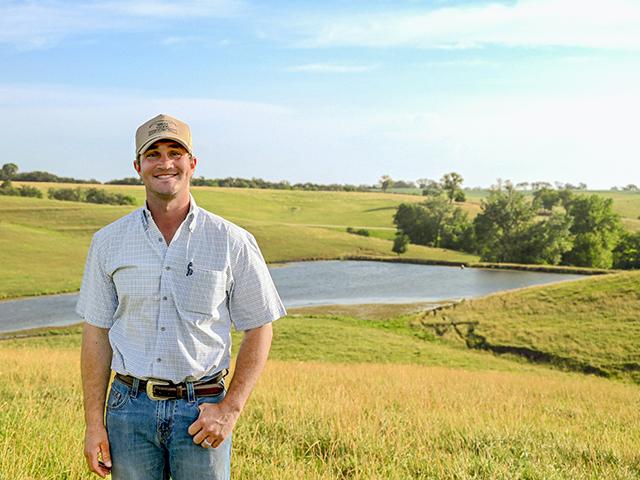
The Conservation Reserve Program (CRP) adds a critical piece of income diversity to Wiese & Sons Herefords, which raises purebred and commercial Hereford cattle near Manning, in west-central Iowa.
Since its founding in 1912, the operation's goal has been to raise real-world Hereford genetics, all while embracing stewardship and conservation practices that boost soil health and protect the land.
"We have had rotational-grazed pastures and had CRP since the 1980s. We look at CRP as a tool to diversify our business and provide seasonal cash flow to help us, especially in the years when we need it," says Shayne Wiese, who runs the operation with his father, Dave, and brother, Chance. "I know that CRP was started to help protect the highly erodible ground, but I also think there may be an opportunity for the program to be more conducive to the cattle industry."
For decades, the CRP has idled millions of acres of cropland to prevent erosion, protect water quality and preserve wildlife habitat. Now, cattle producers say those acres could do double duty -- protect the land and help rebuild a shrinking national cow herd.
At its Summer Business Meeting in July, the National Cattlemen's Beef Association (NCBA) passed a policy update calling for an expansion of managed grazing on enrolled acres -- the clearest signal yet that the cattle industry intends to push for changes to one of agriculture's most established conservation programs.
POLICY IN MOTION
USDA established CRP as policy in 1985, and landowners began enrolling highly erodible cropland into 10- to 15-year contracts the following year. Enrollment reached 33 million acres by 1990 and peaked at more than 36 million in 2007. The 2018 farm bill capped enrollment at 27 million acres, allowing for annual inflows and outflows of enrolled acres under general and continuous sign-up programs.
Under current law, CRP can only be used for haying and grazing in emergencies. A county qualifies if it carries a D2 (Severe Drought) or higher designation on the U.S. Drought Monitor or has documented at least a 40% loss in normal forage production. Where those conditions are met, emergency haying or grazing is permitted provided the grass stand is strong enough to support the activity, and the producer has a modified conservation plan in place. There are also restrictions around nesting seasons for birds.
Wiese says opening CRP land to grazing creates access to a new land base for producers, and that could be big in Iowa, where demand for land outstrips available supply.
"CRP causes competition for cattle producers and has undeniably affected cow numbers," he explains. Iowa had nearly 1.28 million beef cattle in 1985 but only 815,000 in 2026, according to USDA's National Agricultural Statistics Service. "We can't afford to lose more, and finding a way to be able to better utilize CRP with cattle production could really help all producers."
P[L1] D[0x0] M[300x250] OOP[F] ADUNIT[] T[]
PUSH FOR CHANGE
Kelli Klink, director of government relations and public policy for Iowa Cattlemen's Association (ICA), helped lead efforts to change NCBA's official policy, which guides the organization's lobbying activities. She says the group hopes that making grazing available on these acres would benefit young and beginning producers.
"We think this could help provide some much-needed grassland to help grow the cow herd and add some longevity for producers who may not see an option to keep their cows," Klink says.
The effort started at CattleCon in February in Nashville and took a big step forward at the NCBA Summer Business Meeting in July, in Colorado. The ICA, along with Illinois, Kansas and Wisconsin cattlemen's organizations, introduced a modernized policy to make CRP more usable by cattle producers as working lands.
The policy passed a vote of the state organization delegations and now moves on to NCBA's full membership in a mail ballot vote, expected in September. If passed by the membership, NCBA will work with legislators in Washington, D.C., to get it written into law.
The new policy supports reforms that prioritize grazing as a primary conservation tool across all types of CRP while opposing increases in acres enrolled in the program. It calls for using livestock grazing as a conservation management practice under a working lands framework.
The policy calls for reducing CRP rental rates to reflect forage value while maintaining emergency haying and grazing provisions during drought. Any rate reduction could be offset by lease income a landowner receives from a cattle producer. Klink hopes USDA, which sets rental rates administratively, will ultimately adopt the policy.
But, broader structural changes will require legislation. Current versions of the House and Senate farm bill proposals allow more grazing on CRP ground under certain conditions, such as drought, but fall short of establishing a nonemergency grazing plan.
"Management plans would be an important part of a grazing allowance," Klink says, especially to prepare for drought and excess moisture scenarios. Time frames for grazing will need to be discussed to earn the backing of wildlife organizations.
COMMON GROUND
Voluntary and incentive-based programs are already bringing ranchers and wildlife conservation groups together, says Julia Peebles, senior director of public policy for Ducks Unlimited.
"We partner with ranchers to implement sustainable grazing systems that promote healthy ecosystems through grazing and water-management plans, and grazing infrastructure that not only improves conservation on the landscape but also enhances economic stability, livestock health, water quality and vegetative growth," she says.
In the Prairie Pothole Region, nesting bird communities and herds of grazing bison successfully coexisted for millennia.
"Grazing is compatible with the bird community achieving good reproductive success," Peebles says. "Our philosophy at Ducks Unlimited is, 'What is good for the herd is good for the bird.'"
Peebles says Ducks Unlimited supports establishing a working lands component under CRP, which would allow managed grazing as a conservation practice on enrolled acres.
"Doing so will promote continuous grazing, enhance perennial grass cover and restore grassland habitat," she adds.
Wiese says that when pasture is managed correctly, it doesn't just benefit the cattle: The entire ecosystem improves. With an integrated grazing system, he's seen improvements in soil health and biodiversity. The key, he says, is keeping grass from going stagnant.
"By grazing ground properly, we have seen improvement in our pastures. The plants seed themselves back, and new plants are more likely to grow in a good ecosystem," he says, adding he doesn't see as many new grass species on ground that's locked up in CRP.
**
-- Jennifer Carrico can be reached at jennifer.carrico@dtn.com
-- Follow Jennifer on social platform X @JennCattleGal
[PF_0926]
(c) Copyright 2026 DTN, LLC. All rights reserved.