


Blueprint for Growth: Pollen
A New Gold Standard
It's the news no corn farmer wants to hear from the local meteorologist: A "heat dome" is in the forecast. No rain and above-average temperatures both day and night are expected to settle in for the next week to 10 days -- just as the corn crop is beginning to silk.
Pollen may be plentiful, but it's also fragile and dies quickly. Silks dry out and lose their receptivity. The resulting poor pollination reduces total kernel set and ultimately corn yield.
"Today, we manage for disease. We manage for pests. We manage nutrients. We do everything we can to manage for environment, but we have left pollination completely up to nature," says Carl Cox, CEO of PowerPollen, based in Ames, Iowa. "Our founders believed that the management of pollination was the last remaining factor that would allow farmers to control their production systems and have real control over their profitability."
For more than a decade, the PowerPollen team has worked to develop and refine systems for pollen collection, preservation and application. The resulting technology now allows for pollination to happen when and where it's needed most.
"If you can store pollen and apply it on demand, you can overcome so many issues," says Jason Cope, PowerPollen cofounder. "Everything from the timing of pollination, the quality of pollen and the type of genetics you're contributing to increase yield and efficiency."
PERILOUS SHELF LIFE
The concept of controlling pollination is not new. Plant breeders do it all the time, but the process is both time sensitive and laborious.
"Anybody who's hung bags on tassels or developing ears knows the pressure that comes with manually pollinating corn before the pollen dies," Cope says. "You say to yourself a thousand times, 'There's got to be a better way.' So, that's the genesis for PowerPollen. Once we really stored it and reapplied it, and then saw the yield outcome, it's like, 'This is going to change agriculture.'"
Most wind- and self-pollinated crops, such as corn, rice and wheat, produce what is called recalcitrant pollen. Because of high water content (about 60% in corn), the pollen grains are sensitive to drying out and losing viability quickly. To overcome this hurdle, plants take a shotgun approach to pollination, producing copious amounts of pollen in the hope that enough of it reaches the intended target.
"Less than 0.1% of the pollen that exists in a field actually produces a kernel of corn," Cox says. "There are enough pollen grains in 25 to 30 corn plants to pollinate an entire acre of corn, yet a very small fraction of those actually do."
Corn tassels do need dry conditions to shed pollen, but the optimal window for shedding begins to close as temperatures rise during the day. Once exuded from a tassel, a grain of pollen may survive for a few minutes to potentially up to an hour, depending on the ambient environmental conditions.
"Pollen is like a water balloon -- mostly liquid with a thin membrane," Cope explains, noting that corn pollen is about 100 microns in diameter, roughly equivalent to the thickness of an average human hair. "Pollen likes to be cool and likes humidity. So, the corn plant is attempting to shed pollen before it gets too hot or too dry, but it's shedding into a window of diminishing returns. On days when the temperature reaches 100°F-plus, pollen is already dead as it's coming off the tassel."
THREE STEPS, ONE GOAL
The PowerPollen concept is relatively simple: Collect pollen while its viability is high, preserve it to maintain that viability and apply it on the crop when conditions favor successful pollination. Typically, the PowerPollen team gets started with pollen collection in a field soon after the morning dew has burned off.
P[L1] D[0x0] M[300x250] OOP[F] ADUNIT[] T[]
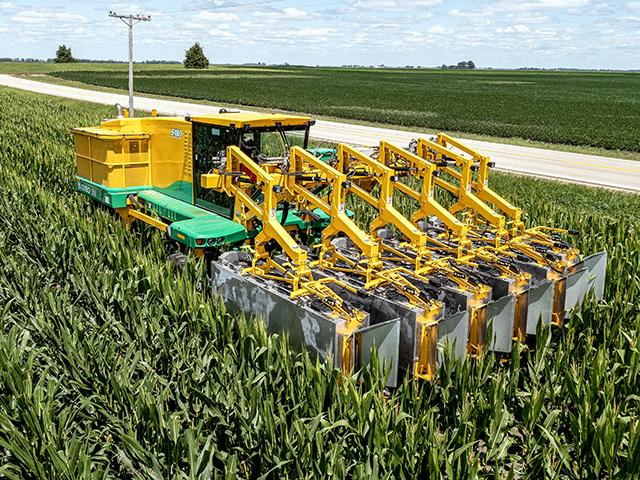
The collector units -- mounted on the toolbar of an Oxbo 5180 high-clearance chassis originally designed for detasseling -- envelope the tops of the corn plants, agitating the tassels physically. Fans create a vortex of negative air pressure that lifts the pollen away and directs it through a series of mesh screens before gently depositing it in a vessel. The process is nondestructive to the tassel, which will continue to shed pollen.
"If we do our job really, really well, and we collect heavily from a field, we might take 3% of the total pollen that's present in that field," Cope says. "So, it's just a testament to how much pollen is really present."
Once a trip across the field is complete, the pollen is emptied from the collector and taken quickly inside a climate-controlled mobile laboratory. Here, the purification and preservation process begins.
"We perform tests on every batch of pollen, and once we've confirmed that it's of high viability, we mix it with our proprietary additive," Cox says. "The additive stabilizes the pollen and allows us to keep it at a high viability. It also allows for flowability and is a key component when we apply the pollen."
After the pollen is preserved, it can be placed in either short- or long-term storage.
"Our short-term system allows us to store pollen for five to seven days for application during the season, and then we have a longer cryo-based system," Cox says. "We've pollinated corn in Mexico with pollen that we collected and preserved in Iowa over six years before."
Whereas pollen collection typically occurs in the morning, application of PowerPollen is most effective in the evening when temperatures fall, plant stress decreases and corn silks become more receptive. The applicator contains a metering device that allows the operator to vary the prescribed rate of pollen row by row. Down tubes -- one of each side of the row -- direct a cloudy band of PowerPollen at ear height to ensure that no matter the ear's location around the stalk, the silks are covered.
"We can apply up to 125 acres in about a four-hour period without reloading," Cox adds.
PRECISION POLLINATION
The ability to collect, preserve and apply pollen on demand offers new opportunities. By enabling precise, reliable pollination, a crop's genetic potential can be maximized. The results include increased yields, reductions in variability and the opportunity to add value to a crop in-season via traits delivered through pollen.
PowerPollen technology has been of high interest to hybrid seed corn companies. Cope says the company works with about 85% of the North American market in terms of seed company market share.
When growing hybrid seed, the male plants that contribute pollen and the female ones that produce the seed won't necessarily achieve synchrony between pollen shed and silk emergence. As a result, seed companies invest heavily in risk-management strategies. They will stagger male plantings or use flaming to stunt male growth in an effort to expand the pollination window. These steps add to the cost of production.
Cox says that with PowerPollen, the need for synchrony between males and females is essentially eliminated. The technology also could allow seed companies to reduce the number of male rows in a field. For example, the 4-to-1 ratio of female to male rows commonly used in hybrid seed production could be replaced with an 8-to-1 ratio, increasing the number of rows producing seed by 11%. In fields where PowerPollen is applied, reliable yield improvements of 30% or more have been consistently achieved, Cope explains.
"One day in the not-too-distant future, PowerPollen will allow us to have a female-only hybrid field. We're collecting the male in a different year, bringing it into that field and ensuring optimal pollination," Cox says. "We can create hybrid products that can't be produced today."
Farmers also can benefit from PowerPollen in their fields. When poor environmental conditions affect natural wind-aided pollination, a supplemental "rescue" pollination could be applied. Optimizing pollination also reduces in-field variability, leading to increased yield, Cox says, while season-to-season volatility in the yield curve is lessened to provide farmers with a way to mitigate risk.
Value also can be added to a crop through specialty traits conferred through pollen. For example, a farmer could apply pollen from a high oil corn hybrid, and the resulting grain would earn a premium.
"The farmer can make decisions about how much it will cost to add that trait via the pollen and what value that decommoditized higher value crop will provide for them," Cox says, noting that yield drags traditionally associated with some specialty traits don't materialize with PowerPollen technology. "They'll be able to make those decisions in real time with real quantitative data. That puts tools in their hands that they don't have today that enable them to be better businesspeople."
COMING TO THE CO-OP?
Within the next five years, Cope believes PowerPollen could join the list of custom services that agricultural retailers offer to farmers. And, while corn has been the initial thrust of the technology's development, it's applicable not only to other self-pollinated crops such as wheat and rice but also insect-pollinated crops like fruits and vegetables.
"We wake up at PowerPollen every day and do things that have never been done before," Cox says. "The people we serve are the people who feed and fuel the world, and so we're passionate about putting tools in their hands that allow them to have greater control over the crop that they're producing. We see pollen as the last frontier."
**
-- Watch the PowerPollen team in action in an Illinois seed corn field at https://www.dtnpf.com/…
-- Learn more at https://www.powerpollen.com/…
-- Follow Jason on social platform X @JasonJenkinsDTN
[PF_0926]
(c) Copyright 2026 DTN, LLC. All rights reserved.