


Farmers Want to Know if Technology Will Pay Off Before Buying In
Proof Before Purchase
Autonomous tractors, artificial intelligence, precision spraying systems, advanced guidance technology and data-driven management tools promise to make farms more productive and efficient, but most farmers aren't rushing to be the first in line to try it.
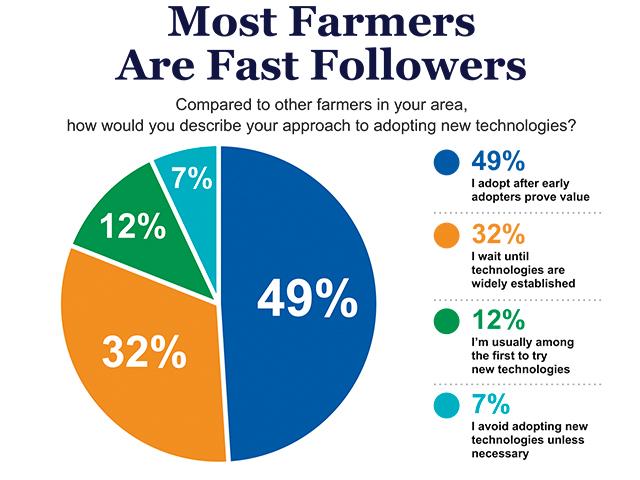
In a recent survey of Progressive Farmer subscribers, nearly half of the 258 respondents described themselves as "fast followers," preferring to see proven results on other farms before investing in new technology. Another 32% say they wait until new tech is widely in use, and 12% say they're usually among the first to try new tools or systems. Only 7% say they avoid change unless it's necessary.
To better understand how farmers evaluate new technology, Progressive Farmer asked about adoption habits, information sources, barriers and decision-making processes. The results emphasize that farmers are pragmatic adopters of technology who want proven returns, compatibility with existing operations and technologies that don't make life more complicated.
For Mount Pleasant, Iowa, farmer Jeff Olson, that cautious approach is the product of decades spent weighing costs, managing risk and learning that every technological breakthrough comes with trade-offs. Like many farmers, Olson embraces technology that solves problems or improves yields -- like GPS guidance, an electronic planter and section control on the sprayer -- but remains skeptical of technology that adds complexity without delivering clear value.
"Technology is a help, but you've got to know how to maneuver around it," he says.
FARMERS TRUST FARMERS
Even as equipment becomes more sophisticated, adoption remains remarkably personal. Farmers still trust other farmers more than anyone else when evaluating a new technology.
Survey respondents could choose up to three sources, and 59% put other farmers at the top of their list as primary information sources. Equipment dealers ranked second at 40%, followed by farm media at 38%. Agronomists, university research and trade shows followed closely behind.
When Progressive Farmer talked to Olson, for example, he'd just returned from a conservation tour in eastern Iowa. He and his wife, Gayle, farm just under 1,000 acres with a focus on specialty crops, organics and direct-to-consumer beef, and are active members of Practical Farmers of Iowa and several other organizations.
"I care about my people I deal with," he says, emphasizing that he's made numerous equipment and technology decisions through the years based on conversations with other farmers as well as the confidence he has in local technical support and service.
ROI STILL RULES
When considering a new technology for the farm, 62% say return on investment (ROI) or the anticipated payback is most important. Compatibility with existing equipment and workflows followed closely at 55%, while 46% cited ease of use.
P[L1] D[0x0] M[300x250] OOP[F] ADUNIT[] T[]
Risk reduction, sustainability, ability to get a loan and data privacy barely registered.
Return on investment topped the survey, but farmers often define "return" differently than an accountant might.
"It's convenience," Olson says, pointing to automatic section control on his sprayer as an example. The system automatically shuts sections off in areas that have already been treated, so if he needs to fix a skip, crops don't get sprayed twice. No more looking for foam markers. "It takes so much pressure off."
A recent study by Chad Fiechter, an assistant professor of agricultural finance at Purdue University, found that most technologies don't broadly improve a farm's overall financial efficiency except for automated guidance and the combination of yield monitors with soil grid sampling.
But, he acknowledges that farmers don't always see financial returns the same way finance professors do.
"Many operators report benefits from technology that are difficult to quantify. If these increases in lifestyle or comfort are large enough, and farms have the financial resources to acquire these technologies, adoption should be considered a logical decision," Fiechter says.
TECHNOLOGY HAS TO WORK
Progressive Farmer's survey found that complexity can be just as important as cost when it comes to technology adoption.
When respondents were asked why they stop using technologies, the most common answer was that it became too complicated or time-consuming.
Fiechter's research shows that 80% of the farms in his sample use automated guidance. It's mostly a plug-and-play technology that proves its worth by reducing overlap, lowering fuel expenses and enhancing consistency. Yield monitors paired with soil sampling is an information-intensive technology that involves meshing two different data sets together.
"The return to precision agriculture is not just a function of whether you own the equipment but whether you have the knowledge and systems to use it," he says.
Olson has witnessed this change firsthand throughout his career. He learned to weld as part of his ag engineering degree and often put those skills to work modifying and fixing his own equipment. Now, he says it takes a computer person to work on equipment.
"Electronics are great, when it works," he says, recalling one time the GPS subscription on the planter didn't auto-renew like he expected. By the time he called the company to make the payment, it was too late for them to reactivate the software that day. He lost a whole day of planting.
COST IS THE BIGGEST BARRIER
While farmers often see the benefits of new technology, money matters. Forty-four percent of respondents identified high up-front costs as the biggest barrier preventing them from adopting more technology. Uncertain return on investment ranked a distant second at 16%. Compatibility concerns, learning curves and unproven claims all trailed far behind.
At 71, Olson is evaluating technology purchases through a different lens than earlier in his career. He's always bought used equipment, and while he'd like to purchase a new-to-him combine, "I don't know at my career stage whether I should be taking on more or not."
For the 38% of the nation's primary farm operators who are at or above the standard retirement age of 65, succession planning, taxes and retirement timelines further complicate the decision on whether to invest in something new.
When Olson retires, he hopes to find a way to minimize taxes while whittling down his machinery fleet and helping a few young people get established in farming. "The amount of capital it takes for a young person to get started -- there's no way without help."
After several broadly unprofitable years in the row-crop sector, farmers are being increasingly selective about their tech investments. Profitability, compatibility and simplicity can swing the decision.
"Technology is a help," Olson says.
For him -- and judging by Progressive Farmer's survey, for many farmers -- the newest innovation isn't necessarily the best investment. The best technology is the one that solves a problem, fits the operation and earns its place.
**
-- You may email Katie at katie.dehlinger@dtn.com, or follow Katie on social platform X @KatieD_DTN
[PF_0826]
(c) Copyright 2026 DTN, LLC. All rights reserved.