


Cattle Producers Reinvest Record Beef Profits in Operational Efficiencies
Make Hay While the Sun Shines
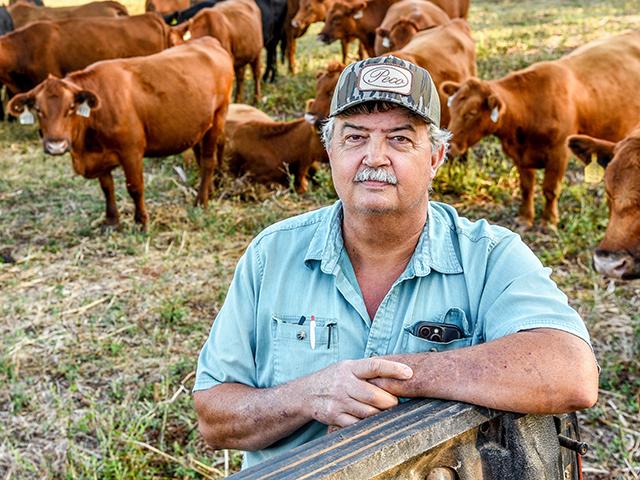
In his 63 years, Johnny Thompson has seen a cattle cycle or two. He also has a long memory. "In the early '70s, cattle prices went up, and my Daddy bought a bunch of high-priced bred cows. Then, the market crashed." Thankfully, his father had an off-farm job. "We didn't sell anything but what we had to sell, but we put heifers everywhere we could put them and basically just lived 'til the price came back."
That lesson means Thompson eyes every purchase carefully, even while his cattle are bringing in extra income. He runs the operation, which also includes four broiler houses, with full-time help from his son Caleb. His wife, Sharon, and son Josh have off-farm jobs but help when needed.
He is slightly increasing the numbers on his 250-cow commercial herd, but only because he was able to buy a 90-acre tract of cutover timberland from family members. "You can't rent land around here, it is all in pine trees from the Conservation Reserve Program (CRP)," he notes.
Besides the purchase price, the land came with expenses. Fortunately, Thompson was able to get Environmental Quality Incentives Program (EQIP) cost-share funds from the Natural Resource Conservation Service (NRCS). He's crossfencing it and putting in waterlines and three all-weather water troughs. "I know it is important for cattle to have good-quality water, but if prices weren't as good as they are, I would have still crossfenced, but I would have just let them drink out of ponds and creeks."
He's also taking a hard look at his equipment. For starters, there are five tractors that do triple duty with the cattle, hay and broiler houses. Despite the fact they are anywhere from 10- to 30-plus years old, he's not in the market for a newer one. "I would love to have another tractor, but we've got enough tractors that are OK."
CAREFUL CONSIDERATIONS FOR PURCHASES
Next, Thompson turned his sights to his balers. He has two older balers that run and a third he says might run in a pinch. He uses the 4 x 6 baler for high-moisture baleage and the 5 x 6 for dry hay. "We try to fix things and just keep running them rather than buying new equipment. Last summer, there was a roller inside one of the balers that was giving me trouble. I gave $12,000 for the baler. We spent a couple of thousand dollars on a new roller, and it bails just like a new $70,000 one."
He does consider the new Krone mower-conditioner a luxury in spite of the fact he needed it for putting up high-moisture baleage, but says, "I would have bought a used one if I could have found one."
In the truck department, even the frugal cattleman doesn't have trouble justifying his recent purchase of a 2017 F-550. Along with the cost of converting it to a flatbed, it was around $27,000. It replaces a 1992 Chevrolet 3500 and a 2005 Ford F-350. The two older trucks are now for sale, and the newer one will take over cattle-hauling duties, as well as pull the lowboy trailer.
P[L1] D[0x0] M[300x250] OOP[F] ADUNIT[] T[]
"People act like they've never heard of the cattle cycle," Thompson says. "Prices are going to go back down. I just wish I had a crystal ball to know when."
PROFITS HELP IMPROVE INFRASTRUCTURE
In Prattville, Alabama, Bill Lipscomb and his sister, Linda Lipscomb, are using the profits from their 100-cow Angus-Hereford herd for infrastructure improvements. Even though the roof isn't finished, the catch pen they built at the intersection of four of their pastures is their pride and joy. "With the roof, now the cows will have shade if we have to get one up," Linda says. It's already getting a workout. They've had three sets of twins so far in their fall calving herd and have used it to convince at least one mama to take both calves.
Bill estimates they have spent around $14,000 to $15,000 on the catch pen and roof.
They are also adding crossfencing and putting gravel down on roads and around water troughs.
In addition, they're adding a 20- x 80-foot roof extension to their main working facility with a $10,000 price tag. "Now, we don't have to quit working cattle when it rains, and the cattle will have shade," Bill explains.
They also added a hay barn in 2023. "A hay barn is something more people should consider," he adds. "The specialists will tell you that you pay for a hay barn in hay losses whether you build one or not."
With their equipment, they bought a grapple to mount to one of their tractors to help keep fences clear of falling limbs. "That's the best $4,000 we've spent in a long time," Bill says.
The Lipscombs' big purchase is a trade-in tractor plus $50,000 for a used 6430 John Deere. "Our 5083 rode like a two-horse wagon," Linda says. "Plus, it was weak." Even with the newer John Deere, their '79 Allis-Chalmers tractor is still on the job.
MAKING IMPROVEMENTS IN THE HERD
While cattle prices are high, they're also planning on improving genetics by raising their price ceiling on bull purchases.
"We're used to working with limited resources," Bill explains. "When we get the resources, we try to use them to make it easier for us to operate." While they do have part-time help from other family members, the day-to-day operation of 3L Ranch is mainly Bill, 72, and Linda, 68, with Bill spending quite a bit of time away from the operation with local, state and national cattle-industry commitments.
"This cattle cycle has lasted longer, and the prices have been higher," he says, "but remember, these prices ain't going to be here forever."
Okeechobee, Florida, rancher Ralph Pelaez is not only taking advantage of higher beef prices but also healthy prices for bahiagrass sod. "While the sod prices are high, we are lifting as much sod as we can." He's replanting with GibTuck, an improved cultivar of limpograss.
"It's going to save a lot of supplement costs in the winter. The calves are going to be heavier, and we'll get a higher pregnancy rate."
He's also working on pens and fences while beef prices are high.
The 79-year-old rancher, who runs a Brangus-based operation with his daughter, Stephanie, adds, "It's important during these times to get your infrastructure updated and do the necessary repairs. I've seen these cycles come and go, and once this cycle breaks, it will just fall off the cliff. When the price of cattle comes down, the inputs don't come down. That's what hangs everybody."
Mississippi State ag economist Josh Maples gives two thumbs up to the producers' improvements. "We need to be thinking about things we can do now to set ourselves up to be successful in the next five to 10 years. It could be servicing debt or investing in your forage program to reduce your feeding costs." He says improving genetics and/or tightening up your calving season are worthwhile investments, as well.
"Now's a good time to think about it," Maples says.
[PF_0326]
(c) Copyright 2026 DTN, LLC. All rights reserved.