

Specialty Crop Farm Faces Similar Challenges of Row Crop Operations
Fruits and Nuts Forever
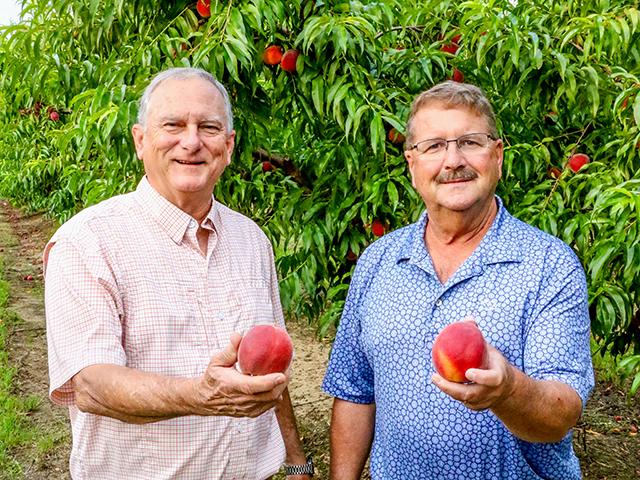
Peach harvest has been underway for several weeks at Georgia's Southern Orchards, and dozens of laborers, nearly all of them migrant H-2A employees, are working quickly, checking individual fruit on the trees for the right color and firmness to pick or not to pick.
Fruit from each tree will be harvested two to four times over 10 to 12 days to pick the majority of it at the optimum time. Different varieties in the orchard -- more than 30 -- will provide ripened peaches from mid-May until August. Southern Orchards is the largest combined peach and pecan producer in the state, with 6,000 acres of pecan groves and 5,000 acres of peach orchards.
"There is an art to being as efficient as possible with peaches," says Mark Sanchez, Southern Orchards' CEO. "You want to make as few trips through the orchard as possible." Sanchez and Jeff Wainwright, president of farming operations, provide a tour of the wholesale operation and retail store at Fort Valley, Georgia.
Today's Southern Orchards is a combination of two longtime family operations in the area, Lane Southern Orchards and Taylor Family Orchards. The Lane operation was purchased a decade ago by Raleigh, North Carolina-based International Farming Corp. (IFC). Several years ago, IFC purchased Taylor Family Orchards.
IFC invests in farms and ag technology companies, both as partners and as outright owners. Overall, the company owns and/or manages farms growing 80 different crops (domestically and abroad) on 500,000 acres.
Peaches and pecans are high-value crops, which generally means there is a lot of risk to go along with potential high rewards. Though owned by a large investment corporation, Southern Orchards does what any farmer executes on an annual basis: It tries to control input, labor, equipment and time costs while leveraging technology.
THESE ARE NOT YOUR FATHER'S PEACHES
As with corn, soybeans or cotton, the seeds being planted today aren't necessarily the same as those planted a few decades ago or even 10 years ago. Peaches are no different. When asked, Sanchez makes it clear that a changing climate -- in a warming sense -- has transformed the peach varieties they grow.
"The peaches grown here 25 to 30 years ago required 850 to 1,000 chill hours, that is hours of temperatures of 45°F or lower during their dormant stage in the winter," Sanchez explains. "We're not accumulating that many hours anymore."
The chill hours, or exposure to cold, are crucial for peach trees to properly break dormancy and initiate flowering and fruiting in the spring. Southern Orchards now uses varieties that need fewer, closer to 650 chill hours annually.
This shift is a double-edged sword, Sanchez says, particularly in a year like 2023, when warm temperatures in February "fooled" the peach trees into developing blooms, which determine fruit production. That was followed by several brutally cold days at the end of March/beginning of April.
P[L1] D[0x0] M[300x250] OOP[F] ADUNIT[] T[]
"Those temperatures killed the blooms and any fruit production," he adds. "It wiped out 90% of our crop." Like any other farmer, Southern Orchards was able to utilize crop insurance to mitigate the losses to be able to move on to the next year.
INTERCROPPING--PECAN STYLE
The peaches and pecans are 100% irrigated. "It's a safeguard," Sanchez says. "And, pretty much a necessity." It costs about $6,000 per acre to establish peach trees, and they'll grow for three years before fruit is harvested.
Once grown, peach trees have 12 to 15 years of commercial fruit production. Southern Orchards will replant orchards to new peach trees. Whether they plant peaches again a third time around on the same land depends on soil quality.
On its 11,000 acres, the company has been shifting land it owns to pecan groves, because mechanization in pecans greatly reduces labor costs, and the trees produce for 50-plus years.
The company owns about half the land it works, leasing the other half. It takes five years before you can harvest nuts and nearly 10 years before pecan trees hit peak production, somewhere north of 1,500 pounds per acre.
The company has begun planting pecan trees amid some of its peach orchards. There might be some pecan trees planted in every other row of a peach orchard as replacements.
"We lose, of course, some peach tree spaces," Sanchez explains. "But, by the time peach production starts to decline, the pecan trees are already producing."
LABOR COSTS
The season for peaches is more compressed than pecans, about 55 days from bloom until the first harvest, he continues. Trees are pruned beginning in February to clean out old wood then selectively pruned in March and April to optimize peach size.
Often, more than half the developing peaches are pruned off the tree when they are marble-sized, Sanchez says. Otherwise, each tree would produce a big crop "of golf-ball-sized peaches," an unmarketable fruit.
The large number of varieties planted ensures there will be fruit maturing from May to August. "The varieties overlap each other so there are no gaps in the supply," he says. At Southern Orchards' production facility, fruit is packaged for several private labels, depending on size and quality.
There is also a difference in labor needs between peaches and pecans.
"It takes 400 people to work 5,000 acres of peaches," Sanchez says. "And, we work pecan harvest on 6,000 acres with 40 people." Pecans are much more mechanized, using "shakers" that cause the nuts to fall onto the ground or into a type of catch basin that are then scooped into carts. Pecan harvest begins in October and is usually done by the holidays but can continue until January.
THE LITTLE THINGS
In terms of cost-cutting, Southern Orchards also relies on technology. Fungicide sprayers use optical sensors that automatically shut off if passing a peach tree that has died.
The operation also used to mow the rows between trees every week during the growing season. Now, they use "weed wipers" in the pecan orchard that utilize saturated applicators to contact the taller weeds while not affecting the shorter, more desirable grass below.
"You're hitting the tall weeds, which die back," Sanchez explains, "while leaving the grass growing, which is fine. We can do one application in the spring and don't have to mow the pecan orchards again in season. It saves a lot of money."
Certainly ownership by IFC has allowed Southern Orchards to make investments in the business, such as optical scanner graders and sorters in the packing house that can "pick out" the best peaches automatically by size and quality.
IFC was founded in 2008 in Raleigh, North Carolina, by Charlie McNairy, a banking and investment fund veteran whose family has had farm businesses in the state going back to the 1820s. The company controls more than $1.5 billion in assets, which are managed on behalf of investors. Its investments range from Lane Southern Orchards to orchards in Washington to a large organic farm in Nebraska.
"International Farming has multiple business lines," says Martin Vogel, partner, Integrated Food Strategies at IFC. "One of those lines is partnering and investing in businesses that we consider generational assets. Southern Orchards fits that because what it's doing is it's allowing people to have a better product."
Southern Orchards' Sanchez reiterates that while there can be good profit with peaches and pecans, weather, as in 2023, can change everything.
"If you have a freeze and lose 30% of your peach crop, you still have to care for all the acres regardless," he says. If peach trees have pretty long productive life, pecans can produce for decades, up to 75 years or more.
"When people ask me what the commercial life of a pecan tree is, I always tell them, 'We'll let you know,'" he says. "You have to be a visionary to plant a pecan grove."
[PF_0126]
(c) Copyright 2026 DTN, LLC. All rights reserved.