

Midwest Farmer Adds Shrimp to Cattle Operation to Diversify Income
Prawns on the Prairie
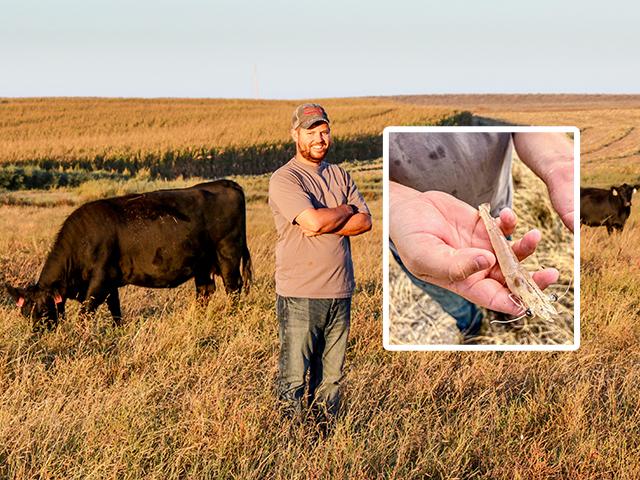
When someone in Nebraska shows you his or her latest livestock venture, you wouldn't anticipate they'd dip a net into a water tank and pull out twitching, nearly-ready-for-market shrimp.
That's exactly what Grant Jones does in a converted machine shed on his family farm, near Haigler, in the far southwest corner of the state. In fact, there are thousands of shrimp growing in one of eight 3,750-gallon tanks in the building, each containing shrimp at various stages of growth.
Every month, Jones receives a new shipment of 10,000 tiny postlarvae (PL) shrimp from hatcheries in Florida or Texas. Each PL is about the size of an eyelash, and all 10,000 of the Pacific white shrimp he grows are initially placed in one tank.
"I'll split them up and divide them into separate tanks as they grow," Jones explains. Over about four months -- dining on a diet of fish meal and soy meal -- the shrimp that survive will be ready for sale.
The 36- x 72-foot building with 14-foot sidewalls is kept at 75 to 80°F by the radiant heat from the water in the tanks. Jones uses a 199,000-Btu water heater and applied spray foam to insulate the building. Spending extra on insulation keeps his heating bill to less than $200 per month.
So far, income from the shrimp is negligible to the farm's overall revenue. "I'd like to expand, but I'm still working on consistency of product and replicating the process," he says.
SMALL-SCALE CHALLENGES
Jones' interest in crustaceans was piqued by an article he read fresh out of college about Midwestern farmers growing shrimp in former hog barns. Jones, 33, grew shrimp consistently from 2020 through 2023, taking a "season" off in early 2024.
Why did he decide on shrimp? "I hate chickens," he says. "I couldn't see myself raising chickens. I wanted to diversify and bring something of my own to our operation. My parents and grandparents have always encouraged me."
Jones has no illusions as to the endgame for growing shrimp on a small scale in rural Middle America.
"Nearly everything I raise is going to someone local," he says. "I've built some regular customers, and I've always got a list of others who are interested if I produce some extra. Those customers have been built by word of mouth and social media like Facebook."
Selling locally, either at an independent retail outlet, restaurant or at the farm itself, is just about the only way to survive raising shrimp, or any aquaculture, on a small scale, according to experts at Purdue University.
P[L1] D[0x0] M[300x250] OOP[F] ADUNIT[] T[]
"Grocery stores are all about price, volume and consistency," says Kwamena Quagrainie, an aquaculture economics/marketing specialist at the university. "Margins are very small, and outlets can get shrimp cheaper from distributors," he adds.
"This type of shrimp operation is very niche," Quagrainie continues, and relies on local area customers willing to pay a higher price for a fresh, local product. "A farmer's breakeven is about $12 to $14 per pound."
Jones sells his shrimp for $20 per pound. He'd like to get costs down below $10 per pound. Farmed shrimp from countries such as Ecuador, India, Thailand and Vietnam, selling for $6.99 to $9.99 per pound -- depending on size -- dominate the retail market, Quagrainie explains.
Even if a small producer can sell shrimp above their break-even cost, that assumes there will be a supply to sell. In the PL stage, shrimp are quite delicate and sensitive, he continues. Mortality rates greater than 50% are not unusual, as Jones can attest. The shrimp, their water quality, temperature and feed ratios must be monitored daily.
CATTLE PRIORITIES
We did say the shrimp was a sideline. Along with three employees, his mother, Julie, and occasional help from his father, Shawn (Shawn Jones is a longtime employee of Helena Agri-Enterprises), the family grows 1,000 acres of irrigated corn, soybeans and hay. They also have 600 mostly Angus cow/calf pairs, along with 1,600 yearlings on 15,000 acres of pasture. Jones is the sixth generation of his family to work there.
"We're predominantly a cattle operation," he says. "We farm to feed the cattle."
In the herd, they focus on genetics -- particularly the females -- that allow animals to do well in some extreme weather conditions.
"We have somewhat desert-type climate, and we want cows that just go out and thrive," Jones explains. The region receives average annual rainfall of about 18 inches.
The family operation, Chundy Land and Cattle, conducts an annual bull sale in Ogallala that involves more than 100 animals, some Angus and others with SimAngus genetics (Simmental and Angus). They also market 50 to 70 females as commercial heifers.
"A lot of time, the heifers go as one big group to somebody," Jones says. "We get a really good response to those animals. We see them adding weaning weight due to heterosis."
The family's 1,000 acres of cropland is 100% irrigated via wells in the Ogallala Aquifer. Allocations allow for Jones to receive 12 1/2 inches of water per year for his mostly sandy soils or 62 1/2 inches over five years.
They use a lot of cover crops, including rye, a sorghum-sudangrass mix they call "cane," millet, triticale and alfalfa. In early April, he was already grazing cattle in fields with newly green cover crops.
"What we've tried to do is move from having something growing four months of the year to eight months," he says.
The family doesn't bale hay on any of its pasture -- only from a portion of the irrigated crop ground. In terms of cattle feed, they are self-sufficient.
"If anything, we might sell some excess alfalfa hay and, in return, buy silage as supplemental feed," Jones adds.
COVER CROPS AND CARBON
The move to increase the use and diversification of cover crops has led Jones to begin the process of qualifying for carbon sequestration payments. He's working with Agoro Carbon Alliance, part of Norwegian-based fertilizer company Yara International. As of the beginning of last year, Agoro officials said they had enrolled 2 million acres in the U.S. in their carbon sequestration program.
"We've always kind of done cover crops," Jones says. "We did things like drilling rye because we also planned to graze it in the spring. This is the first year we'll do multispecies of cover crops."
The multiple species include winter peas, turnips and radishes, as well as rye. Last fall, he was getting ready to seed a new cover crop mix. The grass part of the mix is 42% cereal rye, 21% triticale, 15% winter barley and 7% annual rye. The mix also contains Austrian winter peas (a legume) and small amounts of radish, turnip and forage collards. He plans to interseed legumes into some pastures (using a drone) and apply nitrogen on others.
OUTSIDE THE BOX
Despite his leadership involvement in the Nebraska Angus Association and Nebraska Farm Bureau, Jones suspects he's considered something of an outlier in the region.
Participants in carbon sequestration programs are almost nonexistent in the area, so as "I start to apply more stuff -- some funky seeds -- I think people are going to wonder, 'What is he doing?'"
"I've gotten over what everyone else thinks, I'm just doing me," he says. His father, Shawn, and grandfather, Stan, have become more open to Jones' ideas over time. The reception was good enough on the carbon sequestration program that they'll begin additional cover crops on up to 11,000 acres this year -- both pastures and their cropland.
As for the other enterprise? "Around here, people already know about the shrimp," he explains. "Being in that building off and on all day means I've been that guy running around in shorts and Crocs, even in the middle of winter."
[PF_1225]
(c) Copyright 2025 DTN, LLC. All rights reserved.