

Ag Drone Use Collides With New Tariffs
As Ag Drone Use Grows, Companies Look to Avoid New 100% Import Tariffs
GRAND ISLAND, Neb. (DTN) -- Startup agricultural drone companies are looking for ways to increase domestic production of drones to avoid new tariffs and bans on imported drones, but there are gaps in the supply chain that make it difficult to ensure their equipment includes only U.S.-made parts.
President Donald Trump in August signed a proclamation imposing tariffs of up to 100% on certain imported drones, including a 25% tariff on drones over 55 pounds, along with 25% tariffs on smaller drones and parts. The tariffs have affected a series of startup companies in agriculture that either manufacture and sell drones or use them for aerial applications of pesticide chemicals.
The Trump administration, through tariffs and restrictions on some newer, foreign-made drone models, views its actions as efforts to stimulate domestic manufacturing of commercial drone products. The administration has cited national-security concerns and problems with U.S. reliance on imports of such technology.
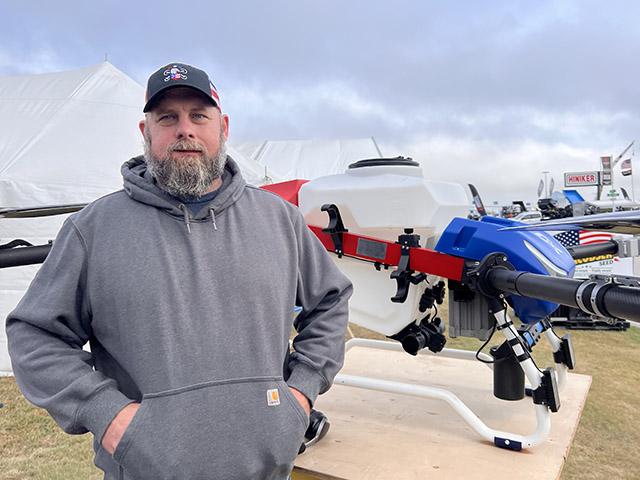
Russell Hedrick, a North Carolina farmer and founder of Revolution Drones, said his company had already been working for roughly 18 months to two years to shift more production from Brazil to the United States before the new tariffs took effect.
"We just got lucky that that plan was already in place, and now we're pushing a little bit harder to kind of get through that process with this new proclamation," Hedrick said in an interview at Husker Harvest Days.
Hedrick was among several drone manufacturers and pesticide applicators at Husker Harvest Days showcasing drone products this past week.
Hedrick said Revolution Drones was hit by the tariffs when they took effect Sept. 3. Some other drone companies received conditional approvals that delay the tariffs until early February, he said.
Revolution instead chose to pursue U.S. production and is working with the Department of Commerce on an onshoring plan that Hedrick said would provide temporary tariff relief while the company ramps up domestic manufacturing.
"We're not mass-producing drones yet because we're going through the process of quality control and putting the drones together with some components that we're still bringing into the country," Hedrick said, adding that the work with the Commerce Department should provide some tariff relief for the company. "It's been a hot topic the past two weeks."
CHALLENGES TO 100% U.S. PRODUCTION
Revolution has already shifted a significant share of its supply chain to the United States. One of the company's drones is about 78% U.S.-made, Hedrick said, but reaching 100% U.S.-made parts to avoid tariffs remains difficult because some key components aren't readily available domestically.
"If you want to avoid tariffs, yeah, you'd have to be 100%," Hedrick said. "That does not exist in the agriculture industry."
Among the biggest challenges are electric motors and lithium batteries. Hedrick said U.S. manufacturers aren't producing the magnets needed for drone motors, while domestic supplies of refined lithium needed for batteries also are inadequate. He expects lithium supplies for batteries to remain a major challenge for nearly all drone manufacturers.
P[L1] D[0x0] M[300x250] OOP[F] ADUNIT[] T[]
"As far as onshoring everything, it's going to be really, really tough to have a drone this big with parts that big and be 100% American-made," he said.
The company's supply chain illustrates the challenge. Hedrick said processors and computer chips have come from Taiwan and some components are sourced from Austria. At the same time, Revolution is sourcing U.S.-made components from California, Texas and Nebraska. Most of its plastic components are now produced in Nebraska, and tanks are manufactured in Illinois.
The company's existing fleet has largely come from Brazil and is roughly 80% Brazilian-made, Hedrick said, though some motors used in those drones have come from China.
DRONE USE EXPANDS
Drones are increasingly being used for aerial spray applications. The American Spray Drone Coalition (ASDC) released a report earlier this year estimating that 16.4 million acres were treated by drones in 2025, up nearly 59% from 2024. The growth was also driven heavily by the number of approved operators getting into the business.
Iowa State University, in its 2025 Iowa Farm and Rural Life Poll, also found that 22% of farmers used drones or hired a drone service operator in 2024, and 56% of those farmers who used drones did so for pesticide applications.
The ASDC, on its website, also has a "call to action" encouraging users to reach out to Congress to prevent a ban on the import of aerosol-dispensing drones from foreign adversaries such as China, "which is home to the manufacturers of the large majority of spray drones used by American farmers." The coalition states it represents farmers and spray-drone operators to ensure continued access to drone technology while domestic manufacturing capacity expands.
Hedrick said Revolution drones and their contractors have a distribution network of 70 dealers in 36 states. Revolution drones covered approximately 2 million acres during their first season in the United States. The Independence 19 accounted for roughly 1.2 million to 1.3 million acres, while the company's larger 40-series drones covered another 700,000 to 750,000 acres. Hedrick also talked to DTN in June about his company's operation, which included sowing cover-crop seeds as well as fertilizer and pesticide applications.
The drones had previously been operating in Brazil before being introduced into the U.S. market.
"For us to be a brand-new brand, working through that distribution network, to have that 2 million acres is, in my opinion, really huge," Hedrick said.
TARIFFS CHANGE DRONE ECONOMICS
The tariffs could significantly alter the competitive landscape for agricultural drones.
James Rafferty, co-owner of Elevon Aerial Ag, said the tariffs could take a drone costing roughly $37,000 now and push the price into the $80,000 range. Elevon's drones are built in Belleville, Ill., with about 65% U.S. parts.
"I would say it's dang-near impossible to be 100% American parts right now," Rafferty said.
Rafferty has been working with the FCC and the Federal Aviation Administration over the past year to receive conditional approval so tariffs would be delayed on the startup's products.
Elevon first launched a product at the Farm Progress Show last year, but relaunched at the show two weeks ago, just as the Trump administration was implementing its latest drone tariffs. Elevon both sells drones and has done custom farm applications since 2022.
"Farmers are starting to look more at a viable purchase for themselves versus hiring an applicator," Rafferty said.
Some Chinese agricultural drones that were priced around $40,000 to $42,000 could eventually cost $55,000 to $60,000 once inventories imported before the tariffs are depleted. That's assuming the federal government will continue to allow those drones into the country, Hedrick said.
Revolution has seen a smaller price increase, he said. Its Independence 19 drone -- which carries a 19-gallon tank -- is expected to sell for around $49,500.
"I don't want farmers to overpay," Hedrick said. At the same time, he said the tariffs could "level the playing field" for companies manufacturing drones in the United States.
Drone capacity also has increased rapidly. Hedrick said the Independence 19 can cover about 60 to 80 acres an hour, potentially treating 600 to 800 acres during a 10-hour day. The company's larger 40-gallon drones have topped 1,000 acres a day.
"I still think that is a huge value to a farmer because of just the amount of acres we can cover with it," Hedrick said.
See, "The Race for the American-Made Drone," https://www.dtnpf.com/…
Also see, "US-China Summit Could Shape Soybean Sales, Drone Tariffs for American Farmers,"
Chris Clayton can be reached at Chris.Clayton@dtn.com
Follow him on social platform X @ChrisClaytonDTN
(c) Copyright 2026 DTN, LLC. All rights reserved.