


Tools for Residue Management
Equipment Manufacturers Expand Choices to Handle Higher Corn Stover Volume
Nature rarely lets us get away without paying a price for improvement. Example: Today's high-yield corn is money in the bank and grain in the food system.
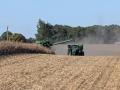
But this corn relies on denser plant populations and tougher cornstalks, which produce a lot of crop residue. A harvested corn field today is a yellow and brown train wreck, with 5 to 7 tons per acre of stalks and leaves strewn in a foot-deep mess. Especially in a corn-on-corn rotation, that can create problems. Soils warm more slowly in the spring; planting is more difficult.
None of this comes as a surprise to farm-equipment manufacturers, who have worked diligently to produce machines to deal with the problems caused by masses of corn residue. New tillage tools, balers that can handle cornstalks, and combine modifications that can chop and spread residue have appeared quickly.
TILLAGE SOLUTIONS
"The tillage system was reset by the introduction of transgenic crops," says Rob Zemenchik, sales and marketing manager for Case IH tillage products. "When transgenic corn was introduced in the late 1990s, we foresaw ... that corn residue would change not only in volume ... but also in composition. ... It was causing increasing plugging for all tillage equipment then available on the market, ours included."
What's more, the residue was affecting the next crop.
"Our research [1,600 plots in seven states over five years] showed 10% of a stand was at risk if residue was not handled properly and if clods and valleys [left] behind were too big [for a planter to work properly]," Zemenchik says.
The hunt began for new tools to deal with residue in such a way that stalk pieces were no bigger than 12 to 18 inches, and no clod (or clod hole) was bigger than 6 inches. And, the new tools should not bury residue too deeply.
"If you bury it completely like we used to do with the moldboard plow, it creates a barrier under the soil that is a little impervious to water trying to percolate through the soil profile. And it doesn't break down [because of a lack of oxygen]," says Bob Boelsen, AGCO senior marketing specialist for seeding and tillage.
Engineers had to develop new ways of thinking about tillage tools to manage residue.
VERTICAL THINKING
"That opened up the window for vertical tillage, or the shallow use of field cultivators in the spring," Zemenchik says.
Case IH was one of the first out of the blocks with its 330 Turbo series of vertical-tillage tools, which it introduced in 2007. Great Plains, John Deere, Krause, Salford, Sunflower and others also offer vertical-tillage tools.
Great Plains entered the market in 2001 with its Turbo Till. It has since added new models with new features. The idea behind them all, says Tom Evans, Great Plains vice president of sales, is to cut residue, size it into small pieces and get it into contact with the soil (but not bury it) so it can begin to break down.
If you add chisels to the Turbo (the Turbo Chisel), it can break up root balls and cover with soil 50 to 65% of residue, Evans says. If you add adjustable gang angles (the Turbo Max), you can vary the sideways movement of soil in the fall to throw more soil on lightweight corn leaves to keep them in place during the winds of winter. Then you straighten the angle in the spring to prepare a seedbed.
Vertical tillage practices vary by region and by farm. Northern farmers want to get residue broken up and in contact with the soil before cold weather slows microbial action. Vertical tillers in the South are more likely to wait until late winter or early spring so decomposition is fresh when they plant.
P[L1] D[0x0] M[300x250] OOP[F] ADUNIT[] T[]
CONVENTIONAL PRACTICES
Most corn farmers rely on conventional tillage. "Our research says 70 to 72% use conventional methods," Boelsen says. Typical formula: Follow the combine with some type of primary tillage tool to break up compaction and also mix residue with surface soil. Do this early before soil gets too cool for microbes to do their work. In spring, do some seedbed prep.
Of course, there are variations.
"A no-tiller might use an inline ripper to leave as much residue as possible on the surface," he continues.
For more conventional tillers, Boelsen likes Sunflower's 4500 Series Disc Chisel, which is adjustable to vary the amount of residue it leaves above ground. "[It's] kind of universal to match an end user's desires," he says.
In the end, Evans says: "It doesn't matter what hat you wear -- whether you are a no-till or a min-tiller or a full-till guy -- growers are all trying to figure out how to manage residue."
BALING SOLUTIONS
Another approach to residue management is to remove excess from the field. This is controversial because removing residue also removes nutrients and soil cover.
"There are water-quality and greenhouse-gas tradeoffs when collecting stover," says Purdue University ag economist Ben Gramig.
Nonetheless, there are several forces pushing farmers to bale corn residue. One, of course, has to do with making a field more friendly to the next crop.
"The other reason to do it is that there is decent money in it [baling residue]," says Jeremy Unruh, John Deere product line manager in charge of balers. Deere's 5 x 6 round balers are "our most popular for baling residue," Unruh says.
Ethanol figures big into the financial side of the equation.
Three cellulosic ethanol plants are due to come online within a year: DuPont and POET in Iowa, and Abengoa in Kansas. Corn stover will be an important feedstock for them. Once those plants get going, "it will become a true industrial process" with balers plying the fields and trucks full of bales plying the highways, says Glenn Farris, AGCO marketing manager for biomass.
But even before cellulosic plants open, ethanol already has made corn residue valuable. When corn ethanol plants first started producing byproducts, cattle feeders and dairymen found a great new feed. But while it was high in nutritional value, it lacked fiber. Corn residue could provide that, and farmers have been baling and selling it to feedlots for years.
The same stuff makes great bedding for dairy cows.
BEEFED-UP BALERS
Unruh says farmers who had old balers sitting around have put them to use in corn fields to "help them pencil out better." But Unruh and others caution that baling corn stover is a different ball game than baling hay or wheat straw. Stover -- with its tough stalks, heavy root balls and lots of dirt -- is hard on balers.
Belts, bearings, drivelines, chains, bale chamber side sheets and especially the pickup area take a beating when harvesting corn stover.
All manufacturers have beefed up balers specifically for corn-residue harvest. Vermeer introduced the Super M Cornstalk Special in 2008 and updated the model with more durable components in 2012, with the 605 M Cornstalk Special. For New Holland, the 3-year-old 7090 Specialty Crop accounts for more than half of its 5 x 6 round baler sales, says Curt Hoffman, crop-packaging manager. "Its five-bar pickup and endless belts have caused it to take off very fast."
Krone North America's BiGPack 1290 and BiGPack 1290 HDP large square balers are cornstalk compatible. "The HDP baler is an excellent option ... because it is able to maximize the amount of weight in a bale," says Kristine Walker, marketing manager.
CLAAS has several round balers in its ROLLANT line that can process cornstalks, and its QUADRANT 3300 square balers "are built to handle those demands," says John Schofield, marketing coordinator.
New Holland's Hoffman says his company's Big Baler 330 and 340 large square balers are ready for corn stover when they roll off the factory floor, with one minor accessory package.
Hesston 2170 XD also is ready for corn residue, with an added kit.
SHREDDING IS KEY
No matter what brand or configuration, baling corn residue works best if the material has been shredded or chopped first. Chopper heads or choppers at the rear of a combine work well. But shredding fields after harvest is the preference of many manufacturers because shredders chop some standing stalks, too.
A problem with shredded corn residue -- especially the leaves -- is that it becomes fluffy as it dries. "It's like trying to bale feathers," says Phil Chrisman, Vermeer's baler product manager.
Vermeer and others have added a powered windguard that has fin-shaped plates to push the light material toward the baling chamber.
After the chopper has done its job, a windrower then puts the residue in rows for pickup. Loftness makes a machine that does both in one operation. The Windrow Draper 30 chops and forms windrows out of the side of the machine instead of the rear. That allows a second pass in the opposite direction to create side-by-side windrows. Result: easier, faster pickup.
Vermeer's 605 Super M Cornstalk Special makes the next step in the process easier. Its Inline Ramp turns bales 90 degrees as they come out of the chamber before dropping into the field. This orients the bales so that they all face parallel to the rows. When a tractor or an accumulator comes to pick them up, the driver can go with the rows rather than across them. That makes for a smoother, faster ride and greater efficiency. It takes 35 to 40% less time to pick up a field of bales correctly aligned, Chrisman says.
FUTURE TRENDS
Square is easier than round to stack and transport. When corn residue becomes part of the "industrial process" of cellulosic ethanol, large square balers might become more popular in corn country. The big balers already are the standard in parts of the country, where commercial haying is important, and in the Willamette Valley of Oregon, where straw from grass seed farms is packaged and sold overseas as cattle feed.
Custom-baling companies are big in those areas; they could be the next big thing in the Corn Belt.
(AG)
Copyright 2013 DTN/The Progressive Farmer. All rights reserved.