



Study Confirms SCN Resistance Erosion
Better SCN Management and a New Trait Can Help Combat the Top Soybean Yield Robber
BOONE, Iowa (DTN) -- Call Greg Tylka the "soothsayer of SCN."
About 10 years ago, the Iowa State University (ISU) nematologist and leading soybean cyst nematode (SCN) expert predicted that the most widely used trait to combat the pest - PI 88788 - would continue to lose its effectiveness. An ISU study released in late August confirmed his prognostication.
"If you are a biologist and study selection pressure, that's no surprise. In fact, it's pretty easy to predict," Tylka said during an SCN panel discussion at the Farm Progress Show near Boone, Iowa, earlier this month.
Tylka, Dylan Mangel, a University of Nebraska soybean plant pathologist and co-leader of the SCN Coalition, and Austin Behrendsen, a farmer near Pocahontas, Iowa, discussed SCN and management strategies. BASF hosted the panel.
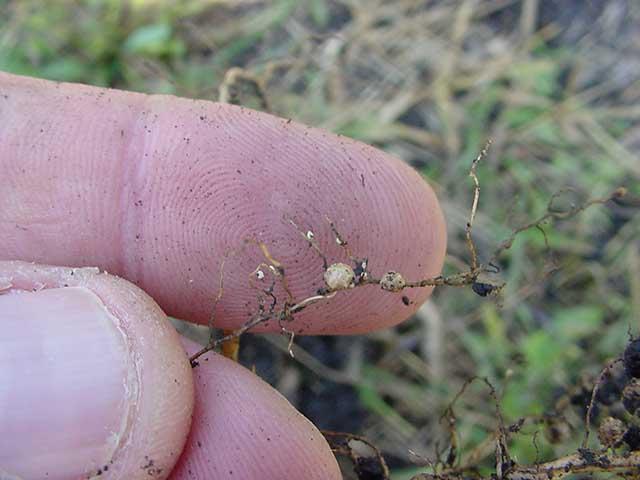
First detected in the United States in the 1950s, SCN is the No. 1 yield-robbing soybean pest, costing farmers an estimated $1.5 billion annually, according to the SCN Coalition, a public/private/checkoff partnership formed to increase the number of growers actively managing the nematode. The parasitic worm feeds on soybean roots, inhibiting plant growth and reducing root function.
Since the late 1980s, PI 88788 has been the primary SCN resistance source in U.S. soybeans due to its initial effectiveness and yield potential. Overuse and the ability of SCN to adapt continue to erode its effectiveness.
Recently released ISU field trial data collected from 2001 through 2023 revealed that the ability of SCN populations to reproduce on PI 88788 resistance increased 2% annually. SCN virulence to the trait is increasing at a nearly identical rate as a decade ago. All the data was collected in Iowa, though Tylka said the results are not unique to the state.
Based on the data, researchers project that PI 88788 resistance may provide only about 40% SCN control by the end of the decade, leaving growers vulnerable to average yield losses of roughly 9 bushels per acre (bpa), equivalent to 12% of yield potential.
"If we don't diversify how we manage the pest, farmers can expect that trend to continue," Tylka said in a statement.
Find the ISU SCN study at https://www.thescncoalition.com/….
WAKE-UP CALL
Behrendsen agrees that better stewardship of SCN traits is a must. His wake-up call about the declining efficacy of PI 88788 came several years ago when he noticed a 15- to 20-bpa yield gap between two soybean fields located about a half a mile apart. After digging deeper, he learned the lower-yielding field was planted to a variety with PI 88788 resistance, while the stronger-performing field was a variety with Peking (PI 548402) resistance.
Peking is currently the only other SCN resistant breeding line used in soybean varieties. It became more widely commercially available five years ago. While highly effective, Tylka said it's only available in 20% of soybean seed offerings to date.
P[L1] D[0x0] M[300x250] OOP[F] ADUNIT[] T[]
Behrendsen is taking steps to boost bean yields and protect SCN resistant traits, including collaborating with ISU on SCN research.
"Rotating varieties is so important. You don't want to plant Peking year over year, or SCN will become resistant to that (trait) faster," Behrendsen told DTN.
MANAGEMENT STRATEGIES
The SCN Coalition and panelists recommend several steps farmers can take to better manage the pest and preserve trait efficacy.
Test soil for SCN after harvest to know your egg numbers. Enter those results in the SCN Profit Checker to better understand potential yield loss and profit risk. Find the checker at https://www.thescncoalition.com/….
Consider planting corn-on-corn if SCN egg counts in a field exceed 10,000 per half a cup of soil, Tylka said. That will help reduce SCN pressure.
Adopt a balanced soybean rotation that includes both PI 88788 and Peking to slow the development of virulent SCN populations while maintaining yield performance. In a corn-soybean rotation, a field would be planted to one of the traits once every three years. In a corn-soybean rotation, rotating traits will extend the effectiveness of Peking to 20 years instead of 10 if Peking is solely used, Tylka estimates. Effective SCN resistance in soybeans is defined as 90% or more control.
"I fear the farmers that go for maximum yield in the short term (and only plant Peking) will hurt themselves in the long term," Tylka told DTN. "Rotation reduces SCN pressure, which will make PI 88788 more effective."
Nematode-protectant seed treatments can complement SCN resistant varieties or when host plant resistance is not available. Both chemical-based seed treatments and biologicals are available and labeled for managing SCN.
"When we plant PI 88788 as part of a rotation, we're more likely to spend money on a seed treatment to make the trait more effective," Behrendsen told DTN.
Consider planting nonhost crops - corn, alfalfa, oats, etc. - to lower egg counts and extend trait efficacy.
Find the SCN Coalition SCN management guide at https://www.thescncoalition.com/….
HELP IS ON THE WAY
BASF is on track to launch a new transgenic trait called Nemasphere to fight SCN in 2028, company officials recently confirmed. It will be stacked with native SCN-resistant traits and Enlist E3 soybean varieties.
The company currently has 28 soybean varieties in development ranging from Group 0 to Group 4.5 maturity.
Nemasphere expresses the protein Cry14Ab-1 that when ingested by the nematode eventually leads to its death, similar to Bt trait technologies that have been used for insect control in corn and soybeans previously. It's the first new novel mode of action to combat SCN in more than 60 years, and the first and only biotech trait.
"We should have all our regulatory approvals by the end of this year. We'll be able to grow enough seed for a full launch in 2028," Justin Moritz, BASF trait technology specialist, told DTN.
Like weeds developing resistance to herbicides, SCN has done the same thing to native traits, Moritz said. Soybean yields can be reduced by 30% or more by SCN with no above-ground visual symptomology.
"We're really excited because Nemasphere will be paired with native traits to create a durable, robust SCN protection system," he added.
Moritz expects current SCN yield losses will be mitigated in soybeans with the Nemasphere trait. "Growers will get back to the level on SCN control that they used to have with PI 88788. It's a unique system that's going to allow for maximum genetic (yield) potential to be expressed."
Another reason Moritz is optimistic about the performance of Enlist E3 soybeans with Nemasphere is that plants will tolerate a fourth herbicide: mesotrione, a Group 27 HHPD inhibitor. Enlist E3 soybeans also tolerate 2,4--D choline, glyphosate and glufosinate. Using multiple sites of action helps control weeds while limiting the development of herbicide-resistant weeds.
"We know mesotrione is a really effective (weed control) tool that works really well from a residual standpoint," Moritz said.
Best SCN management practices are recommended with Nemasphere Enlist E3 soybeans, including rotating native traits. "We're all going to have to continue to be stewards of these technologies," he concluded.
Read a 2024 DTN story about Nemasphere at https://www.dtnpf.com/….
Learn more at https://agriculture.basf.us/….
Matthew Wilde can be reached at matt.wilde@dtn.com.
Follow him on social media platform X @wildeagwriter
(c) Copyright 2026 DTN, LLC. All rights reserved.

