



Senate Ag Unveils Farm Bill, But No E15
Farm Bill Draft Updates Farm Programs, Leaves Out Prop 12, E15
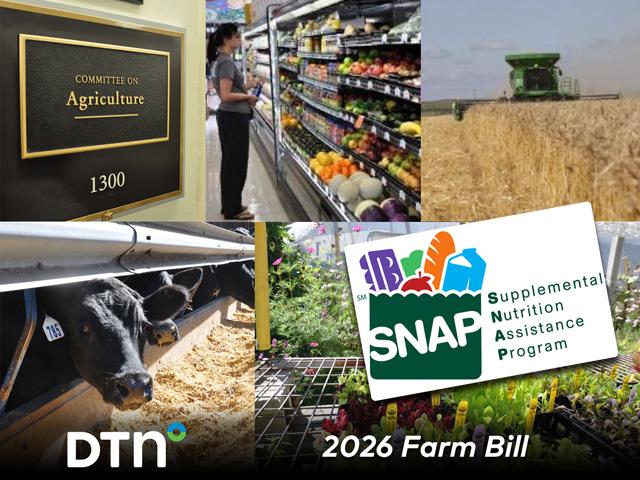
WASHINGTON (DTN) -- The Senate Agriculture Committee on Tuesday unveiled its long-awaited farm bill draft, proposing updates across farm programs, conservation, credit and rural development as lawmakers prepare for committee markup later this summer.
The legislation builds on changes enacted through last year's reconciliation package, the One Big Beautiful Bill Act, which increased commodity reference prices in crop insurance and made significant nutrition policy changes that together account for roughly 85% of farm bill spending.
The bill is budget neutral, looking for the easiest path to 60 votes and includes over 100 bipartisan bills included in the discussion draft, an agriculture committee staffer told DTN.
"I'm proud to put forward this discussion draft that reflects the input and priorities of Republicans, Democrats and most importantly, rural America," said Sen. John Boozman, R-Ark., in a press release.
A FEW KEY DETAILS FOR FARMERS
The legislation includes several farm-focused provisions.
-- Farmers would have access to higher Farm Service Agency direct loans and guaranteed loan limits. Conservation Reserve Program (CRP) payment limits would increase from $50,000 to $125,000 and expand USDA's emergency haying and grazing authority.
-- New certification pathways would allow agricultural retailers and crop consultants to provide conservation technical assistance and conservation loans could be used for precision agriculture equipment.
-- Cotton farmers would be able to both buy STAX crop insurance coverage and enroll in the Agriculture Risk Coverage (ARC) program.
-- The bill clarifies that whole milk is allowed in school breakfast programs.
MISSING FROM THE BILL
What is left out may be just as significant for various agricultural groups.
The new Senate text does not include language to overturn California's Prop 12 and similar laws, dubbed the "Save Our Bacon Act" or prohibit states from imposing livestock production standards beyond their borders. It's placement in the farm bill was discouraged by Boozman and its support weaned when Sen. Marshall, R-Kan., withdrew his full co-sponsorship, leaving eight senate co-sponsors left.
E15 also will need to find another path in the Senate, as Boozman had warning that it would not be included in the chairman's bill. Sen. Chuck Grassley, R-Iowa, has proposed that the legislation passed in the House could be passed as a stand-alone bill in appropriations. Senate Majority Leader John Thune, R-S.D., also has told the Senate agriculture committee, he wants to consider E15 during the summer work period, before August recess.
Democrats are expected to push for a two-year delay before states assume new responsibilities tied to the Supplemental Nutrition Assistance Program (SNAP) error-rate penalties. Last year's cost shift to states has already led many states to reduce exposure to new expenses. The Center on Budget and Policy Priorities reported SNAP participation fell by more than 4 million people, or 10%, between July 2025 and March 2026.
LINES OF CREDIT
Farmers won't have to cope with government shutdowns affecting commodity loans again. USDA would be required to service marketing assistance loans, sugar processing loans and loan deficiency payments in the case of a lapse in appropriations. Loan applications could not be processed during the 43-day shutdown last fall. Still, existing borrowers were still required to meet scheduled operating-loan payments.
Farm Service Agency loan limits would also increase. Farm ownership loans' allowable indebtedness would rise to $850,000 and up by $3.5 million for guaranteed loans beginning in fiscal year 2027. Farm operating loans would increase to $750,000 and $3 million for guaranteed loans.
The Farm Storage Facility Loan Program also would be expanded to include loans for on-farm propane and fertilizer storage facilities used for agricultural production.
P[L1] D[0x0] M[300x250] OOP[F] ADUNIT[] T[]
CRP GROUND
The bill increases the Conservation Reserve Program (CRP) payment limit from $50,000 to $125,000 -- the first payment increase in the program's history.
The bill also gives USDA more authority to allow emergency haying and grazing on CRP ground "in response to a localized or regional drought, flooding, wildfire or other emergency, on certain practices, outside the primary nesting season or during the final 2 weeks of the primary nesting season, on not more than 50% of contract acres, as identified in the site-specific plan," the bill said. Still, the provision falls short of broader grazing access sought by some livestock groups.
Conservation easement payments are also now excluded from adjusted gross income limits. That would allow more landowners to put their farms in conservation easements.
As a budget neutral bill, dollars from the EQIP programs are to be reallocated toward two new forest programs: the Forest Conservation Easement Program and the State Conservation Assistance Program.
MORE TECHNICAL SERVICE PROVIDERS, LESS NRCS
A new certification program would allow agricultural retailers or crop consultants to provide conservation technical assistance instead of relying solely on USDA Natural Resource Conservation Service staff.
This would allow organizing bodies like an irrigation association to certify individual technical service providers (TSPs), instead of directly going through USDA, a delegation of the agency's powers.
The reduced reliance on NRCS staffing follows USDA deferred employment programs that reduced the workforce by 23% between January 2025 and January 2026, according to research by the National Sustainable Agriculture Coalition and Prospect Partners LLC. A total of 700 soil conservationists and technicians were lost in the employment restructure.
"There's never enough staff on the ground to be able to get all the demand out there, so this is a way to supplement," an agriculture committee staffer told DTN. "That's really what the TSP program when it (was) ... brought about years ago was supposed to do."
The bill also allows conservation loans under USDA programs to be used for precision agriculture equipment.
NEW ARC USERS
Farmers growing Stacked Income Protection Plan (STAX) cotton in states like Texas, Georgia and Mississippi can now enroll in Agriculture Risk Coverage. The provision moves the restriction on combining STAX coverage with seed cotton ARC or Price Loss Coverage from the crop insurance title (Title XI) to the commodities title (Title I) beginning with the 2026 crop year. It replaces the existing prohibition with a narrower rule: producers may participate in both programs but cannot receive ARC or PLC payments on acres covered by STAX.
TAKING AIM AT FOREIGN FARMLAND OWNERSHIP
A provision in the text strengthens enforcement of the Agricultural Foreign Investment Disclosure Act (AFIDA) by increasing penalties for false filings. Foreign landowners who knowingly submit incomplete, misleading or false reports would face a minimum civil penalty equal to 5% of the fair market value of their agricultural land interest. The legislation maintains a maximum penalty of 25%. The changes are intended to improve compliance and oversight of foreign ownership of U.S. farmland, the text explained.
RURAL HOSPITALS
Through the Community Facilities Direct Loan Program, USDA would create temporary zero-interest loans to support rural hospital construction and renovation, an issue the committee said rural communities have long been facing.
But the provision follows the One Big Beautiful Bill Act's roughly $1 trillion dollars in Medicaid reductions over the next decade, which the National Rural Health Association estimates could reduce reimbursements for rural hospitals by about 21%. Despite including a $50 billion Rural Health Transformation Program (RHTP), it's expected to only offset only about one-third of projected losses, according to the KKF Health Foundation.
ANIMAL DISEASE PREVENTION
The Agriculture Act of 2026 combat threats that have arrived more persistently since the last farm bill including highly pathogenic avian influenza, New World screwworm and Asian longhorned tick.
The bill allows qualified veterinarians to conduct animal import inspections when Animal Plant Health Inspection Service staffing is limited. The bill also mandates to report on USDA's readiness to assist producers during foreign animal disease outbreaks and establish the U.S. Swine Health Improvement Plan (US SHIP) as a permanent voluntary certification program to "improve biosecurity, disease surveillance, traceability preparedness within the swine industry."
SALE BARN OWNERS
A provision would allow livestock auction owners to hold ownership stakes in finance or help manage certain meatpacking businesses, provided the operation remains below specified slaughter-capacity limits. The change could open new investment opportunities for local sale barns and smaller regional processors.
RURAL ENERGY FOR AMERICA PROGRAM
REAP would be expanded to allow USDA to provide up to $100 million in grants.
The proposal also simplifies applications for projects under $50,000, expands technical assistance, adds a rebate pilot for unexpected equipment purchases, considers applicants' financial benefits when awarding assistance and sets aside funding for emerging renewable technologies and technical assistance.
However, changes are also being made by USDA Secretary Brooke Rollins in alignment with Trump's "Ending Market Distorting Subsidies for Unreliable, Foreign Controlled Energy Sources," executive order. USDA sent a final rule to the White House Office of Management and Budget on June 15 to "simplify and streamline requirements and processes" for the REAP.
As part of the rulemaking process, REAP applications have been paused. The agency halted all new grant awards and stopped accepting applications, angering grazing, renewable, and sustainable agriculture coalitions.
Still, Boozman continues to back REAP and renewable energy investments in agriculture, committee staff told DTN, as demonstrated by the proposal to increase project funding capacity.
Rollins also announced USDA would not use taxpayer dollars to fund solar projects that displace farmland. Yet REAP primarily funds small-scale projects that are generally not large enough to remove farmland from agricultural production for power generation.
NEXT STEPS
Boozman has already indicated that a Senate Agriculture Committee markup is likely to occur after the July Fourth recess and before the August break, which runs from July 13 to Aug. 7.
"Hopefully at the end of the day, we'll get them (Democrats) on board and have a product that we can all be proud of and most importantly ... a product that will help out farmers," said Boozman in a radio interview this week.
Beyond appropriations and defense legislation, Congress has not convened a formal conference committee since 2023 and has done so only rarely since 2019. If the Senate committee advances a partisan bill, the farm bill could face a prolonged back-and-forth process between the House and Senate before a final agreement is reached.
DTN Business Editor Chris Clayton contributed to this report.
For legislative text: https://www.agriculture.senate.gov/…
Read more at "NPPC Pushes Back on $30M Prop 12 Ads," www.dtnpf.com/agriculture/web/ag/livestock/article/2026/06/19/prop-12-fight-escalates-animal-ad
Also read "Stalling E15 Expansion Risks Corn Acres," www.dtnpf.com/agriculture/web/ag/news/business-inputs/article/2026/06/17/report-us-lose-30-million-corn-acres
Jake Zajkowski can be reached at jake.zajkowski@dtn.com
Follow him on social platform X @jzajkow
(c) Copyright 2026 DTN, LLC. All rights reserved.

