


Smith Defends Rural Loan Cuts, REAP
Undersecretary Smith Defends Rural Development Performance
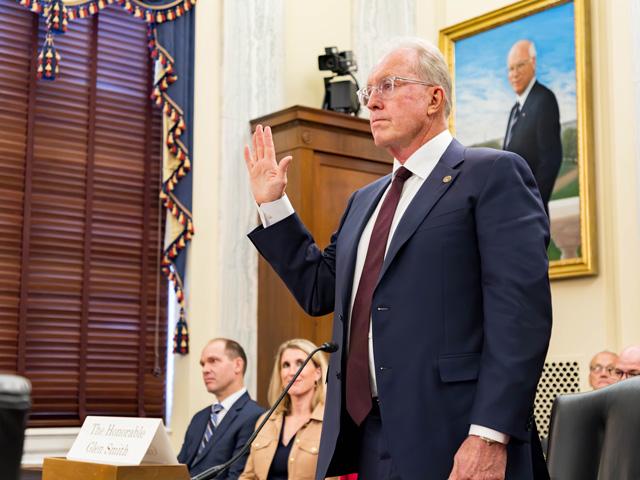
WASHINGTON (DTN) -- Agriculture Undersecretary for Rural Development Glen Smith on Friday defended the Trump administration's decision to issue about half the historic number of rural housing loans and appropriated money, as well as require upfront funding for some renewable energy projects under the Rural Energy for America Program.
An article in Politico last week reported that USDA had spent only about half of the $1 billion that Congress had provided for a rural housing program known as Section 502, which provides zero-down-payment mortgages with deep payment subsidies to help low- and very-low-income families buy or build primary residences in eligible rural areas.
Members of Congress said last week that the decision not to spend the money would contribute to a housing crisis in rural America.
But in the interview, Smith maintained that the program was "originally funded" at the $750 million level and that $571.7 million, or 76.2%, was obligated. Another $250 million will carry over into the current fiscal year, Smith said.
The undersecretary described the Trump administration's handling of the program as "a success story." He said that the direct loan program had "a high level of delinquency," but that the delinquency rate fell from 3.82% to 2.89%, a 25% decrease. The delinquency rate was "not only a disservice to the taxpayer," but defaulting on a federal loan can "destroy" a borrower's ability to get credit for life.
USDA followed up with a factsheet posted on its website on Tuesday.
The Trump administration, Smith said, has imposed a higher level of scrutiny on the validity of the loans and is increasing the financial literacy of low- and very-low-income borrowers.
"If the borrowers have no possibility of repaying, it does a real disservice," he added.
Smith also said that the government shutdown, combined with the end-of-the-year holidays, made the agency "inoperative" for nearly three months. Without the shutdown, USDA would have obligated all the money for rural housing that was funded, he said. As the fiscal year ended, rural development employees worked into the night to obligate spending, he added.
P[L1] D[0x0] M[300x250] OOP[F] ADUNIT[] T[]
But while Smith maintained that the Politico housing story was "incorrect," Bob Rapoza, a lobbyist for the National Rural Housing Coalition, said Smith "is incorrect," citing the 2026 appropriations act.
"For the last 10 fiscal years, prior to FY 26, USDA has averaged $1.01 billion in loans and made over 5,400 loans and spent every dime appropriated by Congress," Rapoza said. "USDA can obfuscate how much money was available. However, it cannot get around the facts: In FY 26, USDA underperformed by an astonishing degree -- obligating only $571 million and making only 2,115 loans."
Rapoza added, "USDA concocted a policy on Section 502, slowed the program to a crawl, made it unusable in over 20% of rural counties, and resulted in close to $200 million of Section 502 funds lapsing, which we believe is impoundment and in clear violation of the Impoundment Control Act of 1974."
REAP REFORMS
On Friday, USDA published a new rule shifting the REAP program, formerly providing grants to renewable energy projects on farms, to a post-completion, performance-validated model, which now forces interested farms to pay for renewable system up front.
"During the last administration, we saw solar farms consume fertile farmland that should be feeding America. Those days are over," the USDA press office told DTN during the rule's release. "USDA will not actively participate in repurposing farmland historically used to sustain this country's abundant food supply."
But Smith said, "We are not eliminating solar for REAP." He explained that, under a new rule announced for REAP, "we want 12 months of data in the application coming in." During that interim period, he said, the applicant is eligible for a guaranteed loan with a bank, but not eligible for grant funding.
USDA will work with a primary lender up to 80%, and the participation fee, which had been around 3% for the lender, has been lowered to 1%. After the applicant has "proven what they are doing," he added, USDA can finance the project for "the usable life of the equipment" with grants and loans.
A coalition of farm environmental and solar development groups last week filed a lawsuit against USDA, charging that the Trump administration "has imposed unlawful anti-solar eligibility criteria on REAP while abruptly changing the rules of the program such that farmers and rural small businesses across the country have been individually stuck with tens of thousands of dollars of unexpected expenses."
(See "Groups: USDA Violated Law on REAP Rules" here: https://www.dtnpf.com/….)
The lawsuit was filed on behalf of farmers, solar developers and installers, grant writers and organizations representing these interests.
Smith also acknowledged that the Trump administration has reduced the rural development staff by 1,500 employees, leaving 3,100 employees nationwide. He said the administration is hiring additional staff and is determined to place a public information officer and an engineer in every state. He also said he believes that modernizing rural development's information technology programs "will significantly increase the capacity of the 502 program," but its first impact will be on REAP.
He said that the previous IT systems in the rural development mission area dated to the 1960s, and he is "excited about the new IT platform." He said the new system was not developed by Palantir, the controversial company in charge of developing a new IT system for farmer-facing programs.
Smith was the last of President Donald Trump's USDA nominees to be confirmed by the Senate. An Iowan, he was sworn in on Aug. 24 at the Iowa State Fair.
See the USDA housing news release here:
DTN Ag Policy Editor Jake Zajkowski contributed to this report.
Jerry Hagstrom can be reached at jhagstrom@nationaljournal.com
Follow him on social platform X @hagstromreport
(c) Copyright 2026 DTN, LLC. All rights reserved.