



NWS Prevention, Eradication Important
US Agencies Battle New World Screwworm Through Prevention Measures
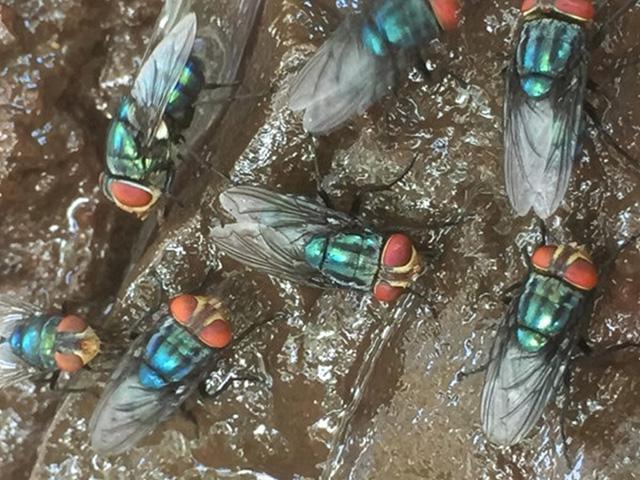
REDFIELD, Iowa (DTN) -- While New World screwworm (NWS) is not currently found in the U.S., officials say it is important to be aware and prepared for the pest and understand how it could affect animal industries.
Deputy Director NWS Directorate for USDA Animal and Plant Health Inspection Services Chris Needham said there is an all-government approach to keep NWS out of the U.S.
"Our No. 1 goal is to keep it out and keep our animals and food supply safe," he said. While working toward this goal, Needham said it is important to constantly be on the lookout for the insect. "The pest feeds on living tissue, often through wounds. If we get one, we will likely get more than one and even though it's not contagious animal-to-animal, we have to have a plan to attack the insect to eradicate the problem," he said during a webinar hosted by the Council for Agricultural Science and Technology.
Needham explained the insect will destroy tissue, bone and ligaments. If left untreated, the animal can die in 7 to 14 days. Newborn animals are particularly susceptible and have almost a 100% death rate if infested.
WHERE TO LOOK FOR NWS
Sonja Swiger, professor and Extension specialist with Texas A&M University, said the flies are generally found in forested areas and are active in clusters. Their best survivability is between 60- and 90-degrees Fahrenheit. Even though a female will only breed once, she can lay between 200 and 300 eggs on a host from that breeding. "Target spots for egg laying are in wounds, the navel, ears, cuts, castration and dehorning spots, or on areas as small as a tick or fly bite," she said. "The New World screwworm fly is a little bigger than a housefly with red- or orange-colored eyes, a yellow face and metallic blue or green body."
She said the eggs are very small and hard to see and when animals are infested and moving from one place to another, they can spread the pest as larvae moves to the pupae stage it will drop from the animal and develop into an adult fly on the ground. The entire lifecycle of the NWS is 18 to 21 days.
P[L1] D[0x0] M[300x250] OOP[F] ADUNIT[] T[]
HISTORY OF THE PROBLEM
The New World screwworm was first found in the U.S. in 1842 in the southwestern states. The pest gradually spread through Texas and to the southeastern states. The Sterile Insect Technique (SIT) was first introduced in 1936 by two prominent entomologists Edward Knipling and Raymond Bushland. This is the same technique used in present day for eradication. Up until late 2024, the pest had been eradicated for many years in the U.S. and Mexico. The pest has been kept out of the U.S. but has gradually moved northward through Mexico over the past year, being detected as close as 70 miles from the U.S. border in southern Texas. "Surveillance and reporting are crucial. Animals must be treated and sterile flies have then been released in the areas where NWS has been found," Swiger added.
HUMAN CASES CAN HAPPEN
Humans can be affected by NWS also. Megin Nichols, NWS Incident Manager with the Center for Disease Control (CDC) said the U.S. coordination efforts to combat NWS has many agencies working together. "We must educate health care providers on what to look for and what to do if they suspect a human case," she said. "It's first important to positively identify that it is in fact NWS. This includes seeing visible larvae, having a painful lesion with discharge and a terrible odor."
Removal of the larvae, regardless if on a human or animal, should be done carefully by wearing gloves and putting the larvae in rubbing alcohol in a leak-proof container. Nichols said often a telediagnosis with doctors or CDC officials can be done to determine what the treatment steps should be.
People can protect themselves from NWS by keeping skin wounds clean and covered, limiting exposed skin by wearing long sleeved shirts and long pants, socks and hats, she said. Insect repellents containing DEET should be used, clothing and gear can be treated with 0.5% permethrin and sleeping indoors or in rooms with screens is also important.
WHAT TO DO IF CASE SUSPECTED
Needham said if animal owners suspect an NWS infestation, they should contact their local or state veterinarian immediately, along with USDA officials.
"The USDA and other agencies are doing our best to keep the pest out and have had constant surveillance since the problem was identified in Mexico," he said. This surveillance includes 120 screwworm specific traps along the southern border with continual inspection of flies that are caught. More than 7,000 fruit fly traps are doing double duty to catch fruit and NWS flies. None have been found in these U.S. traps. Additional traps are placed in high-risk areas of Mexico. Surveillance of wildlife has also been an important prevention factor.
"Sterile flies are the key to eradication since females only mate once," he said. "But the 100 million produced at the Panama facility is not enough." Additional production facilities are planned, with one in Metapa, Mexico, projected to open by mid-2026 to produce another 100 million sterile flies per week and at Moore Airbase in Texas by the first part of 2027 to produce 100 million and ramping up to 300 million sterile flies per week. In addition, a sterile fly dispersal facility will be ready to use in early 2026 also at Moore Airbase.
"We want to maximize our readiness. We have been training the tick riders who are looking for stray cattle and wildlife on the border to be looking for these pests. As well as the Beagle Brigade to be able to detect the NWS at ports of entry," he explained.
Through the end of November, 135,000 cumulative animal cases have been found in Central America and 980 human cases. Mexico has marked 11,667 cumulative animal cases and 86 human cases. The officials conducting the webinar stressed NWS is preventable and treatable. Keeping the pest out of the U.S. through good biosecurity is the key. The Food and Drug Administration has given conditional approval for some drugs to be labeled for use with NWS prevention and treatment.
For more information on the NWS problem, visit www.screwworm.gov.
Jennifer Carrico can be reached at jennifer.carrico@dtn.com
Follow her on social platform X @JennCattleGal
(c) Copyright 2025 DTN, LLC. All rights reserved.