



Ag Weather Forum
Winter Storm May Help Control New World Screwworm
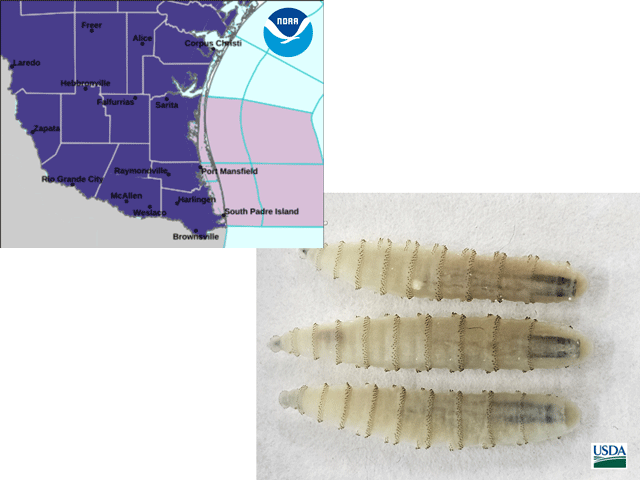
Across the central and eastern United States, the 2026 mid-January winter storm has brought delays, damage and danger. The storm brought record-breaking cold, blizzard-strength winds, freezing rain and snow to many states east of the Rocky Mountains. Problems related to human safety and livestock health threats resulting from this Arctic cold outbreak have been well-covered. (See "Cattle Producers Battle Winter Weather," https://www.dtnpf.com/…)
But there is one potential benefit from the extensive cold wave. That possible benefit is the impact that the cold might have on the New World screwworm population in northern Mexico, and the capability of this parasite to encroach northward on the U.S.-Mexico border later this year. That's because the low temperatures during the Jan. 23-26 weekend -- the coldest in Texas in five years -- did not stop at the Rio Grande. They also spread southward into the state of Tamaulipas in northeastern Mexico. The cold, in turn, may have caused some stress to the New World screwworm flies and larvae that were reported in Tamaulipas state back in early January.
P[L1] D[0x0] M[300x250] OOP[F] ADUNIT[] T[]
A look at weather conditions for Reynosa, Mexico -- a large city in Tamaulipas state -- shows some frigid values for that part of North America. The early week forecast for Reynosa calls for overnight low temperatures of around 30 degrees Fahrenheit with possible new record cold for this point in January. This cold outbreak is coming at a favorable time when it comes to looking at the prospect for the New World screwworm to propagate and move farther north toward the U.S. border.
The cold air in northern Mexico does pose a threat to New World screwworm larvae. The 30-degree Fahrenheit temperature category in northern Mexico may not kill the parasite, but its population growth cycle is definitely delayed. Research published in 2013 by the World Organization for Animal Health finds that "In this pupal stage, NWS cannot survive in soil temperatures below 46 degrees F." Any slowdown in the screwworm's propagation means a later date for the NWS to make its way into the U.S.
Looking further ahead, how quickly the temperature pattern switches from this strong cold wave to more normal or even above-normal values will be well-worth monitoring. The New World screwworm is most active when temperatures are between 77 and 86 degrees Fahrenheit. A quick change from this January chill to those more sub-tropical conditions could give a quick charge to the NWS reproductive cycle and make any midwinter delay just a minor slowdown.
Bryce Anderson can be reached at bryce.anderson@dtn.com
(c) Copyright 2026 DTN, LLC. All rights reserved.