



Buy Inputs Early to Manage Margins
Winning the Input Game
Every August, when many farmers are still worrying about the crop growing in their fields, Rick Schmitz is already thinking about next year's crop.
The southwest Iowa farmer typically buys his anhydrous ammonia in late summer, months before he will need it. The timing isn't accidental.
Last August, Schmitz locked in anhydrous ammonia at $720 per ton. By spring, prices in his area had climbed to roughly $1,100 per ton.
"That's a huge difference between operating in the red and black," Schmitz says. He spent more than two decades as an agricultural lender and, today, views prepurchasing inputs as a business necessity. "When margins are red or breakeven, you've got to watch every dollar."
That mindset is increasingly important for crop producers facing lower grain prices and stubbornly high input costs. While fertilizer prices often receive the most attention, opportunities to improve profitability can come from strategically purchasing all inputs, including seed and crop-protection products, months before they are needed.
Finding the cheapest price is only part of the equation. Capturing those savings requires planning, liquidity, access to credit and a clear understanding of farm profitability.
"It's really important that producers make sure they're proactive in planning for the upcoming crop year," says Joe Springer, who leads Compeer Financial's retail agricultural lending team, which covers parts of Illinois, Minnesota and Wisconsin.
BALANCE CASH-FLOW WITH PRICE
For many producers, the biggest obstacle to prepurchasing isn't identifying a bargain: It's finding the capital to take advantage of it.
During his time as a banker, Schmitz says he saw a lot of farmers hesitate to buy fertilizer in late summer and early fall because they were heavily invested in the current crop and hadn't yet received any income from harvest.
"That's a time when a lot of farmers don't want to spend the money because they've obviously spent all of their money on the crop that they are waiting to come in," he adds. Yet, Schmitz believes the savings can justify the effort.
UNDERSTAND SEASONAL TRENDS
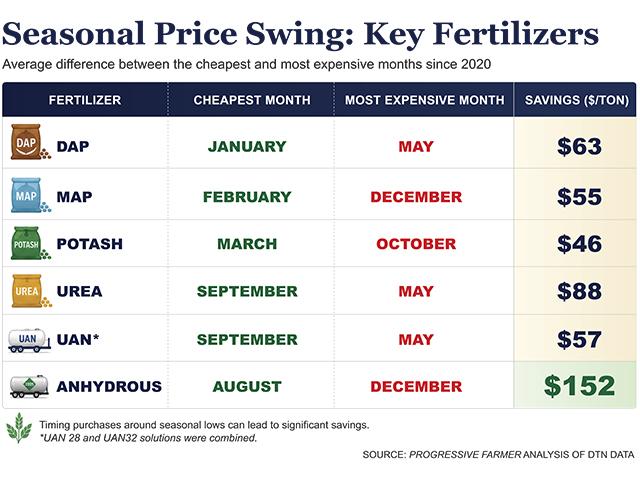
DTN has been tracking retail fertilizer prices on a weekly basis since 2008, and the data confirms that, on average, prices for nitrogen fertilizers are cheapest in the late summer and early fall.
Since 2020, August has been the cheapest month to buy anhydrous ammonia, costing an average of $88 per ton less than in October and $152 per ton less than in December, according to DTN data.
Urea and UAN (urea-ammonium nitrate) solutions are usually cheapest in September and most expensive in May. Farmers who purchase in September would save an average of $88 per ton on urea and $57 per ton on UAN.
Typically, diammonium phosphate (DAP), monoammonium phosphate (MAP) and potash are cheapest in the first quarter of the year.
P[L1] D[0x0] M[300x250] OOP[F] ADUNIT[] T[]
Just like grain markets, seasonal price trends are not a guarantee -- especially when prices are tied to global markets -- but they can be helpful guides.
SEED, CHEMICALS FOLLOW DIFFERENT CALENDAR
While farmers often focus on fertilizer purchases in August, it's also when seed companies roll out early-order discounts, financing incentives and promotional programs.
Schmitz says he generally finalizes most seed purchases by Dec. 1 and often begins making commitments during harvest.
Seed companies "want you to commit or buy as early as possible. They're willing to give you bigger discounts and perks to do that," he explains.
Schmitz typically purchases crop-protection products by mid-January to capitalize on manufacturers' incentive programs and retailer discounts, which become increasingly important as farm profitability tightens.
DON'T LET TAXES DRIVE THE ENTIRE DECISION
"Prepay should be more than just a tax play," says John Maman, a financial specialist with Nutrien Financial. He argues producers should view prepurchasing as part of a broader capital-management strategy designed to improve cash-flow, secure agronomic needs and maximize return on investment.
Maman recommends regular conversations with tax advisers, as well as agronomists, lenders and financial advisers throughout the year, to review various market offerings rather than waiting until harvest. "The best time to start looking at this is right after you get that crop in the ground," he says.
Many companies, including Nutrien Financial, offer input-financing programs that can help farmers lock in purchases, incentives and discounts. Many credit offerings will let farmers pay the bill after they harvest the crop produced with the inputs.
Springer says taking advantage of those programs often requires conversations with lenders, and those discussions should start well before discount opportunities arrive.
"If I have a revolving line of credit, is it sized properly so I can make these decisions when I need to?" Springer asks. "If it is not sized properly, let's talk about that."
Those conversations can help farmers determine whether cash should be directed toward fertilizer, seed, chemicals, machinery or debt reduction. In some years, preserving liquidity may be more valuable than locking in an input purchase.
GEOGRAPHY MATTERS
Farmers in some regions are more consistent prepurchasers than others, and the Iran war has illustrated what's at stake.
"As you go further south, inherently because of agronomic reasons, you are a spring-applied marketplace," Maman says. Warmer winter temperatures increase the risk of nitrogen loss from leaching and denitrification, making fall application impractical.
A survey by the American Farm Bureau Federation (AFBF) found that growers in the South, Northeast and West are "more likely to purchase fertilizer closer to application, increasing exposure to in-season price volatility during periods of market disruption."
The April survey, which was conducted after the Iran conflict caused prices to spike, found just 19% of Southern growers had prebooked fertilizer compared to 67% of their Midwest counterparts. As a result, 78% of Southern farmers say they were unable to afford all the fertilizer they needed for their 2026 crops.
"Overlapping increases in fuel and fertilizer expenses help explain why more than 90% of farmers surveyed reported that their financial conditions have worsened or remained the same since last year," AFBF Economist Faith Parum writes.
The survey highlighted a broader lesson: Planning ahead doesn't just help secure lower prices. It can also protect farmers from supply disruptions and market shocks.
FERTILIZER, SEEDS ARE PREDICTABLE NEEDS
Maman, Schmitz and Springer all recommend farmers begin discussions with lenders and suppliers early enough to take advantage of available incentives, especially since these inputs are needed every year.
"Don't wait until fall to decide ... because at that point in time, you might be a little bit behind the eight ball if you're having to go through the process of getting something set up from a lender perspective," Springer says.
Prepurchasing can also create counterparty risk, so Springer encourages written contracts that confirm delivery terms.
"The last thing you want is when you need a product, it's not there but you have already paid for it," Springer says.
FOCUS ON MARGINS, NOT JUST THE COSTS
Ultimately, Springer says farmers should avoid viewing prepurchasing as a simple exercise in finding the lowest price. The goal is protecting profitability.
Crop inputs are just one element of profitable farming, but an analysis from the Illinois Farm Business Farm Management Association looked at profitability data from more than 4,900 farms during the past 20 years. Among the trends, the most profitable farms found a way to save $35 to $44 an acre on crop input costs compared to less-profitable farms.
For Schmitz, that reality has become increasingly clear as crop margins have tightened. In an era of narrow margins, successful input purchasing has less to do with predicting fertilizer markets and more to do with preparation, planning and putting capital to work at the right time.
"When corn's $7, and beans are $15, that really doesn't matter," he says. "We can all get sloppy then. But, when margins are red or breakeven, you've got to pay attention."
**
-- Follow Chris Clayton on DTN at https://www.dtnpf.com/… or follow him on social platform X @ChrisClaytonDTN
[PF_0826]
(c) Copyright 2026 DTN, LLC. All rights reserved.