


Cattle Industry Leader Builds a Legacy for Her Family
Rooted on the Range
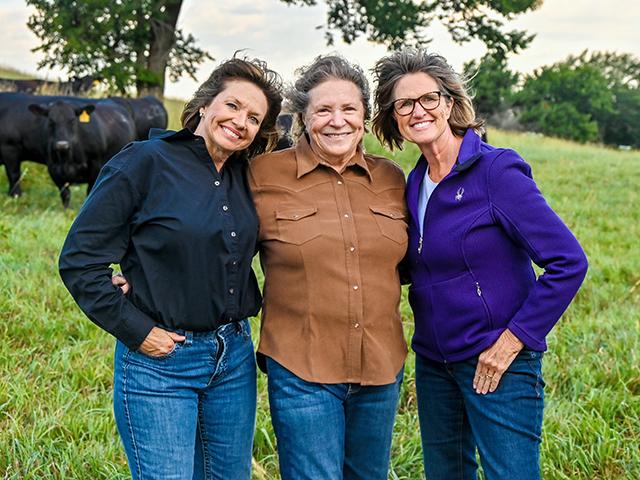
The Kansas wind sweeps across the Flint Hills, stirring the grass around the Angus cattle Jan Lyons has spent nearly 50 years raising. Beside her are daughters Debbie Lyons-Blythe and Amy Lyons Langvardt, the next generation of women shaped by this land, these cattle and the example of their mother.
They learned early that ranching demands more than physical strength. It requires resilience, problem-solving and an unwavering commitment to family, livestock and land.
Those lessons, passed from one generation to the next, have shaped not only the Lyons family ranch but also three women who have spent their lives advocating for agriculture.
Their story is especially fitting in 2026, designated by the United Nations as the International Year of the Woman Farmer. The Lyons family's experience reflects how women's roles in agriculture have evolved from doing essential work far from the spotlight to leading some of the industry's most influential organizations.
"Women have always been involved in agriculture," Jan says. "They were out there doing the work. But, the strength, mentally, to do what the pioneer women did was unbelievable."
Jan rarely separated the challenges of being a woman from those of being a cattle producer. The work needed to be done, regardless of gender. For her, that meant balancing a growing cattle operation and raising a family with an expanding role as an industry advocate.
While building the ranch and raising two daughters, Jan became the first woman to lead both the Kansas Angus Association and Kansas Livestock Association (KLA), and she later served as president of the National Cattlemen's Beef Association (NCBA). Her 2004 term came at a pivotal moment for the cattle industry, as the United States grappled with its first case of bovine spongiform encephalopathy (BSE). Jan became a public face for cattle producers, helping communicate with consumers about beef safety as the industry confronted an unprecedented crisis.
But, the confidence to take on those roles began much earlier on an Ohio farm.
ROOTS IN OHIO
"My dad worked away from the farm so he could have the farm," Jan says, reminiscing on milking cows with her brother. "He switched to Angus cattle in 1950, which made life totally different. We just loved those cows."
Her dad started with eight cows and a bull, and he gradually grew the herd. Jan helped with the cattle and in the hayfield, while 4-H gave her an opportunity to learn more about raising and caring for livestock.
Her future husband, Frank, grew up nearby. They married the summer before Jan's third year at Ohio State University, where Frank was also a student. Money Jan saved from selling calves at the fair helped pay for her education.
"The rewards of working hard and learning about cows made me want to continue that lifestyle. I found something that was profitable and I enjoyed," she says.
Just as important as the skills Jan learned from her father was the confidence he instilled in her. He encouraged his daughter to believe she could do anything she set her mind to -- a mindset she carried with her long after leaving the Ohio farm.
P[L1] D[0x0] M[300x250] OOP[F] ADUNIT[] T[]
As Frank trained to become a physician, the couple knew they wanted to eventually return to the land and raise their children on a farm. That opportunity would take Jan hundreds of miles from the place and family she knew.
A SHIFT TO THE PRAIRIE
Jan and Frank left Ohio for Fort Riley, Kansas, where Frank worked at the Army hospital after his formal training to be a doctor.
"We got here, and the rolling hills were just so much like what we were raised with in Ohio," she adds. "But, there weren't all the people. We discovered the Kansas grass was so good, and it was a perfect place to raise cattle."
By 1977, they purchased a ranch near Manhattan and began building a family operation. Daughters, Debbie and Amy, joined 4-H and starting with lambs before the family added Angus cattle to the ranch.
"I told the girls that their dad would mostly be working, so if we were going to have cows, we would have to do the work," Jan says. Frank helped on the ranch at night and on weekends, but much of the day-to-day work fell to Jan and the girls.
Every summer, the family hooked up a trailer and headed to cattle shows. While some people questioned a mother and daughters hauling livestock on their own, the Lyons women focused on the task at hand. They learned to back trailers, care for cattle on the road and make decisions under pressure.
"The girls grew up working and helping with the cattle. We weren't afraid to load up the cattle and head to a show. We learned we could do about anything," Jan says. "If you expose them to it and include them, then they know it's part of the family and part of who they are."
The family also attended the National Junior Angus Show each summer. The experience offered lessons far beyond the show ring.
"We had heifers to show, but we learned so much more," Debbie says. "The first quiz bowl was in 1982, and we had talked about the beef industry at dinner nearly every night, and our team won that first quiz bowl contest."
Those experiences built skills the women still use today, particularly the ability to assess a situation, make a decision and explain the reasoning behind it.
"We have to do that every day," Amy adds. "Day-to-day assessments of the herd and how to make the right decision. That's what Mom taught us."
Back at the ranch, the work was also building something less tangible. Looking back, Jan sees those years together as lessons in responsibility to the land, the livestock and one another.
"What it means is you're building a life. You're building a respect for the land. You're talking about not only the cattle, but you're talking about the pastures, the grass, what you're feeding, how you're taking care of the animal," Jan adds.
LEADING BEYOND THE RANCH
Jan approached ranching as a learning experience. She attended KLA events and sought guidance from organizational leaders when land issues arose in their area. Conversations with other producers, educators and industry professionals broadened her perspective and eventually opened doors to leadership.
Jan's willingness to speak up for agriculture soon led to leadership opportunities in state and national cattle organizations, even as women remained uncommon in those roles. She became the first woman president of the Kansas Angus Association in 1982 and the KLA in 1994. She went on to chair the Cattlemen's Beef Board in 1996 and serve as president of NCBA in 2004.
"I feel like Mom and some other powerful women who were involved in agriculture at that time broke the glass ceiling for women to be involved," Debbie says. "So, by the time I was looking for leadership opportunities, I knew I was going to be accepted. And, it might not specifically be as a woman, but it was as a rancher."
That influence extends beyond industry leadership. Debbie and husband, Duane Blythe, live on Blythe Family Farms, near White City, Kansas, where they raised five children on their commercial and Angus cattle operation. Amy, her husband Karl Langvardt and sons, Trey and Tanner, are co-owners of Lyons Ranch with Jan and Frank. Trey and his family now live and work at the ranch headquarters, carrying the family's connection to cattle into another generation.
PASSING IT ON
In March 2027, the Lyons family will hold its 39th bull sale as it celebrates 50 years of Angus production. Debbie and Amy say they learned how to market cattle by watching their mother -- from the way she talks about the herd to her honest representation of the cattle and genuine respect for the people buying them.
"We always have worked together as a team, and gender didn't matter," Amy says. "The work had to be done. Sometimes, we may need to take a little different approach to doing something, but we'd always get it done."
It is an approach Jan learned long before she came to Kansas. As a girl on an Ohio farm, her father encouraged her to believe she could do anything she set her mind to. She carried that confidence into building a ranch, raising a family and taking on leadership roles few women had held before her.
Today, the tools and technology have changed, but the lesson has not. Jan passed that same confidence to her daughters, who have carried it into their own ranches, families and leadership.
For Jan Lyons, that may be the most important legacy of all.
**
-- Jennifer Carrico can be reached at jennifer.carrico@dtn.com
-- Follow Jennifer on social platform X @JennCattleGal
[PF_1126]