

Ag Tech Pays, But Adoption Lags
Technology Delivers Value to the Farm, But Not Always Well Adopted, Says Fieldwork Robotics Chair
Seth Crawford works where dirt meets data. With more than 30 years of experience at John Deere and AGCO -- most recently leading AGCO's $1.3 billion precision ag unit, PTx -- he is now chairman of a robotics company. Crawford is closely involved in vast efforts to bring artificial intelligence (AI) and modeling, digital analytics, optics, and precision technology into farmer-friendly systems.
That last goal is not always met, he noted in a recent interview with DTN/Progressive Farmer.
In addition to his work in ag technology, Crawford is a fifth-generation farmer. Along with his cousin, he works his family's corn and soybean farm in Minnesota where some soils have been cultivated for 150 years. In not too many years distant, Crawford foresees a very different landscape when perhaps, a fifth of all farm work in the Heartland will be performed autonomously.
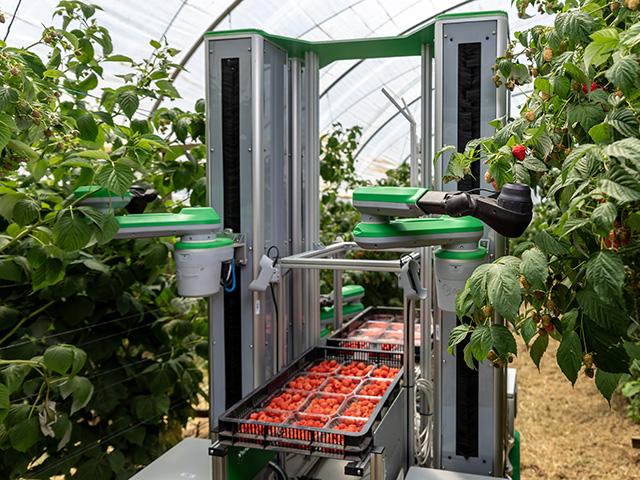
In December, Crawford was named chairman of Fieldwork Robotics, a UK-based technology innovator developing an autonomous robot for harvesting soft fruits, such as raspberries (see a short video at www.fieldworkrobotics.com). Crawford also sits on the advisory board for Verdant Robotics. Verdant's SharpShooter innovation is a precision application system that is said to deliver millimeter-accurate weed control, crop thinning and input application, reducing labor costs by up to 85%.
Crawford is also the founder and CEO of Crawford Advisory Partners, helping farms and industrial businesses turn technology into financially rewarding results.
Here is DTN/Progressive Farmer's conversation with Crawford about Fieldwork Robotics and what technology means to agriculture. It has been edited for clarity.
**
DTN/Progressive Farmer: Seth, tell us first about Fieldwork Robotics.
Seth Crawford: We're focused on Rubus crops. That's raspberries, blackberries, soft fruits. And it's harvesting those soft fruits robotically, whether that be inside a lane within a poly tunnel or outside; we're focused on supplementing human labor.
**
DTN/PF: What are the technical challenges in harvesting these fruits?
P[L1] D[0x0] M[300x250] OOP[F] ADUNIT[] T[]
Crawford: The biggest challenge is locating the fruit, making sure it's at the appropriate stage of ripeness, and then being able to grab the fruit and detach it from the plant without damaging it. We believe we can get a high pick rate that's at least equivalent to a human but also do a better job of getting the fruit that's ready to be picked and doing it with less damage. There's about 30% of the crop that is either left unpicked or that goes to waste. We believe with this technology, we'll be able to reduce the percent that goes to waste.
**
DTN/PF: Describe the key functions of the robot.
Crawford: It's the way we grab the fruit. Instead of an opposable thumb and fingers, think of it as a cup that goes up and it applies the appropriate amount of pressure around the fruit, and then it's able to pull the fruit off the plant. That's the big breakthrough. The robot picks with four arms on one cart. Each arm has multiple cameras. (The cameras guide the picking process) but also produce the images that allows us to get better and better at identifying the stages of ripeness, how fast the fruit progresses. We (learn) about the health of the plant. These images help us build out better robots.
**
DTN/PF: Over the time of your career, you've been witness to the rapidly expanding work to deliver technology to the farm. How is it working down on the farm?
Crawford: I'd say it's fragmented. And I say that having lived and worked in the corporate environment, being part of guidance (technology) from the very beginning over the last 20-plus years and now living the farming life. I'm shocked that you see tractors operating without even basic guidance. Some of the things I think we took for granted in the precision ag world, on the corporate side, was that variable rate was well adopted; rate and section control was used by all. And that's just proving to be false. It's fascinating to me to hear the reasons why. In some cases, farmers say it simply doesn't pay. In other cases, they'll say it's too hard to use, or they have tried it, but they couldn't get it to work.
**
DTN/PF: When you say it takes effort to learn and efficiently manage the technology, is it that farmers just don't want to take the time, or it's not as intuitive as maybe it's represented to be?
Crawford: I'm a firm believer it does pay, and it is worth the effort. But it does take effort, and that's a challenge. There's a little bit of a fear, you know, along the lines of, what if I mess this up? But there are a lot of good companies out there doing a lot of farmer education. I'm inundated now with the invitations, whether it's planting, fertilization, just crop care throughout the year. I think that's all fantastic. But as a person sitting through those sessions, I know it also can just feel overwhelming.
**
DTN/PF: Is there an age divide between those who adopt various technologies and those who do not?
Crawford: Farmers who have been (farming) for a long time, who are not real comfortable with the technology, especially if they're financially secure, they're just going to get it done. There are strong, young farmers taking full advantage of the technology. But even young farmers will tell you when it's the heart of the season, if they try something and it doesn't work, they're going to default to the old way.
**
DTN/PF: Let's talk about the technology that is out in the field. AGCO is fielding an autonomous grain cart system. Deere and AGCO are commercializing autonomous tillage technologies. What's your view of it all?
Crawford: If I can have an autonomous grain cart, and it is highly reliable and easy to use, I'm absolutely for it. (But) I still want to be able to unload into the truck autonomously. I'm excited about what I see some of the companies out there doing, as far as autonomous tillage work. I think once it is perfected, you'll see autonomous planting. The planter is pretty darned automated already. We need the tractor to be automated to pull it through the field.
**
DTN/PF: Seth, from the perch of your farm in Minnesota, what do you think you'll see in the next five years from technology?
Crawford: The labor crisis is going to get even more extreme and severe. I was here for the full harvest in 2025. Hauling loads to the grain terminal, I brought the average age of those drivers down. I'm in my 50s, and these (other) folks are in their 70s. There were a lot of them. They're going to have a tough time doing that in five years. If we don't have the automation and full autonomy, I'm not quite sure how we're going to get everything done. I think that in five years, it's a very real possibility that we'll have 20% plus of the work being done autonomously in the Heartland.
Dan Miller can be reached at dan.miller@dtn.com
Follow him on social platform X @DMillerPF
(c) Copyright 2026 DTN, LLC. All rights reserved.